PARIS, March 20, 2010 – Europe’s fascination with oriental rugs dropped off markedly from the mid-1600s to the mid-1700s, as the French baroque decorating style, with Savonnerie and similar carpets, swept the Western world.
But by the late 1700s, oriental rugs were back.
And throughout the 1800s and well into the early 1900s, European interest in oriental rugs reached heights never known before or since.
It was a rapid comeback, which went from importing small-format rugs in the first half of the 1800s to importing large-format, room-size carpets in the second.
At the same time, oriental carpets went from being exotic accent pieces shown in isolation on the floor to being fully integrated into the Western concept of interior decorating, including being placed beneath sofas, tables and chairs.
And, in a final measure of success, even Europe’s machine-made rug industry began making copies of hand-made Eastern rugs in addition to European styles.
What happened to make oriental carpets not just the status symbol of the wealthy, as in previous centuries, but a standard part of Western homes?
Part of the answer is Orientalism, the art movement that swept the West from the early 1800s to well past the turn-of-the-last century.
If Orientalism had a starting point, it was probably Napoleon’s expedition to Egypt in 1798.
 This picture is ‘Bonaparte Before the Sphinx,’ painted many years later by the Orientalist artist Jean-Léon Gérôme in 1868.
Napoleon’s expedition set off a wave of enthusiasm across Europe for rediscovering the Eastern world. The enthusiasm was not unlike earlier generations’ desire to rediscover ancient Greece and Rome via The Grand Tour.
Of course, Napoleon was not a tourist in the usual sense of the word.
His purpose in trying to seize Egypt, then a province of the Ottoman Empire, was to protect French trade interests and undermine Britain's access to India at the height of the French Revolutionary Wars.
But while Napoleon was ultimately forced to withdraw by British naval power and a newly reformed Ottoman army, the fact that his Armée d'Orient campaigned in Egypt and Syria for three years had an electrifying effect on his countrymen.
 One result is this building in Paris (No. 2, Place du Caire) which was erected in 1799.
 On its façade are hieroglyphs and busts of the goddess Hathor, regarded by ancient Egyptians as the goddess of motherhood and the annual flooding of the Nile.
The building includes an entrance of the “Passages du Caire,” a shopping arcade built at the same time and inspired by the Grand Bazaar in the Egyptian capital. It and other “passages” offered the novelty of covered shopping in the period before the streets of Paris had sidewalks.
By 1833, Paris had its own obelisk, as well. The Obelisk of Luxor, a gift from the Ottoman viceroy of Egypt, Mehemet Ali, was erected in the Center of the Place de la Concorde.
The fact the obelisk had spent most of its 3,000 years marking the entrance of the Amon temple at Luxor, and in no way matched French architecture, caused no-one alarm. Instead, that seemed only to make it more desirable.
 Other cities followed suit.
 London put up its obelisk, also a gift from an Egyptian ruler, in 1878.
New York did the same in 1881, after loading its obelisk into the hull of a steamship.
And, of course, Rome already had one - in St. Peter’s Square - imported by Emperor Caligula in 37 AD.
The burgeoning interest in the East, mixed with the Romanticist spirit of the time, inspired thousands of 19th century artists, writers, and travelers to journey east to personally discover the Orient for themselves.
 What they saw and depicted, in paintings and travel literature, made even those who never left home eager to take part – even if just by having a carpet.
Gérôme’s ‘The Carpet Merchant’ (painted in 1887) shows the Court of the Rug Market in Cairo, which Gérôme visited in 1885.
Rug expert Jon Thompson writes in his book ‘Oriental Carpets: from the Tents, Cottages, and Workshops of Asia’ (1993):
“The resurgence of interest in carpets was stimulated by the so-called Orientalist painters, artists working in the Middle East, who presented to the European public a romantic and dramatized view of local life. This type of painting … became extremely popular.”
 Not all Orientalist painters were particularly strict about what they saw and what they later added to the scenes from their imagination.
 One good example of liberties taken is Charles Robertson’s ‘A Carpet Sale in Cairo.’
The most prominent "carpet" on display is in fact an embroidered cloth, an Uzbek suzanni, of supernatural size.
The figures in the painting are made deliberately small in relationship to everything around them -- a standard Orientalist trick for emphasizing the exotic nature of the setting.
Orientalist writers offered their readers a similar mix of fact and fiction.
Some writers, reflecting the expanding power and self-certainty of Europe in the colonial age, passed harsh judgment on what they saw.
Edith Wharton's described the people in the marketplace of Marrakech with a string of stereotypes in her book ‘In Morocco’ (1920):
"Fanatics in sheep skins glowering from the guarded thresholds of the mosque....consumptive Jews with pathos and cunning in their large eyes and smiling lips, lusty slave-girls with earthen oil-jars resting against their swaying hips."
 That was in the same spirit as pictures like this one: ‘Her Master’s Choice’ by Fabio Fabbi.
But other writers saw the East as not so different from Europe itself, despite the outward dissimilarities.
Lady Mary Wortley Montagu, the wife to the British ambassador in Istanbul, wrote about Turkish women to her sister in 1717:
"It is true their law permits (husbands) four wives, but there is no instance of a man of quality that makes use of this liberty, or of a woman of rank that would suffer it. Thus you see dear sister, the manners of mankind do not differ so widely as our voyage writers would make us believe."
 This picture by John Frederic Lewis seems more in line with her impressions. It is entitled “Indoor Gossip, Cairo.”
It is interesting to note that throughout this period, Eastern visitors to the Europe were just as filled with mixed emotions as Orientalist artists and writers seemed to be.
Zeynab Hanoum, the daughter of the minister of foreign affairs for the Ottoman Empire, wrote in her book ‘A Turkish Woman's European Impressions’ (1912):
"One thing to which I never seem to accustom myself is my hat. It is always falling off. Sometimes, too, I forget that I am wearing a hat and lean back in my chair: and what an absurd fashion - to lunch in a hat! Still, hats seem to play a very important role in Western life. Guess how many I have at present – twenty."
 Travel between West and East did not become easy until the large scale use of steamships and, ultimately, the railroad.
 In 1833, the newly inaugurated Orient Express still only took passengers as far as Vienna. But by 1889 passengers could travel direct all the way to Istanbul.
Suddenly, it was very possible for tourists to travel to the same exotic Orient once reserved for artists, writers, diplomats, and soldiers. And this, too, fed the appetite for carpets back home.
As Thompson notes:
"Paintings of 19th century interiors often include a rug or carpet, usually a tribal or village weaving from the Middle East. Some of these were bought in the local bazaar and brought home by those tireless Victorian travelers, while others were imported by merchants from Turkey, which became the center of the carpet trade."
 Here is a painting of the sitting room of the artist-poet Dante Gabriel Rossetti. It is by Henry Treffry Dunn, Rossetti's studio assistant after 1867.
Not all the carpets that came to Europe as part of the now booming carpet business were collectibles. Far from it.
The exploding Western demand for carpets brought an explosion of supply in response, and Turkey soon began producing large quantities of coarsely made, crudely patterned carpets for export.
Many of these low-quality carpets are now staples for sale in bric-a-brac shops, where they sometimes shock modern rug lovers. But they once were just as commonplace on hotel and parlor-room floors as were the better quality pieces we so much more often associate now with the 19th century.
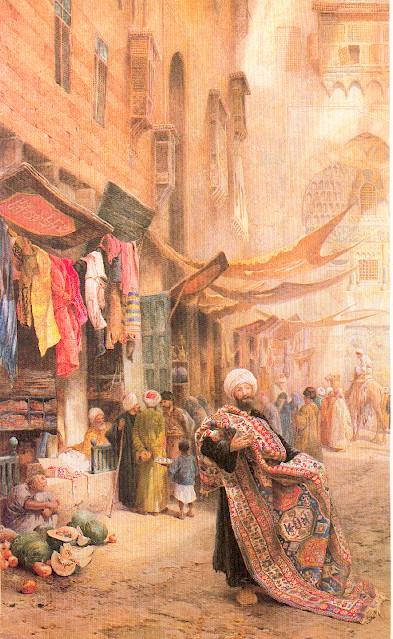
(The photo at the top of this story is a detail from Charles Robertson’s painting ‘The Bazaar Khan El Khaleelee Cairo’.)
#
RETURN TO HOME PAGE
#
Related Links:
Orientalist Art of the 19th Century
Orientalist Paintings (Gallery)