Showing posts with label Ottoman Empire. Show all posts

Saturday, 15 October 2011

The Baroque Era: When Europe Fell Out Of Love With Oriental Carpets

PARIS, October 22, 2011 – It is a strange thing that during Europe's long love affair with oriental carpets, the love once cooled for almost a hundred years.

That period roughly corresponds to Europe's Baroque era when, instead of importing oriental carpets as they had for centuries, European nobility began buying European-made carpets instead.

Those carpets, like the Savonnerie carpet shown here, looked nothing like the Turkish and Persian styles depicted in the Renaissance paintings of earlier generations. Rather, they were specifically woven in Europe beginning around 1644 to compliment the new baroque architecture of European palaces and mansions.

In fact, the new European carpets did not just compliment baroque architecture, they often directly imitated baroque ceiling designs. That enabled Europe's designers to do what they had never done so lavishly before: swaddle the wealthy in a single style of interior decoration from head to foot.

The single style – Baroque and its spin-off Rococo - conveyed power and opulence and corresponded with Europe's own rising sense of economic wealth and importance.

Still, if the development of French-made Savonnerie and Aubusson carpets, or similar Axminster and Wilton carpets in Britain, suggests that Europeans somehow entirely lost interest in Eastern designs at this time, the impression would be wrong.

Ironically, the Baroque Era in which Europeans lost interest in Oriental rugs coincides with what was Europe's greatest ever period of fascination with all things Turkish. That fascination was so widespread that it had a name: Turquerie.

Here is a portrait of Austro-Hungarian Empress Maria Theresa at the height of the Turquerie fad which swept Europe in the 1600s and 1700s. She is dressed in a Turkish costume and is holding a mask. It was painted circa 1744 by Martin van Meytens.

How the Turquerie fad took shape and why it did not include rugs is one of the stranger stories in carpet history. After all, Turquerie – the French-coined word for Europe's taste for Turkish styles – could be found in many other arts: from dress, to fabrics, to interiors, to porcelain.

To understand Turquerie – which was a precursor of, but quite different from, Orientalism – one has to return to Europe of the 1600s. It was a time when Europe's relations with the Ottoman Empire changed dramatically.

Prior to the the mid-1600s, the Ottoman Empire had been Europe's most feared neighbor. The Empire had grown with astonishing speed from its start two centuries earlier and directly annexed much of Eastern Europe, including Greece.

But by the mid-1600s, the Ottoman's power to expand deeper into Europe was clearly spent. The Empire's second attempt to take Vienna with a 60 day siege in 1683 ended in a disastrous route and, though Eastern Europe would remain under the Ottomans almost another two centuries years, fear of the Empire in the rest of Europe subsided.

Instead, Western Europeans suddenly became very interested in the art and lifestyle of the foe they no longer feared. To dress up for palace balls "alla Turca" became the rage. And the practice of drinking coffee – something that had previously reached only Venice from Istanbul -- suddenly spread across Europe.

In Vienna, one of the first cafes was the House under The Blue Bottle, which opened in 1686. Its origins, just three years after the Ottoman siege of the city, perfectly illustrates the new fascination with the East.

The Blue Bottle's proprietor, Georg Franz Kolschitzky, had lived in Istanbul as a young man and learned Turkish. During the siege he used his language skills to spy on the Ottoman camp. Legend says that afterwards he claimed the coffee beans the Turks left behind as his share of the war booty and used them to start his business. For decades, he ran his café dressed as an Ottoman cafe owner, as this painting from the time shows.

Like any fad, Turquerie was a mix of reality and fantasy. It came when still very few Europeans traveled to the East and it was heavily influenced by Europeans' own imaginary visions of oriental luxury, Ottoman customs, and even harems.

But even if Turquerie was in large part make-believe, there is no doubt that genuine curiosity about -- and even admiration of the Ottoman Empire – was equally part of it.

When one of the most famous, and large-scale, weddings of the time took place in Dresden in 1719, the celebration included days of specially themed events.

On one of those days, the newlyweds (the Prince-elector of Saxony, Friedrich August II, and the Austrian Archduchess Maria Josepha) had a palace in ‘Turkish style’ erected complete with a corps of janissaries. The guests, who included an Ottoman ambassador, were requested to appear in Turkish costume.

Similarly, it became the rage for noble women to have their portraits painted wearing a Turkish costume and in an Oriental setting, sometimes even sitting on an oriental carpet.

Here is one portrait from the time, Mademoiselle de Clermont "en Sultane" painted in 1733 by Jean-Marc Nattier.

A much more famous sitter, the Marquise de Pompadour, commissioned three portraits of herself dressed as a Sultana in 1750. The portraits not only allowed the sitters to appear in exotic fashions but also to abandon their body-constricting corsets -- something that would not become possible again in Western fashion until the 1900s.

Men also took part. In the 1700s, it was in fashion for wealthy men to smoke Turkish tobacco in a Turkish pipe, sometimes wearing a Turkish robe. And when people went out to the opera, it was possible to find Turquerie there, too.

The most famous of the Turquerie operas – still played today – is Mozart's 'The Abduction from the Seraglio'. It was first presented in 1782, but 13 other similarly themed operas predate it. Often the productions clothed the singers in authentic Ottoman fashions, knowing that theater goers were curious about them.

Even in architecture Turquerie found a place, this time in the form of Ottoman-inspired pleasure domes.

Here is the central building of a "Türkischer Garten" built between the years of 1778-91 in southwestern Germany. It is part of the Schwetzingen Castle, the summer residence of the rulers of the then German state of Baden-Württemberg.

One could easily imagine that so much interest in the Ottoman Empire would have to increase interest in that most essential symbol of the orient of all – carpets. But the fact that Europe's taste in carpet patterns went in an entirely different direction may only prove that, ultimately, Turquerie was more a measure of Europe's growing sense of self assurance than of cosmopolitan tastes.

Throughout the 1600s, when Turquerie began, and through the 1700s as it continued, the "gout Turque" coincided with the greatest period of expansionism in European history. It was a fad in an epic period that included the transformation of the New World and the creation of sea trading networks and ultimately colonies across Asia.

That meant that the key status symbols European society would have to be European too. Whereas wealthy Europeans in the Renaissance showed off their Turkish carpets to underline their rich status, the people of the late 1600s and early 1700s centuries furnished their mansions with European-woven baroque carpets instead.

Here is an antique Axminster, woven in Britain, that reflects the English taste of the time. It is available from the Nazmiyal Collection in New York.

Interestingly, Europe's overwhelming preference for baroque carpets over oriental ones would not last long. By the mid 1700s, the taste for oriental carpets would begin returning with redoubled strength as Europe's view of the East started to dramatically change again.

This new change, seen most visibly in Napoleon's military expedition to Egypt in 1798, would come as Europeans directly entered into the life of the Orient as never before. It, too, would be accompanied by a new fad: Orientalism. But that is the subject of another story (see: Orientalism and Oriental Carpets).

#

RETURN TO HOME

#

Friday, 5 March 2010

Orientalism And Oriental Carpets

PARIS, March 20, 2010 – Europe’s fascination with oriental rugs dropped off markedly from the mid-1600s to the mid-1700s, as the French baroque decorating style, with Savonnerie and similar carpets, swept the Western world.

But by the late 1700s, oriental rugs were back.

And throughout the 1800s and well into the early 1900s, European interest in oriental rugs reached heights never known before or since.

It was a rapid comeback, which went from importing small-format rugs in the first half of the 1800s to importing large-format, room-size carpets in the second.

At the same time, oriental carpets went from being exotic accent pieces shown in isolation on the floor to being fully integrated into the Western concept of interior decorating, including being placed beneath sofas, tables and chairs.

And, in a final measure of success, even Europe’s machine-made rug industry began making copies of hand-made Eastern rugs in addition to European styles.

What happened to make oriental carpets not just the status symbol of the wealthy, as in previous centuries, but a standard part of Western homes?

Part of the answer is Orientalism, the art movement that swept the West from the early 1800s to well past the turn-of-the-last century.

If Orientalism had a starting point, it was probably Napoleon’s expedition to Egypt in 1798.

This picture is ‘Bonaparte Before the Sphinx,’ painted many years later by the Orientalist artist Jean-Léon Gérôme in 1868.

Napoleon’s expedition set off a wave of enthusiasm across Europe for rediscovering the Eastern world. The enthusiasm was not unlike earlier generations’ desire to rediscover ancient Greece and Rome via The Grand Tour.

Of course, Napoleon was not a tourist in the usual sense of the word.

His purpose in trying to seize Egypt, then a province of the Ottoman Empire, was to protect French trade interests and undermine Britain's access to India at the height of the French Revolutionary Wars.

But while Napoleon was ultimately forced to withdraw by British naval power and a newly reformed Ottoman army, the fact that his Armée d'Orient campaigned in Egypt and Syria for three years had an electrifying effect on his countrymen.

One result is this building in Paris (No. 2, Place du Caire) which was erected in 1799.

On its façade are hieroglyphs and busts of the goddess Hathor, regarded by ancient Egyptians as the goddess of motherhood and the annual flooding of the Nile.

The building includes an entrance of the “Passages du Caire,” a shopping arcade built at the same time and inspired by the Grand Bazaar in the Egyptian capital. It and other “passages” offered the novelty of covered shopping in the period before the streets of Paris had sidewalks.

By 1833, Paris had its own obelisk, as well. The Obelisk of Luxor, a gift from the Ottoman viceroy of Egypt, Mehemet Ali, was erected in the Center of the Place de la Concorde.

The fact the obelisk had spent most of its 3,000 years marking the entrance of the Amon temple at Luxor, and in no way matched French architecture, caused no-one alarm. Instead, that seemed only to make it more desirable.

Other cities followed suit.

London put up its obelisk, also a gift from an Egyptian ruler, in 1878.

New York did the same in 1881, after loading its obelisk into the hull of a steamship.

And, of course, Rome already had one - in St. Peter’s Square - imported by Emperor Caligula in 37 AD.

The burgeoning interest in the East, mixed with the Romanticist spirit of the time, inspired thousands of 19th century artists, writers, and travelers to journey east to personally discover the Orient for themselves.

What they saw and depicted, in paintings and travel literature, made even those who never left home eager to take part – even if just by having a carpet.

Gérôme’s ‘The Carpet Merchant’ (painted in 1887) shows the Court of the Rug Market in Cairo, which Gérôme visited in 1885.

Rug expert Jon Thompson writes in his book ‘Oriental Carpets: from the Tents, Cottages, and Workshops of Asia’ (1993):

“The resurgence of interest in carpets was stimulated by the so-called Orientalist painters, artists working in the Middle East, who presented to the European public a romantic and dramatized view of local life. This type of painting … became extremely popular.”

Not all Orientalist painters were particularly strict about what they saw and what they later added to the scenes from their imagination.

One good example of liberties taken is Charles Robertson’s ‘A Carpet Sale in Cairo.’

The most prominent "carpet" on display is in fact an embroidered cloth, an Uzbek suzanni, of supernatural size.

The figures in the painting are made deliberately small in relationship to everything around them -- a standard Orientalist trick for emphasizing the exotic nature of the setting.

Orientalist writers offered their readers a similar mix of fact and fiction.

Some writers, reflecting the expanding power and self-certainty of Europe in the colonial age, passed harsh judgment on what they saw.

Edith Wharton's described the people in the marketplace of Marrakech with a string of stereotypes in her book ‘In Morocco’ (1920):

"Fanatics in sheep skins glowering from the guarded thresholds of the mosque....consumptive Jews with pathos and cunning in their large eyes and smiling lips, lusty slave-girls with earthen oil-jars resting against their swaying hips."

That was in the same spirit as pictures like this one: ‘Her Master’s Choice’ by Fabio Fabbi.

But other writers saw the East as not so different from Europe itself, despite the outward dissimilarities.

Lady Mary Wortley Montagu, the wife to the British ambassador in Istanbul, wrote about Turkish women to her sister in 1717:

"It is true their law permits (husbands) four wives, but there is no instance of a man of quality that makes use of this liberty, or of a woman of rank that would suffer it. Thus you see dear sister, the manners of mankind do not differ so widely as our voyage writers would make us believe."

This picture by John Frederic Lewis seems more in line with her impressions. It is entitled “Indoor Gossip, Cairo.”

It is interesting to note that throughout this period, Eastern visitors to the Europe were just as filled with mixed emotions as Orientalist artists and writers seemed to be.

Zeynab Hanoum, the daughter of the minister of foreign affairs for the Ottoman Empire, wrote in her book ‘A Turkish Woman's European Impressions’ (1912):

"One thing to which I never seem to accustom myself is my hat. It is always falling off. Sometimes, too, I forget that I am wearing a hat and lean back in my chair: and what an absurd fashion - to lunch in a hat! Still, hats seem to play a very important role in Western life. Guess how many I have at present – twenty."

Travel between West and East did not become easy until the large scale use of steamships and, ultimately, the railroad.

In 1833, the newly inaugurated Orient Express still only took passengers as far as Vienna. But by 1889 passengers could travel direct all the way to Istanbul.

Suddenly, it was very possible for tourists to travel to the same exotic Orient once reserved for artists, writers, diplomats, and soldiers. And this, too, fed the appetite for carpets back home.

As Thompson notes:

"Paintings of 19th century interiors often include a rug or carpet, usually a tribal or village weaving from the Middle East. Some of these were bought in the local bazaar and brought home by those tireless Victorian travelers, while others were imported by merchants from Turkey, which became the center of the carpet trade."

Here is a painting of the sitting room of the artist-poet Dante Gabriel Rossetti. It is by Henry Treffry Dunn, Rossetti's studio assistant after 1867.

Not all the carpets that came to Europe as part of the now booming carpet business were collectibles. Far from it.

The exploding Western demand for carpets brought an explosion of supply in response, and Turkey soon began producing large quantities of coarsely made, crudely patterned carpets for export.

Many of these low-quality carpets are now staples for sale in bric-a-brac shops, where they sometimes shock modern rug lovers. But they once were just as commonplace on hotel and parlor-room floors as were the better quality pieces we so much more often associate now with the 19th century.

(The photo at the top of this story is a detail from Charles Robertson’s painting ‘The Bazaar Khan El Khaleelee Cairo’.)

#

RETURN TO HOME PAGE

#

Related Links:

Orientalist Art of the 19th Century

Orientalist Paintings (Gallery)

Friday, 29 January 2010

Mejid Rugs And The End Of The Ottoman Era

ISTANBUL, January 29, 2010 -- Can a single carpet style symbolize the sudden decline of a country’s carpet making tradition?

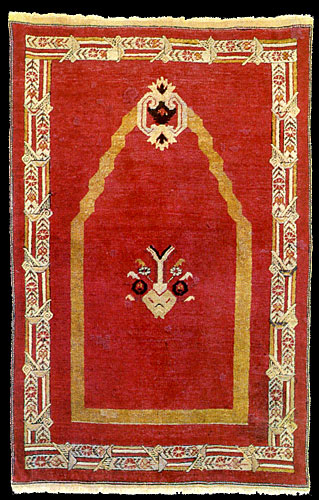
Many European carpet collectors once regarded this carpet – a so-called Mejid rug – just that way.

The rug is typical of a whole class of small-size, town-woven carpets that appeared in the mid-1800’s. It was a time when the Ottoman Empire was moving rapidly toward its final eclipse in 1923.

The rugs are striking for several reasons. One is their distinctly non-Anatolian look. The other is that, even though they were clearly influenced by the West’s own artistic values, Europeans at the time found them distasteful and fled from them.

How did these rugs come about and why were they popular in Turkey at the time?

The place to begin the story of the rugs is with their namesake, Sultan Abdul-Mejid.

He reigned from 1839 to 1861, during a time of massive threats to the empire’s traditional way of life. His efforts to fend off those threats by Westernizing many Ottoman institutions reached to every level of society, including the Arts. But the results were often mixed.

Abdul-Mejid came to the throne just as one of the empire’s prize possessions, Egypt, had permanently broken away. That followed the earlier loss of Greece and dramatically underlined the need to modernize both the army and to build loyalty among the empire's far-flung, multi-national subjects.

Abdul-Mejid, like his father Mahmud II before him, looked to France and the ideals of the French Revolution for inspiration.

At the time, monarchies everywhere were awed by the way ordinary Frenchmen had enlisted en-masse in the Revolution’s armies to defend the values of Liberty, Equality and Fraternity, and how Napoleon had later harnessed that power to all but conquer Europe. Many kings realized that their future depended upon at least partially making their societies more equitable.

Abdul-Mejid sought to transform Ottoman life by introducing the first of what would be many attempts at “Tanzimat,” or “Reordering” over the next decades.

The reforms attempted to stem the tide of nationalist movements within the Ottoman Empire by enhancing the civil liberties of non-Turks and non-Muslims and granting them equality throughout the Empire.

They also established a new system of state schools to produce a new generation of government officials more open to European technologies and administrative practices.

But the reforms were not only changes in substance but of style. Abdul-Mejid built Dolmabahce Palace in the French baroque manner, decorated it the same way, and moved there from Topkapi Palace. He also dressed in the European fashion and government functionaries began to do the same.

Over time, the new European dress-code would fully replace the complicated Ottoman hierarchy of different clothing styles and even shoe colors which had distinguished officials by rank and office. It consisted of a monotonous, long-tailed frock coat that was called the “stambouline” in the West and, more facetiously, the “bonjour tuxedo” in Turkey. Like new uniforms for the army, the coat was intended to change the mindset of those who wore it.

The message was not lost upon Turkish artists, including weavers, who closely watched court styles.

Entrepreneurs responded with new European-flavored designs of their own. One answer was the “Mejid” carpet, which gained wide domestic popularity.

The “Mejids” clearly reflect the Francophile taste of the sultan, though it is not known whether the sultan liked them himself. They were woven in bright pastel shades and decorated with sparse, natural-looking flowers or even rococo swirls. It was a huge departure from Turkey’s own design tradition of non-naturalistic ornamentation and richly concentrated colors.

Here is a carpet woven in Ghiordes at the time. The carpet is available to collectors from the Nazmiyal Collection in New York.

How much any empire can stave off collapse by adopting new models at times of crisis is debatable. Abdul-Mejid’s efforts ran into huge obstacles, not the least of which were the Western European powers themselves.

They loaned him massive amounts of money to buy weapons to confront the expanding Russian empire, but attached fatal conditions to the loans.

The conditions were demands for trade concessions to open the empire’s raw materials -- wool, cotton, silk and coal -- to European businesses and its markets to European products, including textiles. The results of this, too, were soon visible in the carpet industry and its commercial hub, the Istanbul bazaar.

Until 1830, the Ottoman Empire was still largely a self-contained and self-sufficient space. But with the opening to the West, its manufacturers suddenly came into direct competition with the industrial revolution. European textiles flooded the market and domestic producers found it impossible to compete.

Worse still for the domestic producers, the introduction of European fashions in the court harem caused a wave of emulation among Otttoman women. Dresses were made of European rather than local fabrics and the market for fine Ottoman silks collapsed.

Celik Gulersoy in his 1980 book ‘Story of the Grand Bazaar’ sums up the process this way:

“When ten thousand hand looms disappeared, villages could no longer be closed production units and the villagers turned into laborers and imported European goods rapidly took the place of domestic textiles in the Empire’s markets.”

The new shopping focus was the Bonmarches, the borrowed-from-French generic name for the shops erected in European style on the main avenue of Istanbul's chic Beyoglu district.

In 1881, a visiting English writer, Lady Brassey, described in her book ‘Sunshine and Storm in the East’ how rich Turkish ladies with their servants visiting the Grand Bazaar were surrounded by the treasures of the East but demanded the merchants show them Western goods instead, though these were mostly second quality. She regarded it as very strange.

By the turn-of-the-last century, the Grand Bazaar itself lost its most distinctive feature: the merchants sitting passively on wooden divans with their cupboards full of goods behind them. That, too, gave way to the new European style.

The arches lining the walls of the old Bazaar were connected to form shop facades and the merchants took to standing in their doorways.

In many cases, the merchants had no better choice because their new premises were no bigger than telephone booths. To complete the image of shops on a European street, they added signs and advertising above their doors.

During these decades, the Ottoman carpet production industry changed equally dramatically. Western capital entered the business and the Western market became the driving force of almost all the large-scale carpet manufactories.

Miroslav Jungr observes in his 2005 book ‘Oriental Carpets:’

“The European powers brought every aspect of mass production to bear on the weaving process, including using synthetic dyes and demolishing traditional design schemes. Floral patterns, beloved by foreign customers, became standard even though – with a few exceptions such as medallion ushaks – they had never been part of the Turkish tradition.”

Curiously, the Mejids, the Turkish weavers’ own early experiment with incorporating European styles, were completely overlooked in Europe. Jungr notes their stylized flowers and mostly shiny colors did not correspond to the cosmopolitan taste of the time. But in Turkey they remained popular even after the death of Sultan Abdul-Mejid himself in 1861.

Only today, as their story is becoming better known, are the Mejids beginning to win respect from collectors. And that is partly because of the bittersweet story they tell of the end of one era and the start of another.

#

RETURN TO HOME

#

Saturday, 16 January 2010

Salting Carpets And Topkapi Prayer Rugs: A Detective Story

ISTANBUL, January 16, 2010 -- The Topkapi Palace treasury is the repository of many interesting things.

But for carpet lovers, some of the most fascinating – and mysterious – are the niched prayer rugs which are carefully stored away in its darkened rooms, safe from the aging effects of sunlight, air, and wear.

The carpets are so intricately made, and so fragile, that they were obviously never intended for daily use. But just who made them, and what they were intended for, is one of the great mysteries of carpet history.

Here is an example of one of the niche rugs in the Topkapi collection.

The rug is fragile because it is woven in some places with metal-wrapped silk threads. The metal -- silver that is gilded with gold -- gives parts of the carpet a metallic sheen that glitters in the light. But the metal itself can be worn away by the slightest abrasion and, at the same time, it makes the rugs so inflexible that even folding them could tear them.

Thus any of the normal things one does with carpets, from rolling them to stepping on them -- and certainly praying on them -- would destroy them.

Yet that is just one of the many peculiarities of these prayer rugs.

Still more surprising are the inscriptions on the borders.

Prayer rugs are usually associated with the Sunni branch of Islam, which was also the state religion of the Ottoman Empire. But the inscriptions here are Shi’ite, the state religion of one of the Ottoman Empire's greatest rivals: the Safavid Empire of Iran.

And, because Shi’ia themselves use prayer stones but not prayer rugs in their religious observances, the existence of Shi'ite prayer rugs should be an impossibility.

For decades, carpet experts have wrestled with the problem and come up with two explanations.

One is that many of the pieces are modern forgeries of classical carpets.

Another is that the pieces are, in fact, classical carpets but created for a very special political purpose.

Let’s take the forgery charges first.

The trail, like many a good mystery story, begins in London, specifically in the dark corridors of another museum, the Victoria and Albert.

In 1909, the Australian millionaire and art collector George Salting bequeathed to the museum upon his death a rug he believed was made in the 16th century and which in many ways seemed similar to the prayer rugs in the Topkapi.

Like the prayer rugs, it was extraordinarily fragile and woven in places with metal-wrapped silk threads, It also bore inscriptions in cartouches on its borders.

And though it was not a prayer rug itself – it was a medallion rug – it too was clearly never intended for use on the floor.

The “Salting carpet," as it became known, soon caught the European rug world’s eye but not in the way Mr. Salting likely intended.

One reason was its colors. They were very bright and amazingly well preserved. And that, on a rug which otherwise looked like it was from the classical era, struck many as a blatant sign the weaving was a recent forgery.

The challenge became to discover which carpet workshop in the modern era could possibly have forged such a complex piece. And the leading detective was Germany’s Kurt Erdmann, one of the most influential carpet experts of his generation.

Dubbing the “Salting” and similar rugs in other collections “disturbingly colorful,” he blazed a trail to Hereke, about 50 miles east of Istanbul. That is the home of one of the most famous workshops of the turn-of-the-last century Ottoman court, where weavers were routinely commissioned to make copies of Persian and other classical rugs for Istanbul’s palaces.

The “Saltings,” he concluded in 1941, were frauds, but almost perfect ones, and he paid tribute to their weavers, whose identity was betrayed only by their "Anatolian" sensibilities:

“What was achieved deserves full recognition. In the best pieces, the Persian 16th century style is remarkably successful. A wrong note is often struck in the coloring, whereby a difference of artistic sensibility leads, on the one hand, to an exaggeration of the richness of the coloring and, on the other, to adoption of the Anatolian coloring scheme which is restricted to a few shades.”

Here is a detail from George Salting's carpet showing its bright colors.

Few dared argue with Erdmann. So, for decades the Salting carpets lived in limbo.

Because they were incredible pieces of art by any measure, museums and collectors continued to treasure them. But they were identified as 19th century rugs, making them a historical anomoly.

Things might have stayed that way forever except for the march of time.

More recently, a new generation of rug experts has become intrigued again by the Salting carpets and, more particularly, their similarities to their prayer rug cousins in the Topkapi museum.

And those prayer rugs have cast doubt on Erdman’s theory because they, unlike the Saltings in Europe, have a documented biography. The curators of the Topkapi have listed the prayer rugs as part of the royal collection for centuries, long before the Hereke workshop produced its earliest confirmed rug in 1892.

Now, as scholars increasingly regard Salting Carpets and Topkapi Prayer Rugs as a single category, the hunt has turned to piecing together a history that explains how such clearly “Persian 16th century style” weavings came to Istanbul, why they include such a self-contradictory thing as Shi’ite prayer rugs, and how some of these carpets – the “Saltings” – eventually made it to Europe in such a fresh state that they could be regarded as modern weavings.

It is not an easy task, but the history that is taking shape is fascinating. The supporting evidence comes from two relatively new fields of rug study, rug structure and rug documentation, and have helped trace the carpets to the court workshops of the Safavid Empire during the 1500s.

Michael Franses summed up the historical explanation in his article “Some Wool-Pile Persian-Design Niche Rugs,” published in Oriental Carpet and Textile Studies Volume 5 (ICOC 1999).

He notes that in the 1500’s, the Ottoman Empire and the Safavid Empire were locked in a struggle for supremacy. The balance of power went back and forth and the stakes were who would control eastern Anatolia, Azerbaijan and Mesopotamia.

Eventually, the tide turned consistently against the Safavids due to the energies of Sultan Suleyman, the same Ottoman leader who was known as Suleyman the Magnificent in the West.

His armies took took Tabriz twice from the Safavids for various periods and captured Baghdad for good. As a result, the Safavid Shah Tahmasp, who reigned for 52 years during this regional warfare, turned to a policy of appeasement instead.

The gifts the Safavid court sent to Suleyman and his immediate successors are well illustrated in Ottoman miniatures of the time. The paintings show lines of courtiers streaming before the throne bearing boxes, bags, and lengths of fabrics.

The gifts came in special caravans headed by Safavid ambassadors and the caravans were sizable enough to stagger European diplomats to the Ottoman court who witnessed their arrival.

A Hungarian ambassador who was present to see a Safavid delegation arriving to congratulate Suleyman’s son, Selim II, on his accession to the throne in 1567 wrote:

“The train consisted of 700 men and 19,000 pack animals, bearing all sorts of luxuries, including woolen carpets so heavy that seven could scarcely carry them.”

He also wrote that he saw “silk carpets from Hamadan and Dargazan … 20 large silk carpets and many small in which birds, animals, and flowers were worked in gold.”
Some of the miniature paintings of the time show what could be courtiers carrying rolled-up carpets among other gifts including precious silver trays and decanters.

If the carpets did indeed come to Istanbul as gifts, there are still other things to explain, including the giving and accepting of “Shi’ite” prayer rugs.

That they had to be considered “Shi’ite,” there is no question. The calligraphic inscriptions on many of them are in praise of Ali, the Prophet Mohammed’s cousin and son-in-law, who is particularly venerated by the Shit’ite faithful.

Similarly, there is no question that the Ottomans, who controlled Mecca and styled themselves the protectors of Sunni Islam, knew what the inscriptions said. The language used in the Ottoman court during much of the 16th and 17th centuries was Persian and Persian culture, like Italian Renaissance culture in Europe, was familiar to everyone in the region.

Were the messages on the carpet a diplomatic slap to the Ottomans even as the gifts were sent as tribute to keep the Ottoman powers at bay?

Or were they a Trojan Horse, slipping the Safavids’ state religion into the very inner sanctum of the Ottoman Sultan, the “Guardian of all the Holy Places”?

The answers may never be known, but the carpets were clearly so valuable that they were not only accepted but preserved in immaculate condition in the vaults of the Topkapi Palace treasury. Whether they were ever publicly displayed is not recorded.

That leaves one last mystery: how some of the Salting type carpets - like this one in Copenhagen's David Collection museum -- arrived in such pristine condition to Europe.

One intriguing possibility is offered by John Mills, whose article “The Salting Group: History and a Clarification” also appears in Oriental Carpet and Textile Studies Volume 5 (ICOC 1999).

Mills suggests some of the rugs may have been smuggled out of the Topkapi and sold in the streets of Istanbul when the city plunged into chaos during the Russo-Turkish War of 1877-1878. That was when Russian troops, pushing the Ottoman Empire out of Bulgaria, advanced to the gates of the city and were thought to be on the verge of taking it.

As refugees from the Balkans streamed into the city, there was near anarchy, the price of food shot up, and panicked people began liquidating valuables for cash. Incredible carpets began appearing in the bazaar.

Were carpets from the Topkapi Palace among them?

An anonymous correspondent writing a report five years later in Burlington Magazine has left this intriguing clue:

“I well remember much hawking of harem treasures during the terrible winter of the Russo Turkish war,” he wrote in 1903.

At least one European buyer is known to have bought a Salting type rug at that chaotic time. It is Prince Lobanov-Rostovsky, who was the Russian ambassador in Istanbul in 1878.

If some of the Salting carpets did come out of the Topkapi treasury, that could account for why their colors were so perfectly preserved that they could be mistaken for recent work.

It is an intriguing thought and one which carpets scholars are likely to keep pursuing in the years ahead.

Meanwhile, some Western museums continue to identify their Salting-type carpets as 19th century Turkish work. But the Topkapi palace curators have no doubt their own collection of prayer rugs comes from the Safavids.

#

RETURN TO HOME

#

Wednesday, 16 December 2009

Topkapi Palace And The Art Of The Ottoman Court

ISTANBUL, December 17, 2009 -- Ottoman court carpets are intimately connected with a very special artistic culture, that of the Ottoman court itself.

The court both inspired and was the main consumer of the carpets, tiles, illustrated books and other art objects by countless artisans attached to court workshops inside and outside of Istanbul.

The imperial artisans, collectively called the Ehl-i Hiref or Community of the Talented, produced much of the finest work in the Ottoman Empire and their designs were copied or adapted by commercial artists even down to the village level.

But what why did the Ottoman rulers attach such great importance to developing and maintaining an artistic style that would clearly distinguish the court from the rest of the world outside?

The immediate answer might be that all courts in all lands tend to do the same. Just one other example is Versailles, designed as a pinnacle of Baroque style to underline the power of Louis XIV.

But the Ottoman court, with its seat in Topkapi palace, was very different from Versailles. Whereas Versailles was designed as a public stage, Topkapi was designed as a private one, and its culture was far more self-defined and self-contained.

There was a logic behind that choice.

The story is neatly told in the book ‘The Ottomans’ by Andrew Wheatcroft (1993). As he points out, the Ottoman court projected power through an image of inaccessibility, exclusivity, and mystery designed to create a sense of public awe. And everything about Topkapi palace and its court culture was intended to heighten that effect.

The first great Ottoman sultan, Mehmet II, began building the palace almost immediately after he conquered Constantinople in 1453.

A contemporary, the Greek historian Critoboulos of Imbros, wrote at the time:

“He gave orders for the erection of a palace on the point of old Byzantium which stretches out into the sea – a palace that should outshine all and be more marvelous than the preceding palaces in looks, size, cost and gracefulness.”

The site was the ancient Greek acropolis of Byzantium, the highest ground in the city. And originally, the grounds were far vaster than they are today, extending all the way down the shoreline below.

But if the acropolis had been an open area, Mehmet’s Yeni Sarai (New Palace) was deliberately isolated and separated from the city. Its buildings were hidden behind a massive wall some 35 feet tall. And it was organized in three areas, of ever diminishing accessibility to the public, guarded by three successive entry gates.

The first great courtyard, behind the Imperial Gate was the largest, with an area of 500,000 square feet. It included the workplaces of some 600 craftsmen: goldsmiths, weavers, amber-workers, armor-makers, potters, upholsterers, and many others. There were also stables and the barracks of guards and gatekeepers.

Anybody could enter from the street but once inside had to move and speak quietly.

Europeans found the hushed atmosphere eerie and regularly remarked upon it. Artist Nicolas de Nicolay wrote in 1551 that “notwithstanding the number of people coming together from all parts is very great, yet such silence is kept, that yee could scarcely say that the standers-by did either spit or cough.”

The second courtyard, behind the Gate of Saluation, marked the real boundary between outer and inner worlds. The gate had two sets of doors strong enough to resist a siege and guests passed through it only by invitation or for ceremonial occasions of state.

Once inside, the atmosphere was of a park, with lawns and fountains under cypress trees and gazelles wandering freely. The gardens were dotted with pavilions, or kiosks, which gave the impression of tents erected in an open space. It was an echo – conscious or not – of nomadic life and love of nature in the middle of a thriving but shut out metropolis.

At times, sultans also held outdoor audiences in the park, like the one shown here.

In the park was also the meeting place of the Sultan’s councilors – a kiosk known as the Hall of the Divan. The Hall’s floor was gilded and covered with a carpet of gold and there was a dias with the sultan’s throne. But the sultans themselves often preferred to appear to be absent, listening when they wanted from behind a grilled window.

The window, and the uncertainty of whether the sultan heard what was being said, gave the sultan such a degree of control that many sultans rarely attended the meetings of the divan at all.

The innermost world lay behind a third and final gate: the Gate of Felicity. Here was the sultan’s inner realm with those who lived closest to him, including the harem, with his wives and concubines and their children, and his retainers.

This retreat, known as The Abode of Bliss, was in fact a miniature city where more than 3,000 people spent their entire adult lives.

They spent their lives in splendid, luxurious isolation. But the isolation was not intended to cut them off from the world so much as to produce people who totally identified with the court and would be loyal to it throughout their lives.

These people were the royal pages, for whom court life was a school and who later would be sent out to govern the vast reaches of the empire.

In the early days of the empire, the sultan chose the boys who would become pages from outside the Turkic population, with its strong clan system. That was yet another way of creating an isolated group loyal only to the throne.

Gia Maria Angiolello, a young Venetian who served as a translator in the palace from 1473 to 1481, describes the Sultan’s pages this way:

“Sons of Christians, in part taken in expeditions with foreign countries and in part drawn from his own subjects … after they have been in his service a certain time, when in the opinion of the lord he can trust them, he sends them out of the palace with salaries which are increased as he thinks fitting.”

The “sons” initially were part of the tribute which the Ottomans exacted from conquered peoples, particularly in the Balkans and Caucasus, to create the Janissaries, the Sultan’s most rewarded and loyal troops.

Shown here is an Ottoman miniature of Janissaries battling the Knights of St. John in the siege of Rhodes, 1522.

The Janissaries, too, were an isolated group outside the clan system and the boys who would fill their ranks spent their childhoods on special farms in Anatolia where they became Muslims, gained strength, and learned to fight.

Both the pages, who were raised in the palace, and the Janissaries were the “kul,” or slaves of the sultan.

It was a privileged position, so much so that even after the tribute system was abandoned, the status of kul and the opportunities it offered passed from father to son. And over time many free-born Muslims also bribed or negotiated their way into the Sultan’s household to gain the same status

As Angiolello remarked in his early observations about pages, “there are few that do not accomplish their duties, because they are rewarded for the smallest service to their lord, and also because they are punished for the smallest fault.”

Wheatcroft notes that after the pages finished their training, they were given wives from among the harem women who were also slaves of the Sultan. This became a further bond to the court, because both “shared the common experience of palace life and even the unique dialect spoken in the Abode of Bliss.”

When the couple was dispatched to the provinces, it modeled its own household on the Ottoman court and spread that court culture farther.

Here is a painting of an Ottoman house in Cairo, before the influence of Western styles, by Frank Dillon (1823-1909).

Did the system work well? Yes, and for centuries.

As Wheatcroft puts it, “When the Conqueror built the Abode of Bliss on Seraglio Point, he created more than a building. The palace was the apex of Ottoman society: all power flowed from it, carried forth by the sultan’s servants sent to govern in his name.”

In this system, the arts were not only decorative but also helped create a frame of reference agreed upon by the court’s members. The shared style, like everything else, reinforced loyalty to the group and distinguished them from those outside the walls.

All the procedures within the palace were codified in kanunname, or law codes that even specified the dress for every rank of the ruling class.

Pictured here is the Sultan leaving Topkapi Palace for Friday prayers in one of the capital's mosques circa 1810 by an unknown artist. The once-a-week outing was the only time the Sultan appeared in public.

The advisers to the Sultan, the viziers, wore green. Chamberlains wore scarlet. Religious dignitaries wore purple and mullahs light blue. The master of horse dressed head-to-foot in dark green.

Court officers wore light red shoes. Those who worked in the Grand Vizier’s office, located just outside the palace walls, wore yellow shoes. And among non-Muslims, Greeks wore black shoes, Armenians violet, and Jews blue slippers.

Topkapı Palace gradually lost its importance at the end of the 17th century, as the Sultans preferred to spend more time in their new palaces along the Bosporus.

In 1856, Sultan Abdül Mecid I decided to move the court to the newly built Dolmabahçe Palace (shown here), the first European-style palace in the city.

By then, the Ottoman Empire was changing rapidly and its court life was becoming more European as well.

But how that happened is another story.

#

RETURN TO HOME

#

Friday, 4 December 2009

The Mysterious World of Chintamani And Bird Carpets

ISTANBUL, December 5, 2009 -- Some of the most striking carpets of the Ottoman era are as white as a painter’s canvas and covered with finely drawn, mysterious icons.

The never-changing symbols repeat in array after array, like waves building strength, creating a powerful, mesmerizing effect

The mysterious icons are the “chintamani,” three balls hovering over a pair of cloud-like wavy lines. And for much of the 16th and 17th centuries, they held a special fascination for Ottoman court artists.

The chintamani appear on silks, ceramic plates, tiles, book-bindings, and embroideries. Sometimes, they even appear on the kaftans worn by the Ottoman sultans.

This kaftan, from the mid-17th century and now kept in the Topkapi Palace museum, is an example.

The huge scale of the design, which was typical of Ottoman royal costumes, made the Sultan visible even in large crowds as he appeared in public.

The chintamani design was so popular in all the decorative arts of the time that it was probably inevitable it would spill over to carpets as well. And that is exactly what many rug experts believe happened.

Rug expert Louise W. Mackie writes in “A Turkish Carpets with Spots and Stripes” (Textile Journal, 1976) that it is “highly probable” that the origin of the chintamni carpet design can be traced to the symbol’s popularity in the art of the Ottoman court in Istanbul.

But what is much harder to explain is where the symbol of the chintamani itself originated and what it means.

In carpet literature, the design is often said to derive from a Buddhist emblem. The word chintamani itself comes from Sanskrit and in Buddhist philosophy signifies a treasure ball or wish-granting jewel.

A Buddhist background for the design is an appealing argument because it also recalls the distant past of the Turkic tribes who migrated to Anatolia from Central Asia and created the succession of dynasties that culminated in the Ottoman Empire.

The original cultures of the Turkic tribes were based on religions like Buddhism and Shamanism for millennia before they converted to Islam.

But if the three-ball pattern appears in early Central Asian painting and even is associated with the badge of the great Turkic-Mongol conqueror Timur (Tamerlane) in the 14th century, there are still parts of the symbol that a Buddhist origin cannot easily explain.

Particularly puzzling are the paired stripes that appear in combination with the floating balls.

Some scholars think that the eye-catching combination may have evolved from mixing a Buddhist motif with much more worldly patterns inspired by animal skins to create an instantly recognizable symbol of power.

The argument here is that the stripes and dots are similar to tiger stripes and leopard spots on the kinds of furs powerful rulers may have worn as symbols of their office.

But perhaps the only certainty about the chintamani design is that comes from Eastern Asia, is very old and, despite every effort at interpretation, remains as mysterious as ever.

“The true significance and sources of this ancient pattern still await satisfactory explanations,” Mackie notes.

The chintamani pattern was used both for carpets woven in the Ottoman court workshops of Istanbul or Cairo, and in commercial workshops in towns like Selendi around the city of Ushak (Usak, Oushak) in western Anatolia.

The two kinds of weaving centers – royal and commercial – produced their own distinctive chintamani patterns.

The Ottoman court carpets (right) have the spots placed above the raised center of the stripes.

But the Anatolian carpets (left) have the spots placed above the lowered center of the stripes.

Why this happened is just another mystery associated with this most mysterious of designs.

The chintamani pattern proved so popular that it was woven for hundreds of years, both on white and colored backgrounds, long after the passion for the design faded in the Ottoman court itself.

Today, the motif has finally passed from rugs, too, but it remains popular in Turkey on plates and other household items.

All this makes the chintamani design one of the great success stories in Ottoman carpets. But it is not the only mysterious pattern to be set against a white background in the 16th century that achieved lasting fame.

Another is the so-called “Bird” pattern, which also was produced in or near Ushak and was much prized in Renaissance Europe.

Europeans used the term “Bird” because the design could easily be seen to represent a bird, with its head, wings, and tail.

But in fact the design is a floral pattern of leaves attached to rosettes.

The sharp, birdlike angles are simply the result of Anatolian weavers doing what they did to all Ottoman-era floral designs: converting them to more geometric to fit their own weaving traditions and techniques.

Some researchers believe that the Bird pattern is actually a variation of the chintamani design.

The late Ferenc Batari of the Budapest Museum of Applied Arts suggested the Bird pattern may have evolved from weavers experimenting with framing the floating balls of the chintamani within different arrangements of paired lines.

Batari presented this carpet as a possible step along the way in his article “White Ground Carpets in Budapest" (Oriental Carpet & Textile Studies II, 1986).

If Bird carpets did indeed evolve this way, it would be an interesting example of how one successful carpet design gives rise to another as weavers constantly explore new ideas.

White carpets decorated with chintamani, birds, or other mysterious symbols viewed as crabs or scorpions fascinated the European market, where they all were referred to popularly as “White Ushaks.”

Here is a Bird carpet circa 1625 in the painting ‘Mother, Child and Gentleman’ by Alessandro Varotari.

Three hundred years later, in the early 1900s, the fascination with White Ushaks remained strong enough to inspire one the few short stories specifically about carpets in European literature.

The story is ‘Birds and Chintamani,’ written by Czech novelist Karel Capek in 1929. It describes the discovery of a carpet that, by all known rules, cannot exist. That is, a white carpet on which the two famous designs of birds and chintamani are combined together.

The discovery of the carpet, tucked away in stack of unsold items in a Prague rug shop, changes the collector’s life forever.

You can read the story by clicking here: Birds and Chintamani.

#

RETURN TO HOME PAGE


#

Thursday, 6 August 2009

Istanbul: When The Grand Bazaar Was The Center Of The Ottoman World

ISTANBUL, August 15, 2009 – For centuries, the world greatest emporium for buying carpets was Istanbul, the capital of the Ottoman Empire.

And, specifically, the address was the Grand Bazaar, the richest and most popular shopping palace in the city.

The Grand Bazaar was the biggest terminus of the Silk Roads that moved west across Eurasia and it was to here that carpets and luxury goods of every kind flowed.

The Ottoman Empire itself, one of the world’s largest empires from its founding in the 14th century to its decline beginning in the 18th, was the biggest customer. But merchants from all over Europe also came to buy the goods wholesale and take them home for resale.

What could you find in the Grand Bazaar? What couldn’t you find in the Grand Bazaar!

There were rugs from Central Asia, from the Caucasus, from Anatolia. There were rugs smuggled by the tons across the border from Persia, the Ottoman Empire’s great eastern rival. The border was often officially closed but the carpet trade was so lucrative that both sides turned to a third party – their Armenian populations – to act as the go-between for the business and let them freely cross the frontier.

The carpets were sold in the Grand Bazaar along with rich silk and brocaded fabrics, precious stones, gold, silver, pearls, shoes, books, and jewel-encrusted weapons. The value of the goods was reflected in the rent merchants paid to occupy a space in the bazaar: many times more than for anywhere else in the city. And the bazaar extended through miles and miles of covered, labyrinthine lanes.

The story of the Grand Bazaar is told in a book of the same name written by the late Celik Gulersoy in 1980.

Gulersoy, a leading historical preservationist, conjures up the atmosphere of the bazaar in the Ottoman era through the impressions of Turkish and European writers of the time.

One vivid account comes from a French traveler in 1877, during the last years that the Grand Bazaar could still be seen in its original form. The writer, M. de Gasparin, is an incurable romantic. But there is clearly enough color in the bazaar to spark any imagination:

“An Arab, with his spear in hand, sitting surrounded by the Persian shawls which he brought by his caravans, used to walk after a long row of camels in the desert. Another merchant is from the depths of Central Asia. Another one, with a thin face and pale complexion, has passed the sand and the seaside beaches of Syria on horseback and brought golden colored silk from Lebanon and soft clothes and pleasant scarves from Tyre and Sidon ... Egypt has sent that nearly black-skinned merchant who has brought the heavy cloth of that country, a mixture of silk and wool. This thin-faced bronze, tanned man comes from Morocco, leaning against milk-white threads and lapis blue dresses. Wherever these men may have been, whatever adventures they may have lived and whichever foreign country has injected the traces of other skies into their faces, their brows have lost nothing of their majestic nobility and their meaningful eyes have lost nothing of the depth that comes from authority, self-respect, and self-assurance. These merchants do not call the passers-by to their shops. They do not even have an inviting attitude; one could sense no greed in them, nor any worry in their posture … If a buyer came, ‘Masallah,’ if no one entered their shops, ‘So what?’”

That is a very different image than the bazaar of today, where hustling a customer is the rule. But the Ottoman bazaar was a very different place before Turkey modernized at the turn-of-the-last century.

The traditional arrangement was for the traders to line both sides of the bazaar’s covered streets. Not standing in the doorway of walk-in shops like today, but sitting on divans with nothing behind them but a large cabinet or a set of shelves. The cabinets, fixed to the walls, showcased some of their wares and hid the rest.

“The space occupied by any one of these tradesmen was generally small, about six to eight feet in length,” Gulersoy says. “In the bazaar jargon, these were known as ‘dolap’(stalls) and they had a depth of about three to four feet. Sometimes they were separated by thin curtains or wooden latticework partitions. It was possible for the customer to sit on the divan next to the tradesman and examine his choice while conversing in an easy, comfortable manner and drinking coffee or smoking a ‘long pipe.’”

At night, the cabinets were closed up.

Why did the merchants favor this open-street arrangement for the bazaar?

One reason, says Gulersoy, was “the old traditional practice of women covering their faces in the presence of men. There was a need to prevent women from having to enter closed places where there were men. There was a tendency to resolve all social matters out in the open.” He adds that “the custom was that all the shopkeepers, Muslim and non-Muslim, sit on their benches quietly and only answer when the customer directs as question at them.”

The Ottoman Grand Bazaar was not just the richest shopping center in Istanbul, it was in many ways its economic heart.

Its core, two separate covered markets called the Inner and Outer Bedestan, was built by Mehmet soon after he conquered Constantinople in 1453. Over the following years, the streets between the two covered bazaars were covered over, too, along with the surrounding streets, creating a covered city.

This covered city was not just a marketplace but a bank, too. The Inner Bedestan, built with walls 1.5 meters thick that stand to this day, was Istanbul’s 'coffre fort' where the richest citizens could keep their valuables in security. The Inner Bedestan also had the city’s wealthiest merchants, who lent money at interest for business ventures and themselves might own trading ships or major shares in camel caravans.

When sultans wanted to impress the citizenry with the Ottoman Empire’s wealth, or celebrate special occasions, they would sometimes call out the Grand Bazaar's merchants to parade in public. One Turkish observer of such a parade, Evilya Celebi, wrote this account in the early 1600s:

“Sultan Murad IV, before the Baghdad campaign in the year of the Hagira 1048, summoned the authorities to his audience chamber and said, ‘If I conquer the city of Baghdad in this expedition, I want all the soldiers and shop owners of Istanbul, according to the old regulations, with their guild wardens, sages, sheiks, stewards, Aghas, guild caretakers, and guards, to parade in front of Alay Kosku (a pavilion not far from the Grand Bazaar formerly used by the sultans to watch parades) both on foot and horseback, in groups, with eight military bands playing. Take down all these instructions correctly. Those who supply false information, I will cut in four.”

Celibi then describes the merchants as they march with their wares. Some of them ride on carriages decked out like parade floats:

Carpet dealers – 40 shops and 111 men. They parade with their 'mounted shops' adorned with Thessaloniki, Ushak, Kula, Egyptian, and Isfahan rugs.

Silken Robes of Honor dealers – 5 shops and 105 people. This guild joins the parade weaving the seven types of the Royal Robes of Honor and adorning the robes.

Not just the merchants and craftsmen parade, so do the hundreds of officials and employees of the bazaar:

The Trade Watchmen of the Inner Bedestan – 70 persons. The head of these is the second officer of the Sultan’s black eunuchs. These are all guaranteed people, devout Muslims who light the oil lamps in the Market Hall … when their post is vacated … the vacancy is filled by one of the Bedestan porters who is worthy of the post.

The Porters of the Inner Bedestan – 300 persons. Each night they carry the tradesmen’s chests and merchandise to the outer cellars of the Bedestan, stacking them there as a safeguard against fire. These porters parade with their load supports on their backs, rope in hand, and sword in belt.

The Market Hall Criers – These men have warrants and trade charters and are magnificent and trustworthy men who serve in the Inner Bedestan. All of them join the parade with jewelry on their clothes, wearing swords, double-edged scimitars, fur, and other valuable clothes.

And on, and on.

As the parade suggests, the Grand Bazaar was a highly organized institution, as much or more than an urban shopping mall today. Its administration was overseen by the royal court and its commerce was carefully regulated by a guild system.

The guilds insisted that all the merchants of a single trade be located in a single street or area of adjoining streets in the bazaar. The close seating arrangement was a form of price control because it prevented individual merchants from underselling their fellow guildsmen or overcharging and driving away customers.

Today, the Ottoman market has long since become a free market. The guild system, abolished in 1913, has given way to shop owners of all kinds mixed together and competing for the highest prices.

It is ironic for visitors to realize that today's hustling chaos is a world removed from the calm, rich, self-satisfied air of the Grand Bazaar’s heyday.

Just how different was it?

Gulersoy tries to answer the question this way:

“While gold poured down on the Throne City, the Covered Bazaar was also filled with gold, silver, silver thread, silk, jewelry, and crystal. But when the empire fell, the pale and dead colors of the sunset reflected on these walls.”

He adds: “the mood of Istanbul in each period is shown in the Grand Bazaar … certain other ages came, and copper took the place of gold and bead that of pearl.”

Today, the Grand Bazaar is only one of many places in Istanbul to buy carpets and there are many opinions about which is the best.

But the Bazaar does offer one thing that no other venue can provide. That is, 1,500 years of history and the sense that, like the starting price of a carpet, there is more to the story than meets the eye.

#

RETURN TO HOME PAGE

#