Showing posts with label oriental carpet collecting. Show all posts

Monday, 14 June 2010

Hungary’s Private Collectors Exhibit Their Carpets In Budapest

BUDAPEST, June 19, 2010 – Hungary’s Rug Society is hosting an extraordinary look at carpets in Hungarian private collections this summer.

The exhibition, which began on the first of June and has been extended due to popular interest to the end of August, is jointly sponsored by Budapest’s Jewish Museum, which is the venue.

The 35 carpets on display include both carpets kept in Hungary and several brought in by Hungarian rug collectors living abroad.

One of the most striking pieces is a 17-century Kula carpet (above) contributed by the family of the famous carpet collector Edmund de Unger, who fled Hungary in 1948. His son Richard flew in specially with the carpet, which is rarely seen outside the family home in London.

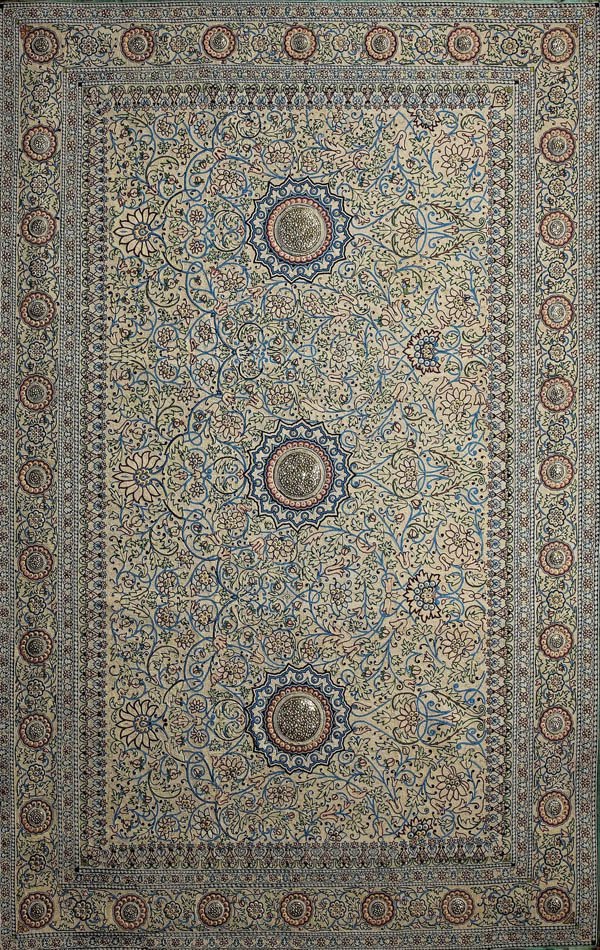
Another extraordinary piece is a 19th century Isfahan Paradise carpet (right) contributed by a collector of Hungarian origin living in New York. The collector has not revealed his name publicly.

The exhibit was opened by Hungary’s Culture Minister Gabor Gorgey, who himself has more than a passing interest in carpets.

Gorgey has written a well-received novel telling the tumultuous history of Hungary from 1940 to 1956 by following the fate of an Isfahan Hunting Rug belonging to a fictional Jewish family.

The novel, called “The Hunting Carpet,” tells how the carpet – like Hungary itself – changes hands from the family, to the fascists, and finally in 1956 (the year of the Hungarian Revolution) to a Soviet general. The novel has been re-printed five times since it was first published in 1988.

Still other fascinating carpets at the exhibit are several Tranyslvanian carpets (below) contributed by collector of Hungarian origin living in Transylvania, now in Romania.

Historically, much of the focus of Hungarian rug collecting has been in Transylvania, where families bequeathed rich Ottoman rugs to the area’s protestant, and sometimes Catholic, churches. Transylvania, which was a vassal state of the Ottoman Empire for 150 years, became part of Romania after World War I.

The fact that the show brings together so many carpets from private collections inside and outside of Hungary is a tribute to the zeal of the Rug Society.

The group, known as “Ten” for the original number of its founders in 2007, wants to re-introduce the Hungarian public to oriental carpets after interest in them all but disappeared during the communist era.

Denes Sandor, one of the group’s founders in 2007, says the current exhibit is the largest to date and the first in the capital. For the first exhibit, in 2007, the group chose a small town, for the second, in 2008, the university city of Szeged.

Sandor would like to revive the days when Hungary was one of the most active places in the Western world for carpet enthusiasts and the home of a number of “firsts.”

Among those firsts was the formation of Budapest’s Carpet Lovers Society in 1923, which debuted with an exhibit of 149 privately held carpets. That was a decade earlier than the formation of the New York-based Hajji Babba Society in 1933.

Going back further, the Museum of Applied Arts in Budapest was the first major museum ever to hold a single-theme oriental carpet exhibit – showing 352 Ottoman Turkish pieces – in 1914. That was when major carpet exhibitions were still very much a novelty and had taken place previously only in Vienna (1891), Stuttgart (1909), and New York (1910).

Here is a photo of the current exhibit at the Jewish Musuem, where oriental carpets are displayed in two of the halls and Jewish textiles in a third.

The huge historical – and growing present – interest in oriental carpets can’t help but make even Hungarian collectors sometimes wonder why rugs so fascinate their countrymen.

Sandor says most people assume it must be because the Ottoman Empire directly occupied much of the central region of Hungary for a century and-a-half. But he believes the ties to carpets go much further back than that: to the Hungarians’ own nomadic origins on the Eurasian steppes.

He argues that before the Hungarians, who were renowned horsemen, settled in Hungary some 1,000 years ago, they would likely have had the same carpet culture as other steppe peoples, including using carpets to cover the floors of yurts.

The Hungarian language today remains a Finno-Urgic tongue, so such cultural echoes might not be so distant as they seem. And, says Sandor, that would at least explain why other European nations under long Ottoman rule – such as Greece or Serbia – have never shown as much enthusiasm for carpets as has Hungary.

Here is yet another fascinating carpet on display at the current exhibition.

It is believed to have been woven in Hereke, Turkey, for Mohammad-Reza Shah Pahlavi’s celebration of 2,500 years of the Persian monarchy in 1971.

One clue to the carpet’s identity is its unusual motif of peacocks – the symbol of the Pahlavi dynasty. Another is the border motif of lions holding a sword in the right hand – the same symbol used on the flag of Iran prior to the 1979 Islamic Revolution.

No discussion of carpets in Hungary would be complete without the extraordinary and tragic story of the Gold Train of 1945 – a tale which the location of the current exhibit in the Jewish Museum cannot fail to bring to mind.

During the 1930s and 40s, Hungary’s Nazi-allied government required Jews to deposit all their valuables – including their collections of carpets – in the national bank.

The majority of Jews were later sent to concentration camps but their seized property remained in the vaults until the end of the war. Then, as the Russian army approached, the fascists assembled a 40-wagon train to remove the goods to Germany.

The train was ill-fated from the start.

As it meandered through Hungary and Austria, anonymous trucks pulled up beside it to unload its gold and vanish.

Next, it was seized by Allied troops, first French then American.

Finally, most of its remaining valuables were sent to a military warehouse in Salzburg. From there, they went on to furnish U.S. officers’ homes during the occupation of Germany or were sold in U.S. military exchange stores.

The value of the paintings, jewels, porcelain, and carpets on the train – based upon the existing documentation – would be in the billions of dollars today. Yet most of them disappeared without a trace.

The events remained all but forgotten until 2005, when a U.S. court ruled that Washington should pay $ 6 million in compensation for the stolen property. Given the difficulty of knowing who exactly lost what, the payment was made to Jewish organizations rather than to surviving families.

The Gold Train and the tragic personal stories behind it amount to an inestimable loss for Hungary in every respect, including its once thriving carpet culture.

But the exhibit taking place in Budapest now is evidence that Hungarian collectors can still exhibit some astonishing pieces. And their pieces, plus those in the country’s famous museum collections, provide every reason for rug lovers to again regard Budapest as a carpet capital.

#

RETURN TO HOME

#

Related Links:

Exhibition in the Jewish Museum

The First Turkish Carpet Exhibition In The West, by Ferenc Batari, Hali

Saturday, 8 May 2010

$ 10 Million Persian Carpet Sets New Auction Record

LONDON, May 15, 2010 -- How much are private collectors ready to pay for Persian rugs?

The answer came at an auction in London last month: just short of $ 10 million.

The carpet – which set a record price of $ 9,599,535 – is a "vase" carpet from Kirman, a city whose weavers are widely considered to have been among the most inventive of the classical carpet age.

The vase carpets, woven in the 16th and 17th centuries, are some of the Kirman weavers' greatest works of art, with spectacular, colorful and intricately designed patterns of swirling branches, foliage and flowers.

The floral patterns may be arranged in vases or, as in the case of the auctioned carpet, there may be no vase apparent.

Such carpets are always highly sought after and rare, with the best examples kept in museums.

But to fetch close to $ 10 million, this carpet measuring 11 feet by 5 feet had to have some unusually distinguishing features. And, in fact, it has several.

One is the unusual energy and charm of its pattern.

Christie's, the auction house which made the sale on April 15, describes its magic this way:

"The designers have worked out an arrangement that makes the blossoms completely secondary to the leaves. It is no longer the powerful scrolling of individual leaves that creates the energy of the design; here it is the rhythm set up by the interlocking leaves.

"Their stems and the drawing of the individual plants growing from each end of the carpet create one rhythm, but the coloring, which makes facing leaves from two different plants still have the same colors, creates the counterpoint. It is an apparently simple but wonderfully satisfying design."

The energy of the arrangement can be seen even more clearly from a distance than from close up.


But the carpet is also noteworthy for another reason that particularly interests carpet historians.

And that is (again to quote Christie's) it "can claim to be the earliest design which can clearly be demonstrated to be a prototype for the most popular Persian carpet design of all - the so-called herati pattern."

Here is a diagram of a herati pattern.

Kirman dominated the rug-making industry of south-eastern Iran for centuries and its weavings were remarked upon by the earliest western travelers to the region.

Marco Polo, traveling through Persia in 1270, praised the carpets of Kirman as a particular marvel.

By the 17th century, at the height of the Safavid era, Kirman’s designers were at their most inventive and their weaving techniques of a sophistication not seen in other parts of the Persian Empire.

One innovation was to set their looms so that the cotton warps were on two different levels. They then threaded the wool wefts, leaving some tight and others sinuous, to give an immediately recognizable wavy finish to the surface of the carpet.

Interestingly, it was this characteristic weaving pattern that helped an art dealer recognize this particular carpet as a Kirman vase carpet (without a vase) and bring it to auction.

The story of who the art dealer is, and where he discovered the carpet, is still being pieced together by an art world hungry for more details. But the early indications are it is the stuff of which legends are made.

The Financial Times reports that the carpet originally was bought for only €18,000 (some $ 23,000) at an obscure German auction house late last year.

"Cataloged simply as “Persian carpet” and estimated at €18,000, the finely knotted wool rug appeared at Georg Rehm, a provincial saleroom in Augsburg, in October last year," the paper says.

It continues: "Asked to confirm the sale, the auction house refused 'to divulge results ... after extensive negotiations with our suppliers and buyers'."

How the carpet fell out of the sky to arrive at "an obscure German auction house" is unknown.

But by the time it went on sale at Christie's enough of its history had become clear to interest some very competitive art collectors.

The carpet was traced to the former holdings of Martine Marie Pol, the Comtesse de Béhague, who prior to her death in 1927 maintained a renowned collection of antiquities, including both European and Oriental Carpets.

One of her many properties, the Chateau de Fleury in the Ile de France region, is shown here.

Much of the countess’s collection was dispersed in two sales in 1927 and 1928, but the Kirman vase carpet was not included in those. Christie's believes the carpet instead passed on to her heirs before being sold at some stage between the 1930s and 1950s.

Yet even as Christie's evaluators widely publicized the carpet's pedigree before the auction, they badly underestimated what price the carpet might command.

The auction house estimated the carpet to be worth from $307,600 - $461,400. But when bidding began, the price immediately began soaring toward the stratosphere.

There were seven bidders, one in the auction room and six on the phone from Britain, continental Europe, the Americas and the Middle East. Among the parties, just one was a museum, all the rest were private collectors.

Britain's Economist magazine described the bidding this way:

"At £2.4m the countess’s rug beat the record price for a carpet at auction; at £3.5m it beat the record for an auctioned Islamic work of art. By £5m, bids began jumping ahead in increments of £500,000, which proved too much for one of the two remaining bidders, who put the phone down at £5.5m, too upset to continue. The rug finally sold for £6.2m (including commission and taxes), proof for the dealer who consigned it that he had been right to trust his instincts."

The identity of the two remaining bidders is secret. But several art dealers have told The Financial Times they believe both were from Qatar.

The Gulf state has a recently opened (2008) Museum of Islamic Art with a major collection of carpets and textiles and it is not impossible the Kirman vase carpet could one day be loaned to it.

In becoming the world's most expensive carpet, the Kirman vase beat the previous record of $ 5.5 million set by the famed Pearl Carpet of Baroda in March 2009 at a Sotheby's auction in Qatar.

The Pearl Carpet of Baroda is not of hand-knotted wool but is "woven" from strings of Basra pearls: one-and-a-half million of them, harvested off the coast of Qatar and Bahrain. It is believed to have been created as a gift for the tomb of Prophet Muhammad in Medina and commissioned by the Maharaja of Baroda, who died before he could make the donation.

After the pearl rug, the previous record-holder for the most expensive auctioned carpet was a silk Isfahan rug dating to the 1600s. It previously belonged to tobacco heiress Doris Duke sold for $ 4.45 million at Christie's in New York in June 2008.

#

RETURN TO HOME

#

Related Links:

Christie's: A Kirman Vase Carpet

Financial Times: How An 18,000 euro Rug Sold For 6 Million Pounds

The Economist: Rug Rave – Prices Fly For A Persian Carpet

Rug Rag: Pearl Carpet Of Baroda

Thursday, 21 May 2009

Rug Art: Turn-of-the-Century Oriental Carpet Advertisements

PARIS, May 22, 2009 – How do you sum up the mystery of oriental carpets in just a few words?

That’s always been a challenge -- both for the people who sell expensive rugs for a living and for the people who buy them and then have to explain why to family and friends.

So, it is interesting to see how advertisers approached the problem in the days when mass marketing was new.

The story is told by the posters that still survive from the turn-of-the-last century. Some of these posters were so successful and popular that they have become collectors items themselves, just like the rugs they show.

Here is an 1891 poster for a Paris store, ‘A La Place Clichy,’ that specialized in textiles, ready-to-wear clothing, and sundries. The ad proclaims the store ‘number one in the world for its oriental imports.’

What gives the poster its appeal?

For one, it sets a mood with stock characters that are instantly recognizable. The desert Arab, the pith-helmeted Westerner, and the treasure-laden camel make the idea of buying a rug adventuresome and appealing.

And, strangely, it doesn’t seem to matter that some of the rugs most prominently shown on the poster are from a world that has nothing to do with any of these stock characters at all. They are from the pine-covered mountains of the Caucasus in the then Russian Empire.

The painting is by Eugene Grasset, a Swiss decorative artist. After studying drawing and architecture, he traveled to Egypt in 1866 and fell in love with its motifs. He used Egyptian elements in a number of his posters for commercial products, perhaps explaining why the backdrop for his carpet advertisement seems to be missing only the pyramids.

A second reason the poster may be appealing is that Grasset was one of the leading graphic designers of his day and clearly knew what his audiences liked. His best known creations is the "Semeuse" logo which is still used by the dictionary publisher, Éditions Larousse today.

Grasset was equally famous as an innovative designer of furniture fabrics and tapestries as well as ceramics and jewelry. Some of his creations are considered milestone Art Nouveau patterns and motifs.

The fact that a talent like this could be recruited for marketing rugs gives some idea of the profitability of the rug business at the time.

And it shows that Art sells Art – something that rug advertisers who rely upon simply putting their logos in newspapers seem to forget.

An original copy of the ‘A La Place Clichy’ poster sells today on the internet for 2,500 euros from the Paris-store Estampe Moderne & Sportive.

Here is another advertisement for a rug sale in Paris in 1899. The venue – ‘Trois Quartiers’ – was a shopping gallery named for its location at the junction of the Madeleine, Opéra, and Concorde neighborhoods. It still exists today but now it is filled with luxury fashion boutiques.

This time the painting is by artist René Péan but many elements are like Grasset’s. The central figure is again the highly recognizable Arab trader despite the fact that, here too, the rugs are from the Caucasus.

The carpet behind the vendor is drawn so clearly that Caucasian rug expert Ralph Kaffel identifies it as an eastern Caucasus Boteh rug.

But why are images of the Middle East being used to sell Caucasian carpets?

One reason may be that Caucasian carpets were relatively new on the Paris market at the time and so had to be linked to more familiar images.

Kaffel observes in his 1998 book ‘Caucasian Prayer Rugs,’ that by the third quarter of the 19th century carpets from the Caucasus were becoming known in the West but were still novelties.

They were such novelties, in fact, that they provided the subject of one of the first ‘carpet books’ in English. The author, Herbert Coxon, traveled to the Caucasus to buy some rugs on site and wrote about his experiences in ‘Oriental Carpets, How They Are Made and Conveyed to Europe,’ published in 1884.

It is interesting to note that the posters for both the Paris department stores seem to be deliberately “positioning” Caucasian rugs as part of the fad for Orientalism that swept Europe in the late 1800s and into the early 1900s.

Tying into the fad meant the sellers could benefit from the free publicity generated by Orientalist fine arts painters. At the same time, buyers could get extra cachet for their purchases.

Here is an example of an Orientalist painting by Arthur Melville in 1881 entitled ‘An Arab Interior.’ On the floor, a carpet helps set the stage.

Like Orientalism, the rug store posters of the turn-of-the-last century belong today to a world long gone by. But they still stand as some of the most successful carpet ads of all times.

How can one be sure? The measure of success is longevity. Other ads have come and gone but the ‘Trois Quatiers’ poster, like the ‘A La Place Clichy’ poster, still circulates among museums and collectors.

And if you can’t find your own original of the ‘Trois Quartiers’ poster, there are replica art companies that regularly reproduce it . It is offered on the internet for $227 to $745, depending upon size, by 1st-art-gallery.com.

#

RETURN TO HOME

#

Related Links:

Original ‘A La Place Clichy’ Poster, 1891


Replica ‘Trois Quartiers’ Poster, 1899


Replica ‘Peerless Carpet & Cloth Soap’ Poster, 1900s

Thursday, 19 March 2009

Books: Three Novels About The Oriental Carpet World (Fun, Epic, Poignant)

PRAGUE, March 20, 2009 -- It's strange so few novels are set in the world of oriental rugs.

After all, it is a place where so many opposites meet.

Things made by the world's poorest people become objects of desire for the richest ...

Sophisticated urbanites are awed by nomadic tribes people ...

Tradition fights for a place in modern life ...

And honest carpet dealers contend with highly unscrupulous rivals.

So, what a pleasure to discover a new novel set entirely in the carpet world that is now appearing -- in chapter-by-chapter installments and free-of-charge -- on the Internet.

The novel, "When A Dragon Winks" is by San Francisco carpet dealer and writer Emmett Eiland and has a lot of attractions. It is funny, rich with insights into the rug business, filled with eccentric characters, and -- perhaps best of all -- has a page-clicking plot.

Here is the link: When A Dragon Winks

New chapters appear every Monday.

Just briefly -- so as not to spoil the fun -- here are some of the main characters.

There is a young carpet store owner trying to get his start in San Francisco.

There is a con man who appears like a good genie in the young man's store and suddenly makes his business take off -- but seems to have ulterior business motives of his own.

And there is a socialite who has climbed as high as she can in the museum world but wants to go much higher.

Plus there is one more highly volatile ingredient: an ancient Chinese dragon rug rumored to exist but never seen -- a rug so valuable that, if it were to appear -- it could make or break anyone's fortune.

What are some of the behind-the-curtain peaks into the rug business this book offers? Here is one description of the young carpet dealer, Holden Carter, as he sits musing in his store:

"He had heard of an African tribe that was said to urinate in rituals on objects to make them powerful. In the West, rather than urine, it was age that imbued objects with power and value.

"Nothing made a piece of furniture more desirable than to uncover it in an attic where it had been stashed away for 200 years. Oriental rugs, he believed, owned their mystique — their fabled reputations as magic carpets and flying carpets — to the fact that often they survived long enough to become quite old. The older a rug, the more valued it was.

"Nevertheless, as Holden’s antique rugs grew six months older and then a year and finally two years older while going unsold in his store, rather than gaining in power and value, they began to lose their magic for him. It was hard to stay in love with rugs that had been passed over by so many shoppers."

It would be unfair to talk of rug novels and speak of only one.

There are least two other novels that are partly set in the rug world which have appeared in recent years and deserve mention.

One is The Rug Merchant by Meg Mullins.

Publisher's Weekly says:

"New York City teems with quiet desperation in this lucidly written but languid debut novel. The titular carpet salesman, Ushman Khan, has left his mother and his wife, Farak, in Iran in order to make a new start in America.

"Told from Khan's perspective, the narrative traces his subtle acculturation into Western life while he sets up shop and develops loyal customers like the wealthy socialite Mrs. Roberts. He plans for his wife to join him, but learns that she has divorced him for a Turkish salesman.

"Crushed, Ushman buys plane tickets to Paris he will never use and finds temporary, self-loathing comfort in a prostitute. Only when he meets Stella, a Barnard freshman, does he begin to see a way out of his isolation.

"Like him, Stella is an outsider struggling with loss and looking for connection, but Ushman must first resolve his conflicted feelings about women and sex and American culture.

"Originally developed as a short story that appeared in The Best American Short Stories 2002, this melancholy novel droops under the weight of a sympathetic but tentative, passive protagonist who can find no real solution to his profound alienation."

Another book is The Blood of Flowers by Anita Amirrezvani.

A review by Publisher's Weekly describes it this way:

"In Iranian-American Amirrezvani's lushly orchestrated debut, a comet signals misfortune to the remote 17th-century Persian village where the nameless narrator lives modestly but happily with her parents, both of whom expect to see the 14-year-old married within the year.

"Her fascination with rug making is a pastime they indulge only for the interim, but her father's untimely death prompts the girl to travel with her mother to the city of Isfahan, where the two live as servants in the opulent home of an uncle — a wealthy rug maker to the Shah. The only marriage proposal now in the offing is a three-month renewable contract with the son of a horse trader.

"Teetering on poverty and shame, the girl weaves fantasies for her temporary husband's pleasure and exchanges tales with her beleaguered mother until, having mastered the art of making and selling carpets under her uncle's tutelage, she undertakes to free her mother and herself.

"With journalistic clarity, Amirrezvani describes how to make a carpet knot by knot, and then sell it negotiation by negotiation, guiding readers through workshops and bazaars."

Altogether, these three novels offer a wonderful library for people who like reading about carpets. And just like carpets themselves, no two of them are the same.

#

RETURN TO HOME PAGE


#

Related Links:

When A Dragon Winks: official website


The Blood of Flowers: official website

The Rug Merchant: Synopses and Reviews

Wednesday, 10 September 2008

In Harry Potter's World, The Carpet Is A Harshang Bidjar

LONDON, September 12, 2008 -- Is a Bidjar Harshang-patterned carpet quietly becoming the most popular rug of the next generation?

It’s possible – if you think that being visibly featured in Harry Potter films is likely to impact future rug buyers’ tastes. That is, ‘future’ in the sense of today’s children growing up to be tomorrow’s rug lovers.

But before going further, it may be necessary to explain a little about Harry Potter’s world.

Harry, the boy magician, goes to Hogwarts, a school of magic. The school is modeled very much on the great British universities such as Oxford, so Harry lives in a 'House,' or dormitory, with a common room where the resident students can gather informally anytime of day.

Harry’s ‘House’ is 'Gryffindor' and the floor of the Gryffindor common room is covered by a giant Bidjar with a Harshang pattern on a brilliant blue background.

Here, Harry (right) and his two close-friends Ron (center) and Hermione (left) meet in the common room in a scene from one of the seven Harry Potter films.

The carpet shows up in most film scenes of the Gryffindor common room and, along with tapestries on the walls, gives the room a very magical, wizard-like feel. The non-figurative Harshang design, which conjures up zodiac-like images of crabs and bursting suns, is perfect for the role. (It also goes well with the wallpaper, which reproduces 'The Lady and The Unicorn' tapestries from the Cluny Museum of Medieval Art in Paris.)

Is it entirely an accident that a Bidjar Harshang almost identical to the one shown below was chosen by the set designers?

Maybe not. More than a few Europeans and Americans who are now deep into adulthood have memories of oriental carpets in university rooms. And a generation earlier, rugs were far common.

Bidjars are the natural choice for such high-wear settings. Produced in and around the northwestern Iran town of the same name, they are the most strongly made and indestructible carpets of all.

Their nickname, after all, is the 'Iron Rugs' of Persia. They are so densely woven and stiff that they cannot even be folded for transportation. Instead, they have to be rolled up.

Below is a photo of the library room in Eliot House at Harvard University. On the floor – again -- a Bidjar Harshang. Only this time the carpet has a red background.

Seeing an oriental carpet in a university common room may not just be nostalgic for lots of adults who watch Harry Potter with their children.

It also is a reminder of the huge export industry which once thrived in northwestern Iran producing room-sized rugs of all types for wealthy Western institutions and homes.

The peak was at the turn-of-the-last-century, when an oriental rug on the floor was the symbol of both a wide view of the world and of a certain standing.

The story of this export industry is well illustrated by the success of Ziegler & Company. The Anglo-British firm based in Manchester, England, was among the first to realize that the West’s ‘Gilded Age’ needed giant rugs that complemented Western room decors of the time.

Arto Keshishian, writing in the magazine Antiques and Fine Arts, gives the background in his article ‘Ziegler and Their Carpets.’ He notes that by the 1850’s Europe’s cyclical interest in the orient was on the upswing again and department stores began stocking up on the existing village and workshop carpets available in Iran.

But, he writes, "unfortunately, the carpets were generally either too long or too narrow for the rooms of the new English homes, because the imported carpets were designed in a traditional format to fit urban, Persian rooms."

The Ziegler Company saw an opportunity. At the time, it was selling printed cottons produced by the Manchester mills to customers in Iran and Turkey. But it changed direction, set up its own looms in northwestern Iran around the town of Sultanabad (now Arak) and began supplying hand-woven carpets to the British market instead.

Ziegler and Company revolutionized oriental carpet production by enlarging the sizes and simplifying the patterns. The company’s artists introduced more space between traditional Persian design elements to achieve, in Keshishian’s words, “an airy visual effect.”

At the same time, “fewer color combinations were used, resulting in a simpler balance and harmony; the color green was liberally incorporated, perhaps to echo the English fondness for the countryside.”

Ziegler did not produce Bidjars and its designs, as shown here, look nothing like the carpet spread across Harry Potter’s floor.

But the principles Ziegler exemplified offer some time-tested guidelines as to how carpet producers respond to changes in the market and supply what each new generation wants.

Will the next generation surprise its parents by switching back from the abstract, tribal carpet designs popular today to the lush feel of turn-of-the-last century Bidjars and Zieglers? Only the next generation can answer and, at the moment, its members are still window-shopping – or should we say movie-shopping – the options.

#

RETURN TO HOME PAGE

#

Related Links:

Barry O’Connell’s Carpet Guide: Bijar Rugs


O’Connell Notes: Bidjar Rugs and Carpets


'Ziegler and Their Carpets' by Arto Keshishian

Thursday, 14 August 2008

Every Era Sees Oriental Rugs It's Own Way

PRAGUE, August 15, 2008 -- Oriental carpets have caught the eye of Western writers ever since they began trickling into Europe in the 13th century or earlier.

But how Western writers look at these exotic creations has changed dramatically over the years.

In the early days, carpets were symbols of impossible luxury and power. They helped seal alliances between the Ottoman court and European kings, and ambassadors carefully recorded their acceptance and delivery.

Just what potent symbols these objects of art could be is apparent in this brief description of the victorious Sultan Suleyman II summoning the Hungarian king John to him immediately after the battle of Mohacs in 1526:

“Along the short mile the King traversed to go to the Emperor, Turkish and various fine carpets were laid on the earth as far as the tent of the Emperor.”

The words belong to the Hungarian royal chaplain George Szerémy, who was there. The picture of Sultan Suleyman II above is from an Ottoman court miniature.

Over time, carpets as trappings of royal command found their way (in reduced versions) into more and more Western households. First nobility, then merchants and then, with the industrial age, the ever more comfortable middle class bought eastern rugs. So many, in fact, that by the mid-1800s, the way carpets were displayed in Western homes could be an issue of public debate.

Edgar Allen Poe is best remembered today as an American pioneer of the Romanticist Horror genre. But he was also a well-known literary and, sometimes, social critic who contributed an essay entitled 'The Philosophy of Furniture' to Burton's Gentleman's Magazine in 1840:

“Carpets are better understood of late than of ancient days, but we still very frequently err in their patterns and colours. A carpet is the soul of the apartment. From it are deduced not only the hues but the forms of all objects incumbent. A judge at common law may be an ordinary man; a good judge of a carpet must be a genius. Yet I have heard fellows discourse of carpets with the visage of a sheep in reverie — "d'un mouton qui rêve" — who should not and who could not be entrusted with the management of their own moustachios."

Poe goes on to accuse the main commercial carpet centers of his day of violating all public standards of good taste. "Brussels is the preterpluperfect tense of fashion" in Western rugs, he claims, and "Turkey is taste in its dying agonies" for Eastern ones.

What does Poe like? Well, colors that are not too lively. "A carpet should not be bedizzened out like a Riccaree Indian — all red chalk, yellow ochre, and cock's feathers," he says, apparently having seen something like that on someone's floor. As for patterns, only non-figurative and preferably Arabesque. "Distinct grounds and vivid circular figures, of no meaning," are his maxim.

If Poe seems surprisingly argumentative about carpets, he is only a little ahead of his time. By the end of the 1800s, passions rose still higher.

Britain's The Burlington Magazine for Connoisseurs offers this view of carpet collecting in a 1903 commentary:

“There are, I must suppose, but few hobbies that claim so absorbing a devotion as does the pursuit of the oriental carpet. Every hobby, no doubt demands a good deal from its victims, but the exactions of most of them are tempered with mercy: thus the collector of old furniture does not necessarily cut himself adrift from pictures, nor does the lover of old arms from bric-a-brac; but the oriental carpet is inexorable and remorseless, and the true carpet lover gives himself to carpets and to carpets only. They are his pictures, his furniture, his bric-a-brac, his all. True, the field of the oriental carpet seeker is an immensely wide one. His horizon extends from Morocco to China, and the period during which the objects of his affections have existed, and existed as they do today, dates back to the days of the Pharaohs; in the palaces of ancient Egypt they were employed as decorations and the priests at Heliopolis used them at religious ceremonies.”

Whether these notes about the ancient Egyptians are well-researched, we can't say. But just a few years later, the same magazine makes it clear that a real connoisseur should and can get to a museum or bookstore to learn more about rugs:

"Not very long ago oriental carpets were bought only as house decorations. It is not much more than a decade since our museums accorded them notice on their own account. Today, however, we have turned over a new leaf. Bode, who may in one word be called the magnet of modern art dealing, has devoted intense labour to carpets and filled with them two rooms in the Kaiser-Friedrich Museum at Berlin. Since the transition of our interest in this species of art from art-craft to the actual art museums, the carpet has become a distinguished gentleman in the salons of science. I know of at least half a dozen books already written or in the press which will go into the new problem. The first of these works – a standard work in compass and contents – lies before me: F.R. Martin’s 'History of Oriental Carpets before 1800.'

The article, which appeared in 1908 translated from German, is signed Professor Josef Strzygowski. Pictured here is the Central Asian collection of the Russian pavillion at the 1900 Paris Exhibition, an event that greatly increased Western interest in the rugs of Turkestan.

Today, good taste, a collector's passion, and scholarly interest are all part of our outlook on oriental carpets. And there is still a sense of medieval awe that overwhelms anyone standing before a masterwork of the Mamluke, Ottoman, Safavid, or Mughal courts.

But contemporary writers also express something new, and that is anxiety - with a capital "A" - about something no previous generation had to think about. The anxiety is that today the chance of finding any new, as yet undiscovered, weaving cultures is nil and that, meanwhile, all the known weaving cultures are rapidly modernizing.

This gives rise to worries that come in both mild and potent varieties. The mild version is that carpet collecting has now reached a dead end and the thrill of new discoveries must give way to recycling what we have. The potent version is fear that the growing globalization of the carpet market will eventually drive many weaving cultures to extinction.

Here is the abstract of a scholarly paper presented in 1999 by anthropologist Tom O'Neill of Canada's University of Western Ontario. It describes how classical Tibetan weaving (below left) has turned into modern Tibetan-refugee weaving (below right) in Nepal:

"The popularity of the Tibeto-Nepalese carpet in the European hand-knotted carpet market created a modern industry in peri-urban Kathmandu, Nepal, that established the Tibetan refugee population there as well as a new class of Nepalese entrepreneur. This paper employs Igor Kopytoff's (1986) perspective on the social life of things and Keith Hart's (1982) definition of commoditization to argue that the short career of the Tibeto-Nepalese carpet as an export commodity has been one of increasing homogenization that has transformed the materials, weaving techniques, and meanings of the carpet.Easy access to the lucrative 'middle' markets of Europe has meant that Tibeto-Nepalese carpets are now standardized to compete with other categories of floor coverings, and that the unique hand-knotted quality desired by connoisseurs and collectors is slowly being eliminated."

The article is entitled 'The Lives of the Tibeto-Nepalese Carpet' and appears in the Journal of Material Culture, 1999.

How will writers of future eras view the art of oriental carpets? As the 21st century only just begins, it is far too early to guess. But if the past is any guide, the subject will remain as full of surprises tomorrow as it is today, or was yesterday.

#

RETURN TO HOME PAGE

#

Related Links:

Edgar Allen Poe: The Philosophy of Furniture


The Burlington Magazine: On Carpets

The Burlington Magazine: Oriental Carpets


Tom O’Neill: The Lives of the Tibeto-Nepalese Carpet

Thursday, 17 July 2008

Tribal Rugs: How The 1960s Changed The West’s Taste In Oriental Carpets

PRAGUE, July 18, 2008 – In the mid-1960s and into the mid-1970s, hundreds of thousands of young Europeans and Americans traveled East – to Morocco and Turkey or, much farther, to Iran, Afghanistan, India, and Nepal.

To the East, as in this verse from ‘Marrakesh Express:”

“Take the train from Casablanca going south
Blowing smoke rings from the corners of my mouth
Colored cottons hang in the air
Charming cobras in the square
Striped djellebas we can wear at home …”

The sudden longing for places with strong colors, tribal designs, and mysticism had an enormous influence on Western taste in oriental carpets. But before considering how much, it is time for the story of ‘Mercedes’ Werner.

Werner, his first name, is a retired German antiques dealer who divides his time today between Wurzburg and Prague. But even a few minutes after meeting him, it becomes clear he considers his spiritual home to be Turkey.

It began in the 1960’s, when he flew to Istanbul for a short vacation. He fell in love with the city and quickly realized he would need a car if he wanted to explore the country. So he flew back to Wurzburg for his old Mercedes and then began regularly driving 20 to 24 hours non-stop from Germany to Turkey.

To pay for his trips, he carried back Turkish rugs, artifacts and, because it was so easy to give the Turkish border guards 5 DM, even antiquities. But the story he likes to tell most is not business related. It is about a roadside village near Lake Van, which had nothing to offer except scenery.

Werner stopped so often at this village that he became very attached to it. He exchanged stories with the people at his favorite restaurant, became friends with the owner, and learned all about the local music. Then, for many years, he stopped going there as business took him elsewhere.

One day, when he was already middle-aged, Werner was home watching a documentary about eastern Turkey. Suddenly he heard the same village music he knew so well and there on the screen was the restaurant owner being asked if tourists ever came to such a remote area.

“No,” said the restaurant owner, “they only go to the seaside resorts.” And he added, “It’s not like 30 years ago when people came here just to see our mountains and learn about how we live.”

“What kind of people were those?” the interviewer asked in surprise.

“Well, like Mercedes Werner,” the restaurant owner said.

Werner says that when heard that he broke down in tears. He didn't know he had this affectionate nickname. And he had not realized how much his visits had been something extraordinary not only for himself but for his friends. The next year he returned to the village and revived what he now sees as a very important part of his life.

Interestingly, there were lots of Werners who came out of the adventures of the 1960s and 70s. Dennis Dodds, the head of the ICOC (International Conference on Carpets), says many current rug dealers got their start just that way. The rugs they discovered on their travels did much to shift their generation’s taste toward village and tribal designs and away from the elaborate city rugs favored by their parents.

In Istanbul, the travelers – including Dodds – gathered at the Pudding Shop, where they exchanged information and contacts for trips across Turkey and on to India. The café’s owner was said to be so helpful that he once gave a chair to a customer to sit on for the journey to Kathmandu. That was when all the usual seats in the minibus were full.

Dodds says that because the travelers were on a low budget and keen to get in touch with nature and natural lifestyles, they were attracted by affordable village and tribal pieces rather than by Ottoman, Safavid, or Mughal-derived designs. The geometric patterns of the rugs they brought home to Europe and America fit nicely with the 1960s fashion of Op Art and they soon became the new market standard.

What weavings most owe their success to these years? Probably kilims. They suddenly became hugely popular, in part because they are so boldly graphic – offering just colors and patterns. By contrast, pile carpets add a third dimension - texture - which diminishes the clarity of the design.

The 1960s and 70s are long gone, along with long hair and long, strange trips. But it is interesting to realize that the aesthetic tastes the travelers helped set for rugs are still very current, and probably will remain so until the next great shift in Western pop culture.

(Kilims pictured here are from: Turkish Culture)

#
RETURN TO HOME PAGE

#

Related Links

Barry O’Connell: Turkish Rugs and Carpets

Barry O’Connell: Guide To Turkish Rug and Carpet Books


The Pudding Shop

Wikipedia: The Asia Overland Hippie Trail

Touring The Hippie Trail Today

YouTube: Afghanistan On The Hippie Trail 1967

YouTube: London To Kathmandu Overland

YouTube: Les Annees Hippies au Maroc (Part 1)

YouTube: Les Annees Hippies au Maroc (Part 2)

Thursday, 3 July 2008

Turkish Prayer Rugs And The Gates Of Eternity

ISTANBUL, July 4, 2008 -- Is eternity something artists should illustrate as a physical thing? Or should artists represent it as something abstract and supernatural?

It is a question that every religion approaches differently and on which philosophers disagree.

But it is interesting that Turkish prayer carpets offer both possibilities: realistic and abstract. And perhaps that is one reason for their great appeal.

Turkish prayer carpets became widely familiar in Europe and America during the late 19th century, when Western tourists began traveling to Istanbul in large numbers by the Orient Express and by ship. The travelers helped popularize the rugs as symbols of the exotic and spiritual East at a time when Orientalism was at its height.

As a result, production boomed in towns like Ghiordes, Ladik, and Melas (Milas), and their typical designs became household names in the Western market.

The Anatolian town and village weavers, who adapted and simplified the designs of earlier Ottomon court prayer rugs, were not trying to show what heaven looks like. The purpose of all prayer rugs is only to mark out a space for prayer that is secluded from the mundane.

This is in line with the injunction in the Koran to "pray in a clean place". The first mosque is traditionally said to have been a space drawn in the sand by the Prophet Mohammed, who said "take off your shoes when you enter here. This is holy ground."

But because the weavers had to fill the space set aside for prayer, they had to address an art problem that is shared by all cultures. That is, how to best symbolize the eternal.

The designers of Ghiordes and Konya opted for solid architecture. They depicted the central feature of all prayer rugs – the arch – as resting upon columns. The arch itself symbolizes the focal point in a real mosque, which is the mihrab, or ornamental niche, that marks the wall facing Mecca.

This carpet above is a 19th century piece from Konya in central Anatolia.

But weaving natural-looking “gates to eternity ” -- as some Western experts like to describe prayer rugs -- is just one possibility.

By contrast, the rugs of several of the other great traditional prayer rug centers of Turkey – Kula, Ladik, Melas, and Mudjur -- took an abstract approach.

In these rugs, the mihrab is still the defining feature. But the field of the rug is fluid and appears to change with each glance. Instead of a sense of certainty, it offers the mystery of a curtain which one day may be drawn aside.

The rug shown here is from Ladik, a town in central Anatolia not far from Konya.

Both the realistic and the abstract designs were widely collected in the West. But partly due to export pressure to adapt to Western tastes, the quality of the patterns began to decline with time. They became more and more decorative and less and less certain of their identity.

Some experts say the export pressure was so great it caused workshops to reverse the way the rugs were woven. Instead of starting at the bottom and weaving toward the mihrab, some weavers started at the top. That way, the pile would catch the light best when hung on a wall.

Other experts disagree. They say that individual weavers may have started at the top when they were uncertain of their stocks of dyed wool. Since the mihrab is considered the most important element in any prayer rug, they may have wanted to be sure of completing it first before running out of preferred colors.

Whatever the case, it is certain that by the middle of the 20th century, Turkish prayer rugs had lost favor – both in the West and at home.

In the West, fashions changed and collectors began looking for bolder village and tribal weavings free of – among other things – Western influence. Today, in real terms, the cost of a Ghiordes or Ladik in the West is said to be less than it was at the height of the rugs’ popularity at the turn-of-the-last century.

In Turkey, the end of the Ottomon Empire and the rise of the secular republic equally reduced the prayer rugs’ value as weavings.

Townspeople who once commissioned expensive pieces for the Haj or for their homes, and later bequeathed them to the local mosque, gave up those customs as the population shifted to major cities. Prayer rugs became plainer and simpler, as shown by this recently made Ladik.

But all that may just make the great 19th century prayer rugs of Turkey more interesting for those who still want to collect them. Not only do they offer a creative vision of the spiritual world, they also offer a reminder of how much our own aesthetic world keeps eternally changing.

#

RETURN TO HOME PAGE

#

Related Links:

Spongobongo: A Guide to Turkish Prayer Rugs

Spongobongo: Notes on Ghiordes Rugs and Carpets

Spongobongo: Guide to Konya Rugs

Spongobong: Guide to Ladik Prayer Rugs

Spongobongo: Guide to Melas Rugs

Old Turkish Carpets: Prayer Carpets

What Do You Mean, “It’s A Prayer Rug?”

New England Rug Society: Prayer Rugs and Related Textiles

Wikipedia: Mihrab

Thursday, 19 June 2008

Pierre Loti: When Oriental Carpets Are Not Enough

ROCHEFORT, France; June 20, 2008 -- Many non-French speakers hear of Pierre Loti for the first time when they visit Istanbul

That is partly thanks to the café that bears his name on a hill overlooking the Bosphorus. The veranda and interior are said to have changed little since the French traveler and writer went there at the turn-of-the-last century to smoke the narghile and gaze at his favorite city.

But once one hears of Loti -- the pen-name of French naval captain Julien Viaud (1850-1923) -- it is hard not to be intrigued.

There is the story, for example, of Loti and Sarah Bernhardt. When Loti wanted to meet the famous actress, he had himself rolled up in an oriental rug and delivered to her door by two men dressed in Arab costume. When he rolled out of the carpet, she was so surprised that they quickly became good friends.

And there is his book ‘Aziyadé,’ first published in 1872. It chronicles the doomed love affair of a young British officer, named Loti, and a Circassian concubine of a Turkish merchant in Salonica. The two flee to Istanbul until finally they are separated by the pulls of their different worlds.

"I swear to you, Aziyadé," Loti tells her, "I would give up everything with no regrets, my position, my name, my country. As for my friends, I have none and I don’t care. But you see, I do have an aged mother."

How much of the tale is autobiography, how much fiction, no-one knows. But Loti maintained for the rest of his life that his one true love was Aziyadé and that she died of heartbreak before they could meet again.

Loti was perhaps the last great French writer of Romanticism and – sailing with the French fleet – took the genre to settings it had never seen before.

His novels and travelogues explore the Ottomon Empire, Japan (his book 'Madame Chrysanthemum' is the forerunner of Madame Butterfly), Polynesia, Morocco, Iran, China, Egypt and Iceland. What his stories had in common is a longing for the exotic, a world-weariness with European bourgeois life, and immense appeal for bourgeois European readers.

But Loti, who was a member of the Academie Francaise and both admired and ridiculed in his day, reserves his greatest surprise for visitors to his rather ordinary looking home in Rochefort, on France’s Atlantic coast.

From his voyages, he brought home immense quantities of momentos. Gradually, they began to overfill his ancestral home until, as he grew richer, he bought the neighboring house and connected it to his own.

Then, he began refashioning the interior into a whole series of rooms that conjured up the exotic world of his books and, he said, inspired him to write more.

The most amazing room is a full, operetta-stage replica of a mosque. To construct it he purchased a fire-damaged mosque in Damascus that was about to be pulled down and had it shipped in its entirety to France accompanied by a team of Syrian masons.


The mosque is complete down to a Turkish multi-niche prayer rug, or Saff, and is adorned with a giant gravestone from an Istanbul cemetery. Loti said it was the stele from Aziyadé’s grave site.

By his own account, he spent hours in these rooms – which also include a fully furnished Turkish salon -- dreaming of lost love.

I spend a lot of time at home, they are the hours of calm in my life, and smoking my narghile I dream of Istanbul and the lovely limpid green eyes of my dear sweet Aziyadé.”

At the same time, Loti loved to give parties and he dressed himself and his servants for the occasion – in Arab or Turkish robes.

Was Loti mildly eccentric? That would be an insulting understatement. He was massively and joyously, but also wistfully, out of step with his rapidly modernizing and Euro-centric world.

During his travels in Morocco, he wrote ecstatically of places that Western influence had yet to reach and, at the same time, described what he knew was doomed to disappear. The clarity, detail, and color of his writing won the admiration of painters such as Matisse and writers including Marcel Proust.

Today, a quick browse through the Internet shows Loti available mostly only in French and Turkish and long out of print in English. But his house – now a museum – is an open invitation to follow him home and, from there, still further home to the farthest corners of the East.

#

RETURN TO HOME PAGE

#

Related Links:

Wikipedia: Pierre Loti

‘The Orient of Pierre Loti’ – Saudi Aramco World

‘Phantoms of the Orient’ - An Exhibition of Loti’s Life and Work – Al-Ahram Weeky

'Armchair Travels with Pierre Loti' - Al-Ahram Weekly

Pierre Loti Museum, Rochefort

Extracts from first chapters of ‘Aziyadé’ (French)

‘Pierre Loti – Turcophile’ (French)

Thursday, 15 May 2008

The Orient

(Fiction - By Karel Capek, 1923)

The well-known Czech journalist Karel Capek wrote about buying oriental carpets in Prague at the beginning of the last century. In his short tale 'The Orient,' he describes Old Europe's fascinating world of carpet connoisseurs and carpet sellers – both honest and not so honest.

It can happen that you win the lottery, or that you get married, or that one day it simply strikes you that you want something beautiful at home; whatever the reason, you decide to buy a Persian carpet. But in the process of actually purchasing an oriental rug, your life turns upside down. First of all, you will have to smoke -- a lot -- because smoking is part of the oriental atmosphere. Second, you will have to walk over mountains of valuable carpets with the air of one who has never set foot upon anything else. You will have to assume the look of a connoisseur, fingering the pile and the back of each rug as you mumble to yourself. There will be a whole array of initiation ceremonies, from special Persian jargon to passionate Turkish haggling, until finally you reduce a carpet seller to tears as he says he feels so close to you that he is ready to give you his rugs almost for free, even at a loss, and simply as a present between equals. There will be, I say, an entire string of extraordinary moments but still you will have only reached the threshold of the Orient. And then, thinking you have finished, you will safely choose a modestly priced Kazak and race home with rosy visions of how it will look beside your bed. In so many ways, a first carpet is like first love.

The next day, someone will ring your doorbell. It is a polite, lively little fellow pushing another, silent, man in front of him. Immediately, he blurts out in the doorway that he is coming to you because you are an exceptional and extraordinary connoisseur of Persian carpets and that he has brought his business partner with him who just arrived yesterday from uh, well uh ... Constantinople ... with some carpets that, truly!, are just for specialists, and he has brought them first to you so that you can just look, nothing more than look, at them, just for the pleasure of it. And already he is opening the door again and shouting, “Vaclav! Come here!” And in comes a delivery boy with a huge pile of carpets on his back. The man from Constantinople really does have a kind of Persian air but he never says anything, and the active little man starts laying out the first carpet with Vaclav. “Now, this is a fine piece, isn’t it? This one is worthy of you ...” You mention it isn’t quite the kind of thing you are looking for. “That’s just what I thought myself!” the vivacious little fellow shouts victoriously. “You, sir, are a marvelous connoisseur; but here I have a Shiraz which is truly perfect for you, that only a real specialist can appreciate!”

This Shiraz seems horrendously pricy and now your lively guest is whispering something to the silent oriental man in a language that might be Persian or might be Turkish. “Also meinetwegen,” the Persian mutters in German, or “fair enough,” and the lively man announces that his friend is giving you the Shiraz simply as a present, almost completely free, because you are you, and just for 40,000 crowns. You fight off the temptation, you will neither accept as a gift a Shirvan, nor a Gendje, nor a Bukhara, nor even a Baluch, not to mention a Kerman and a Senneh and all sorts of prayer carpets; this time you defend yourself against everything, until this obliging fellow asserts that you have truly prodigious taste and that the really valuable rugs he has are still tied up in customs and if you could see those, well, you would cry with joy. Then, he leads out the Persian and Mr. Vaclav, promising to come back later.

So far, so good. But three hours later, a man in a top hat rings your bell. He hands you his visit card and introduces himself as Mr. So and So, an industrialist who is in momentary financial difficulty. He has decided to sell his private rug collection and ... already he is calling down the corridor “Vaclav! Komm hier! ... and Mr. Vaclav is bringing in a new load of carpets on his shoulders. The man in the top hat discreetly speaks of family problems, saying he has to sell at any cost, even way below market price, but only to a real judge, to a true authority, who knows how much a beautiful carpet means. For example, this authentic Hamadan, the man in the top hat sighs, or this fabulous Mosul. To your surprise, each piece in his family collection seems to still have its inventory tag and its customs seal.

You escape from the heavy-hearted monsieur. A day later, a thin man appears who wants to speak to you very privately about things that are “just for four eyes.” Then he tells you that he has … that he has Persian Carpets ... perfect museum pieces ... that he has obtained under rather special circumstances that, well, to be honest, that he personally spirited out of a Sultan’s seraglio, only please don’t speak about it. In short, they are one-of-a-kind pieces for connoisseurs only and staggeringly underpriced. And already Mr. Vaclav is back with a cargo of rugs on his back and on all of them, too, are customs seals and inventory numbers.

If you don’t make use of this exceptional purchasing opportunity, there is no reason to worry, because tomorrow a Russian couple will come to you, from a noble family which has had to flee the country and which escaped with nothing but some rare Persian carpets and now, out of the most dire necessity must part with them. Mr. Vaclav is already waiting in the corridor. And, afterwards, you will get a visit from a resplendent Levantine who does a little business with carpets here and there and the other day came across some pieces that he has not shown to anybody, that are only for true enthusiasts. And after him will come a juvenile delinquent who won’t have Mr. Vaclav with him but who knows of a superb Persian carpet that could be sold to a discreet and well informed collector. And then there still will be the solicitor from Vienna, the widow in need, and the Greek who has no money to pay customs and so has to sell at least one precious Persian carpet -- far below its price, of course, and only to an initiate.

In short, if you keep your eyes and ears open, in a little over a week you will learn how to evaluate the weave, material, age, color quality, and finesse of the design of an oriental carpet. You will meet rogues, cognoscenti, eccentrics, entrepreneurs, and small-time crooks; you will make a kind of pilgrimage to the Orient and, doing so, you will discover a strange, wily, ancient, modern form of business that you will never encounter anywhere else and that richly repays your investment.

(‘The Orient’ was published in the newspaper 'Lidove Noviny' in 1923; Photo of carpet is courtesy of Ali Majdfar/Persian Carpet Museum Photo Gallery.)

#

RETURN TO HOME PAGE


#

Related Links:

Karel Capek


Barry O'Connell: Notes on Oriental Carpets and Persian Rugs

Thursday, 8 May 2008

From Table To Wall To Floor: Oriental Rugs Keep Moving Around European Homes

PRAGUE, May 9, 2008 -- Oriental carpets are the great nomads of European homes

Over the centuries, few furnishings have moved around as much as they have. Rugs have been put on tables, hung on walls, stretched over sofas, displayed on floors and, finally, tucked under the furniture.

In the process, they have helped express the social values of their owners – from medieval merchants looking for status symbols to modern families looking for creature comforts.

All this makes the history of rugs in Western homes a fascinating study.

Rug experts date the first imports of oriental carpets into Europe to around 1200 – the time of the fourth Crusade – or earlier. The knights leading the crusades were keen observers of Eastern court life and eager to acquire the trappings for themselves.

By 1300, Europe’s court painters began to show some of these acquisitions in their artworks and by 1450 the depictions are so highly detailed they can be cataloged. The carpets – then all from Anatolia with geometric motifs – appeared in many paintings with Christian religious themes and were usually placed at the feet of the Virgin Mary or on the steps of alters. One example is Alessio Baldovinetti’s Madonna and Child with Saints, circa 1454.


Giving the carpets such a place of honor in religious paintings may have been a reflection of the awe the oriental rugs inspired in the European public. And it may show how easily the Eastern textiles found a place within Europe’s own tradition of using luxurious tapestries as symbols of power and prestige.

Through the 1400s, carpets began to become sufficiently available to rich Europeans to also appear in portraits of the nobility and wealthy merchants. By 1450, paintings of festivals in cities like Venice and Florence show wealthy merchant families draping their rugs out their windows for all to see.

The public displays seem intended to emphasize the wealth of the merchant families and their growing social status as Europe moved into the Renaissance. And the rugs from distant lands seem a perfect symbol of the cosmopolitan mood that accompanied Europe’s emergence from centuries of feudalism.

By 1550, Persian carpets began to be imported into Europe along with Anatolians. The Persian court pieces, with their curving floral patterns, equally became part of the portraits of the rich and powerful – only now oriental carpets were displayed most frequently on top of tables.


At times, the tables included conference tables, as in a famous portrait of British and Spanish officials concluding a treaty in 1604 over an Anatolian. This painting is The Somerset House Conference, by Juan Pantoja de la Cruz.

Carpets continued to be draped over furniture in European houses through the 1600s and 1700s, but by 1800s they were on the move again.

During the 1800s, the accelerating industrial age made many Europeans and Americans wealthier and they began acquiring the luxury goods of the rich, including oriental carpets. The new owners experimented with putting rugs of many different sizes in many different places in their homes.

The first half of the century saw carpets move onto the walls and, in small formats, onto the floor. They were status symbols to be displayed and, when they were on the floor, other furniture was pushed back to give them pride of place. Different designs became associated with particular rooms. A lady’s boudoir would have a bright and floral Persian rug. A man’s study or smoking room would more likely have a red-and-black Turkmen.

But by the second half of the 1800s, the trend was toward big format carpets covering more and more of the floor. As a result, carpets began to go under furniture. Compared to the earlier taste for putting carpets on top of tables, this was history stood on its head. Yet the practice, and the sense that a carpet – or carpeting – adds comfort to a room but need not be considered as artwork continues today.

Could carpets one day come off the floor again? If they do, there are two directions in which they might go.

One direction is suggested by Europe’s periodic taste for draping colorful carpets over sofas. The famous Austrian psychiatrist, Sigmund Freud, raised his couch to iconic status partly by covering it with a beautiful nomadic Qashqai rug. He maintained that the mysterious motifs in the carpet helped his patient relax and wander back into their memories more easily.

At times, carpets even have become the upholstery of the furniture itself. Jon Thompson writes in his 1983 textbook 'Oriental Carpets' of a fad in the 1870s and 1880s for cutting up tribal carpets to use them as the covering fabric for armchairs. He credits the destructive practice with saving at least parts of some valuable rugs that might otherwise have been worn out by use on the floor. The fad inspired one German businessman, Carl Wilhelm Koch, to machine-weave furniture fabrics in Turkmen and Qashqai designs.

The other direction is for carpets to go back onto the walls, the usual place for artwork. They have often been there before. The 19th century craze for prayer rugs from across the Islamic world made many homes look like museums. And still today, a small silk rug of almost any design is more likely to be hung than walked upon.

The future is never possible to predict. But it is interesting to think that putting an oriental carpet on the floor – so automatic today – is historically a recent trend in Western interior design. And if history is a guide, it may only be a step on the way to something else.

#

RETURN TO HOME PAGE

#

Related Links

Oriental carpets in Italian Renaissance paintings: art objects and status symbols


Turkish Rugs In European Paintings

Kilim Sofas