Showing posts with label oriental carpet designs and production. Show all posts

Friday, 5 March 2010

Orientalism And Oriental Carpets

PARIS, March 20, 2010 – Europe’s fascination with oriental rugs dropped off markedly from the mid-1600s to the mid-1700s, as the French baroque decorating style, with Savonnerie and similar carpets, swept the Western world.

But by the late 1700s, oriental rugs were back.

And throughout the 1800s and well into the early 1900s, European interest in oriental rugs reached heights never known before or since.

It was a rapid comeback, which went from importing small-format rugs in the first half of the 1800s to importing large-format, room-size carpets in the second.

At the same time, oriental carpets went from being exotic accent pieces shown in isolation on the floor to being fully integrated into the Western concept of interior decorating, including being placed beneath sofas, tables and chairs.

And, in a final measure of success, even Europe’s machine-made rug industry began making copies of hand-made Eastern rugs in addition to European styles.

What happened to make oriental carpets not just the status symbol of the wealthy, as in previous centuries, but a standard part of Western homes?

Part of the answer is Orientalism, the art movement that swept the West from the early 1800s to well past the turn-of-the-last century.

If Orientalism had a starting point, it was probably Napoleon’s expedition to Egypt in 1798.

This picture is ‘Bonaparte Before the Sphinx,’ painted many years later by the Orientalist artist Jean-Léon Gérôme in 1868.

Napoleon’s expedition set off a wave of enthusiasm across Europe for rediscovering the Eastern world. The enthusiasm was not unlike earlier generations’ desire to rediscover ancient Greece and Rome via The Grand Tour.

Of course, Napoleon was not a tourist in the usual sense of the word.

His purpose in trying to seize Egypt, then a province of the Ottoman Empire, was to protect French trade interests and undermine Britain's access to India at the height of the French Revolutionary Wars.

But while Napoleon was ultimately forced to withdraw by British naval power and a newly reformed Ottoman army, the fact that his Armée d'Orient campaigned in Egypt and Syria for three years had an electrifying effect on his countrymen.

One result is this building in Paris (No. 2, Place du Caire) which was erected in 1799.

On its façade are hieroglyphs and busts of the goddess Hathor, regarded by ancient Egyptians as the goddess of motherhood and the annual flooding of the Nile.

The building includes an entrance of the “Passages du Caire,” a shopping arcade built at the same time and inspired by the Grand Bazaar in the Egyptian capital. It and other “passages” offered the novelty of covered shopping in the period before the streets of Paris had sidewalks.

By 1833, Paris had its own obelisk, as well. The Obelisk of Luxor, a gift from the Ottoman viceroy of Egypt, Mehemet Ali, was erected in the Center of the Place de la Concorde.

The fact the obelisk had spent most of its 3,000 years marking the entrance of the Amon temple at Luxor, and in no way matched French architecture, caused no-one alarm. Instead, that seemed only to make it more desirable.

Other cities followed suit.

London put up its obelisk, also a gift from an Egyptian ruler, in 1878.

New York did the same in 1881, after loading its obelisk into the hull of a steamship.

And, of course, Rome already had one - in St. Peter’s Square - imported by Emperor Caligula in 37 AD.

The burgeoning interest in the East, mixed with the Romanticist spirit of the time, inspired thousands of 19th century artists, writers, and travelers to journey east to personally discover the Orient for themselves.

What they saw and depicted, in paintings and travel literature, made even those who never left home eager to take part – even if just by having a carpet.

Gérôme’s ‘The Carpet Merchant’ (painted in 1887) shows the Court of the Rug Market in Cairo, which Gérôme visited in 1885.

Rug expert Jon Thompson writes in his book ‘Oriental Carpets: from the Tents, Cottages, and Workshops of Asia’ (1993):

“The resurgence of interest in carpets was stimulated by the so-called Orientalist painters, artists working in the Middle East, who presented to the European public a romantic and dramatized view of local life. This type of painting … became extremely popular.”

Not all Orientalist painters were particularly strict about what they saw and what they later added to the scenes from their imagination.

One good example of liberties taken is Charles Robertson’s ‘A Carpet Sale in Cairo.’

The most prominent "carpet" on display is in fact an embroidered cloth, an Uzbek suzanni, of supernatural size.

The figures in the painting are made deliberately small in relationship to everything around them -- a standard Orientalist trick for emphasizing the exotic nature of the setting.

Orientalist writers offered their readers a similar mix of fact and fiction.

Some writers, reflecting the expanding power and self-certainty of Europe in the colonial age, passed harsh judgment on what they saw.

Edith Wharton's described the people in the marketplace of Marrakech with a string of stereotypes in her book ‘In Morocco’ (1920):

"Fanatics in sheep skins glowering from the guarded thresholds of the mosque....consumptive Jews with pathos and cunning in their large eyes and smiling lips, lusty slave-girls with earthen oil-jars resting against their swaying hips."

That was in the same spirit as pictures like this one: ‘Her Master’s Choice’ by Fabio Fabbi.

But other writers saw the East as not so different from Europe itself, despite the outward dissimilarities.

Lady Mary Wortley Montagu, the wife to the British ambassador in Istanbul, wrote about Turkish women to her sister in 1717:

"It is true their law permits (husbands) four wives, but there is no instance of a man of quality that makes use of this liberty, or of a woman of rank that would suffer it. Thus you see dear sister, the manners of mankind do not differ so widely as our voyage writers would make us believe."

This picture by John Frederic Lewis seems more in line with her impressions. It is entitled “Indoor Gossip, Cairo.”

It is interesting to note that throughout this period, Eastern visitors to the Europe were just as filled with mixed emotions as Orientalist artists and writers seemed to be.

Zeynab Hanoum, the daughter of the minister of foreign affairs for the Ottoman Empire, wrote in her book ‘A Turkish Woman's European Impressions’ (1912):

"One thing to which I never seem to accustom myself is my hat. It is always falling off. Sometimes, too, I forget that I am wearing a hat and lean back in my chair: and what an absurd fashion - to lunch in a hat! Still, hats seem to play a very important role in Western life. Guess how many I have at present – twenty."

Travel between West and East did not become easy until the large scale use of steamships and, ultimately, the railroad.

In 1833, the newly inaugurated Orient Express still only took passengers as far as Vienna. But by 1889 passengers could travel direct all the way to Istanbul.

Suddenly, it was very possible for tourists to travel to the same exotic Orient once reserved for artists, writers, diplomats, and soldiers. And this, too, fed the appetite for carpets back home.

As Thompson notes:

"Paintings of 19th century interiors often include a rug or carpet, usually a tribal or village weaving from the Middle East. Some of these were bought in the local bazaar and brought home by those tireless Victorian travelers, while others were imported by merchants from Turkey, which became the center of the carpet trade."

Here is a painting of the sitting room of the artist-poet Dante Gabriel Rossetti. It is by Henry Treffry Dunn, Rossetti's studio assistant after 1867.

Not all the carpets that came to Europe as part of the now booming carpet business were collectibles. Far from it.

The exploding Western demand for carpets brought an explosion of supply in response, and Turkey soon began producing large quantities of coarsely made, crudely patterned carpets for export.

Many of these low-quality carpets are now staples for sale in bric-a-brac shops, where they sometimes shock modern rug lovers. But they once were just as commonplace on hotel and parlor-room floors as were the better quality pieces we so much more often associate now with the 19th century.

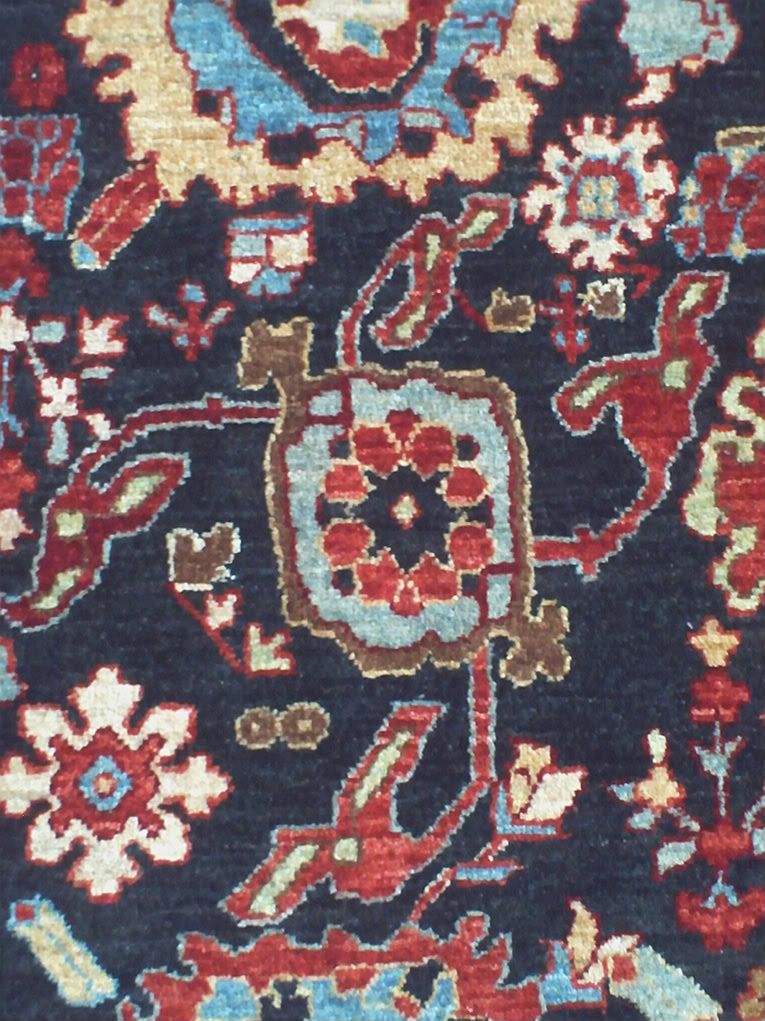
(The photo at the top of this story is a detail from Charles Robertson’s painting ‘The Bazaar Khan El Khaleelee Cairo’.)

#

RETURN TO HOME PAGE

#

Related Links:

Orientalist Art of the 19th Century

Orientalist Paintings (Gallery)

Sunday, 1 November 2009

Ottoman Court Prayer Carpets: The Mystery Of The Ballard Rug

NEW YORK, November 1, 2009 -- Perhaps the best known prayer rug in the world is this Ottoman court carpet woven in the late 16th century.

It is the so-called Ballard rug, named for the American collector James Ballard, who bequeathed it to the Metropolitan Museum of Art in 1922.

It is an amazing rug for several reasons.

First, it is the only surviving example of its kind. All of its sisters and brothers have disappeared with the passage of time.

And second, the origin of the pairs of columns in the design is one of the great mysteries of carpet history.

The mystery comes from the fact that the pattern is clearly inspired by architecture. But it is not the architectural style of the Ottoman Empire or even of any building on Ottoman soil that the weavers might have seen.

Walter B. Denny, a historian of Seljuk and Ottoman art, notes that “in the entire history of Ottoman architecture, from the 14th century onward, there is neither a tradition of slender-paired columns nor is there any tradition of faceted-column bases, nor round arches such as these.”

The main border of the carpet, however, is another story. Its tulips, carnations, rosettes, hyacinths, and leaves very much reflect the Ottoman court style of its time.

But if the architecture of the rug is an enigma, there could be at least one possible explanation.

Denny writes in his book ‘The Classical Tradition in Anatolian Carpets’ (2002) that “there is one place in the Islamic world with architecture that bears significant resemblance to that of the Ballard prayer rug.”

That place is at the other end of the Mediterranean from Anatolia, on a hilltop in Grenada, Spain. It is the Alhambra, and specifically, that Moorish citadel’s famous Court of the Lions.

The Alhambra was completed in the 14th century, one hundred years before the rise of the Ottomans. And by the time the rug was made, Grenada had already long been conquered by the Spanish kingdom of Castile and Aragon. So, the Alhambra hardly seems like something many Ottoman designers would have seen.

Still, the resemblance of the rug to some of the columns in the Alhambra’s courtyard is uncanny.

The courtyard, whose center is a fountain surrounded by small statues of lions, is itself surrounded by the pavilions. And the pavilions have the rug’s same triple-arch pattern that includes pairs of slender columns. The only difference is that the columns are arranged in a different order.

The idea that an artistic model for an Ottoman court rug could travel over time and space from once Moorish Spain to Turkic-ruled Anatolia might seem far-fetched.

But Denny sees it as just another possible example of how widely artistic inspirations can travel.

Carpet weaving in Moorish Spain, and in Catholic Spain for some time afterward, was heavily influenced by designs from Anatolia and, beyond that, the Silk Road as far as China.

“If artistic ideas could travel from east to west,” Denny asks, “then why not in the opposite direction?”

But who could have carried the ideas east?

The answer may be impossible to know. But there were people in motion at the time who could have provided the link.

They were Spanish-speaking refugees who began arriving in Istanbul, Salonika, and Sarajevo at the beginning of the 16th century as they fled the Inquisition.

Denny notes that many were Sephardic Jews and that this community had a connection with carpets. Some synagogues in Spain and in Italy had the practice of covering the Torah ark with a pile carpet that served as a “parokhet,” or curtain. The carpets were made on commission by Muslim weavers and the designs could be very different from the usual vocabulary of patterns the weavers knew.

The missing link between the Alhambra and the Ottoman court conceivably could be a prayer-rug sized parokhet like this one found by Italian carpet historian Alberto Boralevi in a synagogue in Padua, Italy.

The carpet is an intriguing blend of cultures. One of its most striking features is that the columns are drawn as in an Italian Renaissance painting -- from a single point of perspective. The makes the carpet a vivid example of ideas flowing into it only from different corners of the Mediterranean but even from different art forms.

Denny suggests that the Ballard rug may reflect a similarly complex Mediterranean synthesis unique to the 16th century.

He notes that the Ballard rug includes, in part, “elements of Ottoman court design (the borders and flowers in the field), Ottoman architecture (the small domes above the parapet), Ottoman adaptations of Egyptian dyeing and weaving techniques (the materials and construction), Islamic iconography (the hanging lamp and the triple gateway to Paradise), Italian one-point perspective (the column bases) and an adaptation of Spanish Islamic architectural forms that traveled east (slender coupled columns) perhaps in the form of a now-lost embroidered or woven parokhet brought to the Ottoman empire by Jewish refugees.”

If so, all this would make the Ballard rug a fitting symbol for the Ottoman empire at the height of its power in the 15th and 16th century.

The empire did not just physically straddle Asia and Europe, in many ways it did so culturally, too.

Mehmed II, who conquered Istanbul in 1453 was not only a warrior, but also an aesthete and scholar who spoke Greek, Latin, Persian, and Arabic, and maintained an extensive library. He was an enthusiast of both the Eastern and Western art traditions and had his own portrait painted by the Italian artist Gentile Bellini.

By the 16th century, the century in which the Ballard carpet was woven, Ottoman rule extended over the Balkans from Greece to the border of Austria, over Hungary and Crimea, over the Arab East and North Africa, and at times covered parts of Italy, Sicily, Poland and Ukraine.

One result was that craftsmen came to the court workshops of Istanbul from all corners of this far-flung empire and Ottoman patronage tended to reflect the diverse taste and styles of both Eastern and Western cultures.

Interestingly, many of the cosmopolitan and extremely sophisticated court designs these craftsmen produced went on to have a major impact on the folk art of Anatolia.

The Ballard carpet offers a superb example. Town and village weavers, taken by its graceful and exotic colonnade, adapted its design to their own rich tradition of geometric patterned prayer rugs.

The first adaptations spawned further generations of modifications and over time produced many distinctive village prayer rugs that were highly prized by European collectors in the 19th century.

This antique prayer rug was woven in Karapinar, not far from Konya in south-central Anatolia. The carpet is available to collectors from the Nazmiyal Collection in New York.

Denny offers this insightful description of how the Ballard carpet design entered popular weaving:

"The chain of stylization from the prototype to village weavings in the late 19th century is one of the most fascinating art historical metamorphoses in the Islamic world," he says.

“A sophisticated architectural idea, replete with Corinthian columns, faceted column bases, a parapet with flowers between the crenallations, small rumi split-leaf forms in the arch spandrels, and small domes on top of three half-round arches, gradually changes into a more formulaic type of rug. Finally, it succumbs to the creativity of village weavers who knew almost nothing of columns and arches but a great deal about color, and whose desire for top-to-bottom symmetry obliterates both the form and the meaning of the original design.”

Any discussion of the Ballard rug would not be complete without a few words about Ballard himself. His own history is no less amazing than the carpet that bears his name.

Ballard (1851 – 1931) was the son of a wealthy family in Ohio. But rather than enter his father’s timber business, he chose to join the circus and travel the country at a young age.

A natural entrepreneur, he soon moved on to starting drug stores and then manufacturing medical products. One of the most famous of his products continues to be a common product on drug store shelves today. It is Campho-Phenique, a salve for cold sores, and blisters.

In 1905, while waking down Fourth Avenue in New York City, Ballard passed an oriental carpet shop. A small piece caught his eye and he made his first rug purchase. He was 55.

Over the next 15 years, he amassed a collection of over 300 carpets, buying at auctions, from dealers, and traveling the world. By the end of his life, he had traveled over 470,000 miles through Southeast Asia, China, the Caucasus Mountains, India, Northern Africa, the Middle East, and all over Europe, mostly due to his interest in rugs.

As his collection grew in value, he first kept it in a fireproof and burglarproof vault in his home and then added a full-time guard. But his intention even from the start seems to have been to ultimately give his collection to museums.

Ballard’s gifts to the Metropolitan Museum of Art and to the St. Louis Art Museum in the early 1900s created two of the finest public collections of oriental rugs in America.

He put his reasons for collecting this way when he published a book on Turkish Ghiordes prayer rugs from his collection in 1916:

“It would seem to me that every many and woman should have a hobby of some kind – something sufficiently interesting to make it possible to forget for a time, the everyday cares and worries and get the mind into a new environment.”

As far as is known, Ballard never collected anything before oriental rugs and never collected anything after.

#

RETURN TO HOME


#

Wednesday, 18 February 2009

Can Europe's Tapestries And Village Rugs Survive The Global Carpet Competition?

HANOVER, February 19, 2009 – No-one is surprised anymore at how many Western consumer items are produced in Asia.

But it can be a shock to see how many Western handcrafts are rapidly going the same way.

All over Europe, there are merchants selling crystal vases and glassware that once were locally made but now are just as likely to be made in China. The same is true for Baroque porcelain figurines, pewter candelabras, and handmade lace. If store owners remove the “made in” sticker, many buyers never notice the difference.

The East's workshops are excellent enough, and low cost enough, that they not only successfully compete with Europe’s traditional artisans, they also are putting many out of business. The news in December that cash-strapped Waterford Wedgwood is ready to sell off its once star acquisition Rosenthal – the famous German porcelain and china maker – is just one example.

A recent walk around Domotex, the carpet world’s largest annual trade show in Hanover, Germany, shows that Europe’s textile heritage is also no stranger to the trend.

The carpet show brings together producers from Turkey, Iran, India, China, Pakistan, and Nepal. For four days, they meet and trade with the wholesalers who supply Europe’s retail stores and boutiques with the whole spectrum of low-cost to luxury-grade oriental carpets. The styles on show range from classical to tribal to contemporary styles, so one expects to see a bit of everything.

But what one does not expect to see is something like a Moldovan village rug – the kind that is filled with memories of Old Europe. And yet here is one hanging on the wall of an Indian carpet-maker's booth with its characteristic design of roses -- the same roses that Moldovan peasant women traditionally weave into their ankle-length skirts and colorful headscarves.

Standing near the Moldovan rug is its producer, R. K. (Raju) Rawat of Manglam Arts, Jaipur. He is an affable man in a checkered sports jacket who looks pleased when a visitor recognizes how much his rug resembles the originals.

Rawat, who produces about 50 Moldovan rugs a month, says he got the idea some five years ago. That was when he saw some genuine Moldovan rugs on sale at an earlier Domotex show.

"I was attracted by Moldovan designs because of their feeling of freshness," he says. "They make you think about roses and gardens, and everyone loves roses."

But the dealer says getting Indian weavers to reproduce them was not easy. "I found one particular village that was interested, and the weavers were very flexible, but it still took a few years because they had just some photos to work from, they didn't have the original piece in their hands."

He pauses and then adds proudly, "but they did it!"

Have the Indian Moldovans been well received? Certainly.

"We brought them to Frankfurt's 'Heimtextil' show where designers and architects come and they really appreciated them. Even people from Moldova come and say this is fantastic!"

Mr. Rawat is a businessman and perfectly within his rights to reproduce any design he likes. But one has to wonder. If distant weavers take over this bit of Europe’s heritage, how long will it be before the rugs’ real origins become first, irrelevant and, then, forgotten?

It is not just a question that interests Europeans. Vast amounts of Persian carpets are hand-woven outside of Iran and almost all Caucasian carpets today are woven outside of the Caucasus.

The foreign producers reformat and simplify the original designs to fit their own concepts of what the global market wants.

In the case of the Caucasian carpets known as Kazaks that are woven in Pakistan, Afghanistan and India, the market has grown so used to their deliberately harmonized styles that those few weavers still working in the Caucasus get little competitive advantage by sticking to their traditional and much more spontaneous patterns.

Thinking about such things prompts one to walk around the rest of the fair in hopes of finding some genuine Moldovan rugs on sale as Rawat once did. It’s a daunting task. Domotex is a huge trade show, with several aircraft hangar-sized rooms filled with hand-woven carpets.

The carpets sprawl across the floor space in a vast array of knee-high and thigh-high piles, so the vast hangars resemble a giant bazaar. The richest carpet producers have glass enclosures. Others simply sit among their wares.

Everywhere, muscular porters are flipping back carpets as buyers look on with calculators in hand. As sales are made, in lots of dozens of carpets at a time, the porters stack them, bundle them in black plastic, and haul them away.

It is like looking for a needle in a haystack but, amazingly, almost invisible among the mountains of oriental rugs, there is a little stack of Moldovans. They are at the stand of a Turkish dealer, Ozmelek Hali.

How did they get here? One of the salesmen tells what he knows.

Before the trade show, the company went around the Istanbul bazaar collecting them from other dealers because it knows the carpets interest some European retailers. The rugs came to the Grand Bazaar in the suitcases of Moldovan travelers, who sell them cheaply for cash.

The Istanbul salesman, who has the air of a hard-working family man, observes a moment of silence after what he has just said. Moldova is Europe’s poorest nation, with 20 percent of its population working outside the country and sending back money to support the rest. The rugs are as likely to be personal heirlooms as workshop pieces. One of them has an inscription -- the name Iornuvera M. -- and a date, 1964.

It's striking how detailed the original Moldovans are compared to the copies. They are old, many are coarse and with dull colors, but they are definitely interesting.

And, it seems, appealing. Soon, three Norwegian retailers stop by. They circle the stack of old Moldovans with the keen eyes of people who have spotted what they are looking for.

The two women and a man are partners in a small home-furnishings catalog company called 'Home and Cottage' south of Oslo. It’s the kind of company that specializes in supplying rough, unvarnished chairs and dressers that look like they were stored for generations in the family attic.

Kaj Roger, the male partner, says the Moldovan carpets fit well with cottage decors. "We have a lot of cottages in Norway," he confides, "and at the cottage it should be Old Style. It's a place to relax."

Does he mean the Moldovan carpets somehow represent good old days, a grandmother's weavings, memories of lifetimes past?

The three Norwegians, who are entering middle age, do not object to any of these suggestions. One of the ladies pulls out the latest Home and Cottage catalog. She shows a picture of a Moldovan carpet in mellow golden and rust colors spread across a rough wood plank cabin floor. Then she shows another photo of a carpet draped across an ocean steamer trunk. The pictures are contrived but comforting. Old, bygone Europe.

Rawat's fresh and more brightly colored reproductions are not likely to appeal to the customers of Home and Cottage. But there is every reason to believe he will find a market. There are many successful precedents right here at Domotex, and they are not hard to spot.

In the middle of the sea of carpets, there is a small island that serves as a landmark for visitors. It is a restaurant with a terrace of tables ringed by houseplants which manages to look like an outdoor Biergarten. The restaurant competes bravely against the outside caterers who move around the trade show with freezer boxes full of curries and pilafs for the carpet producers.

To have a stand around the restaurant guarantees high visibility, so some of the biggest Persian producers are there. But so is one of the strangest sights of all: a large enclosure full of French Baroque carpets and tapestries.

It is the stand of Renaissance Carpets, a New York-based producer. Inside, one whole wall is covered with a 12 by 24 foot (3.6 x 7.3 meters) tapestry depicting scenes from a 17th century boar hunt. It is amazingly detailed, with all the characters in period costumes.

A young salesman in a department store suit is standing nearby. He has come over from New York because, he says, the company's tapestries and Aubusson and Savonnerie carpets sell equally well in Europe and the United States.

Who buys them?

"People who have houses in a similar style," he says nonchalantly, as if lots of people in the 21st century live in Baroque manor homes.

And where are they made?

"In China."

The boar hunt tapestry, he explains, took three weavers seven months to complete, with a resident French artist overseeing the work. The cost is modest compared to the same piece woven in Europe. Just $ 18,000.

One can't help but admire the quality. If this is a copy, where is the original? In a museum?

"We own the original," the salesman says. The company bought it at an auction for $ 15,000. And with the purchase, it acquired the copyright.

One could ask more questions but suddenly there don't seem to be any left. If a copy can be this good-looking and inexpensive, there is no reason to insist -- except out of vanity -- that your replica French hunting tapestry should be woven in France. Who but an expert can tell if it is woven in China under a French tutor instead?

Or is that really enough? France today still has a viable tapestry industry that continues a rich cultural heritage. But as the market gets used to outsourcing, there is no certainty that it will have one forever.

One leaves Domotex with one's head spinning. Can art, whether it's in Europe, Iran, India, or Africa, be separated from its place of origin and history without simply becoming a commodity? And if it becomes a commodity, what can stop it from inevitably being reworked and simplified to appeal to the widest market, until its meaning and history are all but forgotten?

And, finally, if this is exactly what is happening with globalization, who should come to the rescue? The natural saviors are those who love the original carpets the most -- collectors. But collectors tend to collect carpets from the past, not the present. And doing so, they fail to support today's traditional artisans or guarantee the future.

Perhaps it's time to re-think the business of collecting. If the intention is to preserve carpets as a meaningful cultural patrimony, the efforts being made today may seem a lot less successful tomorrow than they do now.

(The photo at the top of this article is a detail from The Lady And The Unicorn tapestry series in the Cluny Museum, Paris.)

#

RETURN TO HOME PAGE


#

Related Links:

Market Trends Make Maintaining Traditional Designs A Struggle


In Afghanistan's Turkmen Rug Belt, It's Tradition vs. Globalization

Thursday, 5 February 2009

What Do People Want From Oriental Carpets? It Depends On The Country

HANOVER, February 6, 2009 -- Many rug dealers say they can tell what kind of rug you will buy as soon as they meet you. If they know your nationality, they feel even more confident.

One such dealer is Khairi Ezzabi, a Libyan who travels the world looking for luxury goods to import back home to Tripoli. He buys and sells in Europe, the Middle East, and Asia. Along the way, he has learned a great deal about all three markets.

We recently met Mr. Ezzabi in a zimmer frei in Hanover, Germany. The occasion was Domotex, the carpet world's biggest trade show that takes place every January. The show attracts thousands of people, more even than the huge number of hotels in this trade-fair city can accommodate. So, many visitors find themselves taking rooms in private homes, something that leads to impromptu acquaintances.

As the guests come down for breakfast, the lady of the house introduces them to one another. The table is set with all the riches of German hospitality and instantly puts everyone in a good mood. There is bread, rolls, butter, jam, and honey, plates of ham, salami, and different cheeses, soft-boiled eggs, oranges, apples, and slices of kiwi, and then, as if waiting for dessert, an assortment of sweet buns and pound cake.

The conversation flows easily.

"Please tell our guest that the salami is made of lamb, and the ham is made of chicken," Frau Ripphoff says in German. But before anyone can play the part of translator, the well-traveled Mr. Ezzabi waves away the need for words with his hand.

"I was here before, two years ago," he replies in English. "I remember her kindness from before."

Everyone is pleased. The small breakfast corner suddenly doubles in size with the expansive good manners of the East. As the windows slowly turn from night-black to grey with the late winter sunrise, Mr. Ezzabi fills a plate with pieces of bread, abstains from everything else, and takes time to talk.

He is a wonderful talker, punctuating with delighted giggles what he knows will be outrageous observations. But he also knows much of what he says will be true. After all, hasn't he seen it with his own eyes?

"What do people want from oriental rugs?" he asks, repeating a visitor's question. "They want different things."

The French, Italian, and Spanish want imperfection, he says. They want to be able to see where the weaver ran out of a particular color here or made a wrong knot there.

"The Parisians pride themselves on being able to recite the whole personal story of the carpets in their home." He giggles.

Visions of tiny, high-priced boutiques that offer just a few nomadic and tribal pieces float before the eyes. The Paris dealers are not selling rugs, they are selling flights of fancy -- like travel agents. Or it that too much of an exaggeration?

But Mr. Ezzabi is too charming to quibble with.

"The Germans," he continues, eyeing the perfect breakfast table before him but taking only some more bread, "want technical perfection."

In Berlin they like a proper relationship between price and workmanship. And they don't like stories that sometimes sound like excuses for a weaver's mistakes.

The Libyan dealer has been all around the world and clearly knows something of human nature. He lovingly pours a cup of strong black tea. He does not want to offend, he likes everywhere he visits. Should he continue?

Arab, Russian, and Bulgarian buyers share a third taste in carpets, he says. They will spend far more for a single carpet than anyone else. And it will be for a big carpet, to fill a big room.

"Prestige," he says. "They like black and gold colors."

It is impossible to know if Mr. Ezzabi has become rich with these formulas. He is dressed in a simple gray suit of light material that looks Italian but has an accent of hand-tailoring in a distant land. He is trim, with impeccably courteous manners, and middle-aged in way that is impossible to pin down.

What are things like in Libya, one asks. After all, one doesn't meet a Libyan businessman every day.

"I only know Tripoli and the capitals of the world," he replies. I am always traveling."

And the desert, with its starry night sky that shines so bright above the vast dark sands?

"The oil men say it is beautiful."

One can only wonder what kind of carpets he has come to Hanover to find. At the fair, there are carpets from everywhere: Iran, Turkey, China, India, Pakistan. What will he choose?

"I don't know yet," he says. "The last time I came I bought just one carpet."

The carpet was from Mirzazadeh, one of the most famous Persian producers from Tabriz. But it was not a classical carpet, it was a pictorial carpet with a scene from Omar Khayyam.

The cost was over 100,000 euros and the workmanship extraordinary, with some 2,000 knots per square inch (31,000 knots per square decimeter). He took it to Tripoli and put it in the window of his shop in the heart of downtown. Cars crashed into each other on the road when they passed by.

"People suddenly stopped their cars to stare at the carpet," he says. "They admired it because it is as perfect as a picture, as perfect as a color photograph. No one could believe it is just a carpet."

And did he sell it?

"No," he says. "It is excellent advertising for my shop. So, I keep it in the window. And I like it too much myself to sell."

(The photo at the top of this article is of a Mirzazadeh pictorial carpet.)

#

RETURN TO HOME PAGE

#

Related Links:

Mirzazadeh Carpets

Friday, 23 January 2009

Domotex 2009: Oriental Carpet Producers Brace For Economic Downturn

HANOVER, January 23, 2009 -- This time of year in Hanover, northern Germany, the sun barely appears before 8:30 and is gone by 4 pm. And all day long the North Sea wind hurtles into the city with nothing to stop it but the giant flags flapping over the city's sprawling fairground.

Still, hundreds of carpet producers and importers come here, bringing tons of oriental rugs from every corner of the world. They crowd into the fairground's hangers, employ an army of muscle men to stack the carpets in chest-high piles, and wait for thousands of European wholesalers to buy them.

The vast oriental souk is 'Domotex,' the carpet world's biggest trade show, and lasts for four days. During that time, producers and buyers strike contracts worth millions of euros. And they exchange information about everything from what retail customers want today to what they will buy tomorrow.

The talk is always a lively mix of business hopes and fears. But this year it is mostly about one thing: the economic downturn. All the producers, from Turkey, to Iran, to India are feeling the collapse of the housing market in the West because sales of home furnishings and carpets connect directly to the sales of new homes.

The connection is simple enough. When people buy new homes, they like to decorate them. But now the housing market slump that began in America is reverberating across Europe and people are trying to save or sell properties, not buy new ones.

Many producers predict the economic downturn will further polarize the carpet world into high-end and low-end producers. Mid-range producers, already under the stress of rising labor costs, could find it increasingly difficult to stay in business.

Habib Bayat is one of the partners of the high-end producer Bayat Nomad Gaminchi of Tehran and Los Angeles. He takes a moment to consider the trend as he and his daughter, who is also a carpet designer, show buyers their new collection.

The company’s stand, like those of the other top-quality producers at the fair, is a glass-walled enclosure that affords some refuge from the bazaar-like hubbub around it. Inside, like a showroom, the walls are hung with luxurious carpets in rich natural colors. One of them is already marked sold. It will be packed up by the muscle men and dispatched to a home on the other side of the world: Denver, Colorado.


Bayat says that the market downturn comes as many Iranian producers are struggling to retain weavers. “In the last three years, our pay to weavers has gone up two and-a-half times,” he says.

Even at the best of times, he notes, producers, cannot pass on such a sharp increase to the market. Now, with the economic downturn, the higher volume of sales that producers depend upon to offset higher costs becomes harder to achieve.

Why are weaving costs going up in Iran?

Bayat says there are two reasons.

One is an out-migration of weavers to other jobs, creating a bidding game among producers for the weavers who remain.

“In Iran, young people are influenced by what is on television, so girls don’t want to weave carpets,” he says. Instead, they want jobs in factories or in agriculture. People regard factory work as modern and guaranteeing a future – an image that traditional work does not have.

The second reason for rising costs is inflation. In Iran, inflation is in double digits, consistently cutting into the buying power of the rial.

Bayat, whose smaller rugs sell at $700 a square meter wholesale, serves a luxury niche that is unlikely to flee to lower-cost products. But even his company cannot afford to be passive. It stakes its future on a natural dye plant it built near Shiraz 16 years ago. To date, the plant has developed a palette of 140 vegetable dyes. That means continual R&D costs but gives the carpets a clear competitive advantage as they show off as many as 25 natural colors at once.

Most mid-range Iranian producers have no such strong capabilities to keep customers from looking for lower-cost alternatives. So, they worry, and one glance around Domotex is enough to see why.

All over the trading floor, there is a rising tide of competitors from India and China – weaving powerhouses that are able to make technically sound copies of Persian carpets. They can pass on their own lower domestic labor costs to consumers, and many consumers do not require Persian carpets to be woven in Iran.

At another stand, the Hamburg importer and exporter Djavad Nobari covers the floor with its specialty: over-sized Persian carpets. For two generations, the company has supplied 12-meter square rugs for European dining rooms and living rooms. But now, big rugs are not selling like they used to.

Shahin, one of the younger generation of the family-owned business, gives some statistics. “Four years ago, we brought 60 to 70 12-meter carpets to the trade show,” he says. “Now, we bring just 20 to 30.”

The biggest sizes that sell readily now, he adds, are 9-meter-square rugs. He says that reflects the slowing market – “2006 was the last great year” – and changing lifestyles. More and more European homes have high-gloss laminated floors that look nice with smaller, accent carpets. The days of covering dull, scuffed floors with room-sized rugs are ending.

Shahin, who was born in Germany, is fully in tune with European customers. So much so, that the current market downturn does not worry him as much as a longer-term cultural trend: the fading interest in oriental carpets among young people.

"The biggest problem in the Persian carpet trade is marketing,” he says. “We don't show customers how good a carpet can look in their homes.”

On his computer, he displays what he hopes will be the answer. It is a series of advertisements depicting contemporary living rooms with oriental carpets on the floor. The combinations are striking, including a curvilinear white Nain beside a geometric chrome and black-leather sofa.

It’s no longer enough for retailers to put a picture of a rug in the newspaper with their company logo over it, the dealer says. Carpet sellers have to make owning a carpet desirable -- desirable enough to weather market storms. And the current storm may be just the time to begin.

(Photos courtesy of Domotex and Djavad Nobari)

#

RETURN TO HOME PAGE


#

Related Links:

Bayat Nomad


Djavad Nobari


Domotex

Friday, 5 December 2008

Bespoke Carpets And The Fun Of Designing Your Own Oriental Rug

PRAGUE, December 5, 2008 -- One way the Internet is changing the oriental carpet business is by giving rug lovers the chance to directly contact producers.

It has not always been this easy.

Traditionally, customers have been separated from producers by numerous other people. The intermediates include wholesalers and retailers who, for their own good reasons, like to keep the names of producers vague or secret.

After all, who wants to be bypassed?

But now, anyone can find the names of rug production houses by simply doing a word search. A little Googling tells who produces Persian, Turkish, and Caucasian carpets, the subtypes they specialize in, and whether they use machine-spun or hand-spun wool.

And that opens a whole world of possibilities for people to directly commission their own carpets. If a producer agrees, one can even design one's own carpet or, more realistically -- because designing requires considerable experience -- modify an existing design to suit one's taste and fancy.

For those who want to play with designs, the first step is choose a model -- perhaps from a favorite rug book. Here is a Karabagh Tree of Life design taken from "Caucasian Prayer Rugs" by Ralph Kaffel (1998).

Now comes the challenging part. That is, finding a high-quality producer who works with the kind of rug type you like and who is willing to accept a single bespoke order.

Usually, bespoke producers will welcome commissions to produce large-sized rugs, but they are less interested in small-sized ones. And it is the smaller scale pieces that may best suit the individual customer because he is also going to have to pay the shipping and customs fees.

One artisan who is reviving traditional Caucasian carpets in Baku, but who is also willing to entertain single rug requests, is Vugar Dadashov of Azerbaijan Rugs. Like many producers with a sophisticated web page, he has become used to attracting the interest of not just retailers but individual rug lovers, too.

In the case of the Karabagh Tree of Life above, Dadashov saw no reason to refuse even a very unorthodox request. That was to let a child modify the design by choosing her favorite color for the background. The color choice? Yellow.

Yellow, of course, is not a color you usually see a lot in Karabagh rugs. But Dadashov and his designer accepted the whimsy of a child's world and in a few weeks mailed a cartoon of the modified design for inspection.

The cartoon flew airmail in an envelope covered with colorful postage stamps -- something as rare for a child to receive in this day of e-mails as, well, a letter from Azerbaijan.

After that, the project was in the hands of a single weaver. The weaver was just one woman because Dadashov believes reviving Azerbaijan's best rug-making traditions means letting weavers work again from their own homes. That restores individuality and, in the case of the yellow Tree of Life, makes one wonder how many design changes over the years came from women entertaining the whims of their own children and friends.

Weaving always takes months and one's anticipation rises steadily during that time. How much will the paper design change as it is transformed into a three-dimensional, pile rug? How different will the colors of the dyed wool be from those of crayons and colored pencils?

For adults commissioning a rug, these questions are entertaining enough. But for children, they are magical as they open the imagination to distant lands and ancient traditions.

And then, finally, there is a e-mail photograph of the finished rug. It is different from the design in many ways, yet also the same. In the upper-right is one more surprise: the child's name in Arabic letters and the weaving date according to the Hijri calendar.

The remaining step of actually getting the bespoke carpet home offers a quick education in several aspects of international commerce.

That includes the relative per-kilo costs of shipping via a foreign postal system vs. an international courier service. And, more interestingly, it includes learning about customs tariffs and where to collect duty-payable packages -- something that can take you deep into the heart of your own local postal system.

Still, one will emerge wiser and better informed about the rug trade.

One will learn that some imports -- like Afghan goods -- are virtually customs free because of bilateral government agreements to help develop Afghanistan's economy. And this, along with relative labor costs, is another reason why carpets from different countries can vary so greatly in price.

After that, there is only one more decision to make. To follow the trend by ordering more bespoke rugs, or to go back to shopping retail.

#

RETURN TO HOME PAGE

#

Related Links:

Azerbaijan Rugs

Saturday, 25 October 2008

Arts And Crafts Movement Carpets And The West's Longing For Simpler Days

LONDON, October 24, 2008 -- Is all great art defined by its ability to connect with the soul of a culture?

And, if so, is the soul of Western civilization to be found in simpler times than today -- for example, in the Middle Ages?

We won't presume to debate such points here. But it is interesting to note that one of the more enduring design trends of the modern age was founded on just these principles.

That, of course, is the Arts and Crafts movement of 1870 to 1910. Its designers drew on Medieval art to launch their own style of furnishings ranging from wallpaper to chairs to textiles. Incorporating influences from eastern art -- equally known to the Middle Ages -- they also created their own carpet patterns.

Many of those designs, originally woven in England and Ireland, continue to be popular in the West today. They are faithfully reproduced every year by European carpet producers whose weavers are now in Turkey, India, Nepal, and China.

The founding father of the Arts and Crafts movement was William Morris (1834 to 1896), photographed here at age 37. An architect, artist, and poet, as well as a social reformer, he devoted his life to battling what he saw as the dehumanizing effects of the machine age.

His enemy was real. In the late 1800s, the industrial revolution had already swept away much of traditional life in the West, including artisanal culture. Hand looms were being overtaken by power looms and individual craftsmen who made furniture were being replaced by factories that assembled it from machine-made parts instead.

The products the new industrial processes were ugly –- much less finished than they are today – but highly affordable and omnipresent.

Morris organized a coterie of like-minded artists and friends from his time as a student at Oxford to try to hold back the tide. They described themselves as “Fine Art Workmen” ready to “undertake any species of decoration.” And they took the Medieval Guild system of independent artisans as their model for rescuing workers, including children, from being cogs in the new machines.

The Arts and Crafts movement, as it came to be called, was obviously at odds with its era in every way. It idealized a bygone time when the consumer age was just beginning and full of confidence. And it idealized simplicity and fair artisan wages when Victorian homes were full to bursting with new and ostentatious manufactured goods thanks to labor that was intoxicatingly cheap.

But, amazingly, the movement was commercially successful almost from the start. Delving into Medieval art and other handicraft traditions for inspiration, the Fine Arts workmen created a rich Gothic style that connected with modern Britons the same way their allies the Pre-Raphaelite painters did, or the much earlier ‘Ivanhoe’ (1819) of Sir Walter Scott did. The only difference was that the artisans produced everything that was needed for a total living environment.

Here is the interior of Wightwick Manor, owned by a wealthy patron of the style. The effort to turn the home into a temple of art impossible to build from mass-produced items is fully visible.

All that is in line with Morris’s maxim: “Beauty, which is what is meant by art, using the word in its widest sense, is, I contend, no mere accident to human life, which people can take or leave as they choose, but a positive necessity of life.”

This carpet is entitled “Bullerswood” and was woven by Morris & Company, London, in 1889. Its design of scrolling arabesques and stylized flowers and birds is colored with a range of vegetable dyes. It is a prize of London’s Victoria and Albert Museum but its huge size – 4 meters by 7.5 meters – prevents it from being on permanent display.

The Arts and Crafts movement did not completely reject machines and did use some, including for weaving. But its insistence on the finest workmanship eventually priced the products out of all but the wealthiest households. So, the artisans never realized their utopian dream of turning every man’s home, even the most ordinary, into an earthly paradise.

But the movement did set the stage for later schools of design which more populary raised interior design to the level of a fine art. They include the American version of Arts and Crafts, which made much more extensive use of machines to lower the cost of craftsman-produced furnishings. They also include Art Nouveau and Art Deco. In all these styles, the handicrafts of Medieval Europe and borrowings from Islamic and Asian sources remained major inspirations.

Morris once acknowledged his debt to Oriental Art this way:

"To us pattern designers, Persia became a Holy Land, for there in the process of time our art was perfected, and from thence it spread to cover for a while the world, east and west."

Today, Morris remains the best-known face of the British Arts and Crafts movement but he is far from its only successful practitioner. Other leading designers are Gavin Morton and G. K. Robertson, who created this carpet woven in Donegal, Ireland, circa 1900:


Original Arts and Crafts carpets now command high auction prices that put them beyond the reach of most collectors. But the patterns are so popular that many are readily available as reproductions. That includes this replica of a carpet designed by architect and painter Charles Voysey:

The design is "Duleek" -- named after one of the towns near Donegal, where the carpet was woven in the 1800s.

A quick look through the internet shows reproductions of designs like this one are available from $ 25 - $ 50 per square foot ($ 269 - $ 538 per square meter). Those low prices are not due to the use of machines, as the artisans of the Arts and Crafts movement might have feared. Instead, they are due to globalization and the outsourcing of Western hand weaving to the East, a future they never envisioned.

(Note: the picture at the top of this article is a detail of the central field of "Holland Park," a carpet designed by William Morris in 1883.)

#

RETURN TO HOME


#

Related Links:

On the Arts & Crafts Movement:

Interactive Textbooks: The Arts and Crafts Movement

The Arts and Crafts Society

On William Morris:

Wikipedia: William Morris

William Morris Gallery

The Textile Blogspot: William Morris Carpets

The Earthly Paradise: Bullerswood Carpet

Arts & Craft Carpet Reproductions:

J.R. Burrows & Company

The Craftsman Home

Michael Fitzsimmons Decorative Arts

Jax Arts and Crafts Rugs

Poster: Donegal Rug by Morton and Robertson

Wednesday, 10 September 2008

In Harry Potter's World, The Carpet Is A Harshang Bidjar

LONDON, September 12, 2008 -- Is a Bidjar Harshang-patterned carpet quietly becoming the most popular rug of the next generation?

It’s possible – if you think that being visibly featured in Harry Potter films is likely to impact future rug buyers’ tastes. That is, ‘future’ in the sense of today’s children growing up to be tomorrow’s rug lovers.

But before going further, it may be necessary to explain a little about Harry Potter’s world.

Harry, the boy magician, goes to Hogwarts, a school of magic. The school is modeled very much on the great British universities such as Oxford, so Harry lives in a 'House,' or dormitory, with a common room where the resident students can gather informally anytime of day.

Harry’s ‘House’ is 'Gryffindor' and the floor of the Gryffindor common room is covered by a giant Bidjar with a Harshang pattern on a brilliant blue background.

Here, Harry (right) and his two close-friends Ron (center) and Hermione (left) meet in the common room in a scene from one of the seven Harry Potter films.

The carpet shows up in most film scenes of the Gryffindor common room and, along with tapestries on the walls, gives the room a very magical, wizard-like feel. The non-figurative Harshang design, which conjures up zodiac-like images of crabs and bursting suns, is perfect for the role. (It also goes well with the wallpaper, which reproduces 'The Lady and The Unicorn' tapestries from the Cluny Museum of Medieval Art in Paris.)

Is it entirely an accident that a Bidjar Harshang almost identical to the one shown below was chosen by the set designers?

Maybe not. More than a few Europeans and Americans who are now deep into adulthood have memories of oriental carpets in university rooms. And a generation earlier, rugs were far common.

Bidjars are the natural choice for such high-wear settings. Produced in and around the northwestern Iran town of the same name, they are the most strongly made and indestructible carpets of all.

Their nickname, after all, is the 'Iron Rugs' of Persia. They are so densely woven and stiff that they cannot even be folded for transportation. Instead, they have to be rolled up.

Below is a photo of the library room in Eliot House at Harvard University. On the floor – again -- a Bidjar Harshang. Only this time the carpet has a red background.

Seeing an oriental carpet in a university common room may not just be nostalgic for lots of adults who watch Harry Potter with their children.

It also is a reminder of the huge export industry which once thrived in northwestern Iran producing room-sized rugs of all types for wealthy Western institutions and homes.

The peak was at the turn-of-the-last-century, when an oriental rug on the floor was the symbol of both a wide view of the world and of a certain standing.

The story of this export industry is well illustrated by the success of Ziegler & Company. The Anglo-British firm based in Manchester, England, was among the first to realize that the West’s ‘Gilded Age’ needed giant rugs that complemented Western room decors of the time.

Arto Keshishian, writing in the magazine Antiques and Fine Arts, gives the background in his article ‘Ziegler and Their Carpets.’ He notes that by the 1850’s Europe’s cyclical interest in the orient was on the upswing again and department stores began stocking up on the existing village and workshop carpets available in Iran.

But, he writes, "unfortunately, the carpets were generally either too long or too narrow for the rooms of the new English homes, because the imported carpets were designed in a traditional format to fit urban, Persian rooms."

The Ziegler Company saw an opportunity. At the time, it was selling printed cottons produced by the Manchester mills to customers in Iran and Turkey. But it changed direction, set up its own looms in northwestern Iran around the town of Sultanabad (now Arak) and began supplying hand-woven carpets to the British market instead.

Ziegler and Company revolutionized oriental carpet production by enlarging the sizes and simplifying the patterns. The company’s artists introduced more space between traditional Persian design elements to achieve, in Keshishian’s words, “an airy visual effect.”

At the same time, “fewer color combinations were used, resulting in a simpler balance and harmony; the color green was liberally incorporated, perhaps to echo the English fondness for the countryside.”

Ziegler did not produce Bidjars and its designs, as shown here, look nothing like the carpet spread across Harry Potter’s floor.

But the principles Ziegler exemplified offer some time-tested guidelines as to how carpet producers respond to changes in the market and supply what each new generation wants.

Will the next generation surprise its parents by switching back from the abstract, tribal carpet designs popular today to the lush feel of turn-of-the-last century Bidjars and Zieglers? Only the next generation can answer and, at the moment, its members are still window-shopping – or should we say movie-shopping – the options.

#

RETURN TO HOME PAGE

#

Related Links:

Barry O’Connell’s Carpet Guide: Bijar Rugs


O’Connell Notes: Bidjar Rugs and Carpets


'Ziegler and Their Carpets' by Arto Keshishian

Thursday, 28 August 2008

Brussels Celebrates Savonnerie Carpets With 700,000 Begonias

BRUSSELS, August 29, 2008 – Every summer, Brussels weaves a giant carpet of begonia blooms that covers almost the entire Grande Place.

The flower carpet does not last long: just three days and four nights. And the amount of work is immense, with hundreds of volunteers arranging some 700,000 begonias (knot count of 300 flowers per square meter) into a meticulously planned pattern.

Still, Brussels considers the effort worthwhile.

The annual event, which began in 1971, reminds the world that Belgium is the world’s biggest producer of begonias -- exporting about 48 million bulbs a year.

Plus, the flower carpet reminds everyone that Belgium also is one of the world’s largest makers and exporters of carpets -- machine-made.

This year, the floral design (above) honored France’s Savonnerie carpets. Doing so, it recalled the days when European weavers first “Occidentalized” oriental rugs on a commercial scale, setting the stage for today’s immensely successful Western rug industry.

Savonnerie carpets were first produced in the early 1600s and combined Eastern pile-rug weaving with French Baroque designs. The success of the patterns – whose motifs include flower bouquets, fleur-de-lys, fruits, and acanthus leaves – was so great that it swung European taste away from oriental rugs for two centuries.

Here is a Baroque carpet in the kind of typical French interior design that defined Western standards of elegance at the time.

Just how Europe developed its own handwoven carpet industry is a fascinating story with two parts.

The first is the deliberate effort by French kings to monopolize the luxury carpet market in Europe, which was previously supplied from the East.

The second is the coincidence of this effort with a sudden feeling of Western cultural superiority as Europe’s kingdoms first became world powers.

Some steps along the way:

* King Henri IV (1533 – 1610) decides to revive France’s luxury goods industry, which was decimated in France’s wars of religion. He provides leading artisans, including weavers, with workshops in the Louvre.

** Weaving master Pierre DuPont establishes the style that will become famous as “Savonnerie.” The name is taken from the Paris soap factory which becomes the location of a major carpet workshop in 1644.

*** European forces defeat the Ottoman army besieging Vienna in 1683. The victory convinces High Renaissance Europe of its cultural supremacy over its Eastern rivals.

**** King Louis XIV bans the import of oriental carpets into France, protecting French production and ending the huge outflow of revenues to buy luxury goods from the East.

Europe’s handwoven carpets had many variations, including Savonnerie and Aubusson in France and, later, Axminster and Wilton in Britain.

Here is a 19th century Aubusson carpet from France. The carpet is available to collectors from the Nazmiyal Collection in New York.

Such carpets were commissioned only by courts and by the very wealthy. Their patterns proved adaptable enough to be a centerpiece of furnishing from the Baroque and Neoclassical periods into the Napoleonic era.

It was Napoleon, in fact, who gave the Savonnerie factory its last great royal support. Beginning in 1805, he commissioned carpets in the Empire style that defined his age.

The Savonnerie’s story finally ends in 1825 when the manufactory was incorporated with another weaving workshop, the Gobelins, which was famous for tapestries. By this time, the passion for European handwoven carpets had faded under a new set of social circumstances.

Among them was colonialism. As Europeans expanded across the globe, they came again into direct contact with oriental artwork and renewed their interest in it. By the mid-1850’s imports of oriental rugs were booming, along with Orientalism in general.

But perhaps still more fateful for the European hand-knotted carpet industry was the invention of the steam-powered loom in 1785. Carpet producers quickly discovered they could earn much more with mass production for the expanding middle class than they could with artisinal production for just the very rich. Within 50 years, the great names in European handwoven rugs disappeared or became associated with machine-made carpets instead.

Today, one can still buy Savonnerie carpets but they are reproductions hand-made in China. And one can still buy Axminister carpets, but they are machine-made in England (as pictured here).

Does all this make Brussels' Savonnerie flower carpet a bittersweet souvenir of Europe’s rug-making industry?

Champions of hand-knotted carpets might say ‘yes’ if it reminds them too much of a glorious past gone forever.

But one can also argue that history must take its course and that the way Savonnerie carpets evolved into today’s multi-billion dollar machine-made carpet industry is as amazing as any other aspect of the rug trade.

If so, the Savonnerie which bloomed in Brussels' Grande Place this year from August 15 to 17 is a perfect symbol for Europe’s carpet world.


Related Links:

YouTube: Brussels Flower Carpet 2008 - Savonnerie

Brussels Flower Carpet: official website

Wikipedia: Savonnerie

Early Axminster Carpets, by Brenda Rose

Renaissance Carpets and Tapestries Company