Showing posts with label oriental carpets. Show all posts

Sunday, 16 August 2009

The Silk Road, The Camel, And Oriental Carpets

PRAGUE, August 22, 2009 -- Could the Silk Roads have existed without camels?

After all, for thousands of years before and during the Silk Roads the wheel also existed across all of Eurasia, and wagons were used to carry heavy goods for long distances

The Central Asian nomads, for example, commonly used wagons to transport their possession across the steppes and at times even put their yurts – their round, rigid tents – on wheels to transport them.

And at both the Eastern end of the Silk Roads in China and the Western end in the Middle East, the countryside was teeming with on- and off-road wheeled vehicles of all kinds, from horse drawn chariots to carts to wagons.

The answer to why, despite this, the Silk Roads became entirely camel-driven can be found in a fascinating book by historian Richard W. Bulliet. The book is ‘The Camel and the Wheel’ (1975).

Bulliet explains how the camel, which became a transport animal long after the horse, proved so efficient for moving cargo that it not only made the Silk Roads possible it also completely replaced the use of wagons across a vast swath of the Middle East, from central Turkey to North Africa.

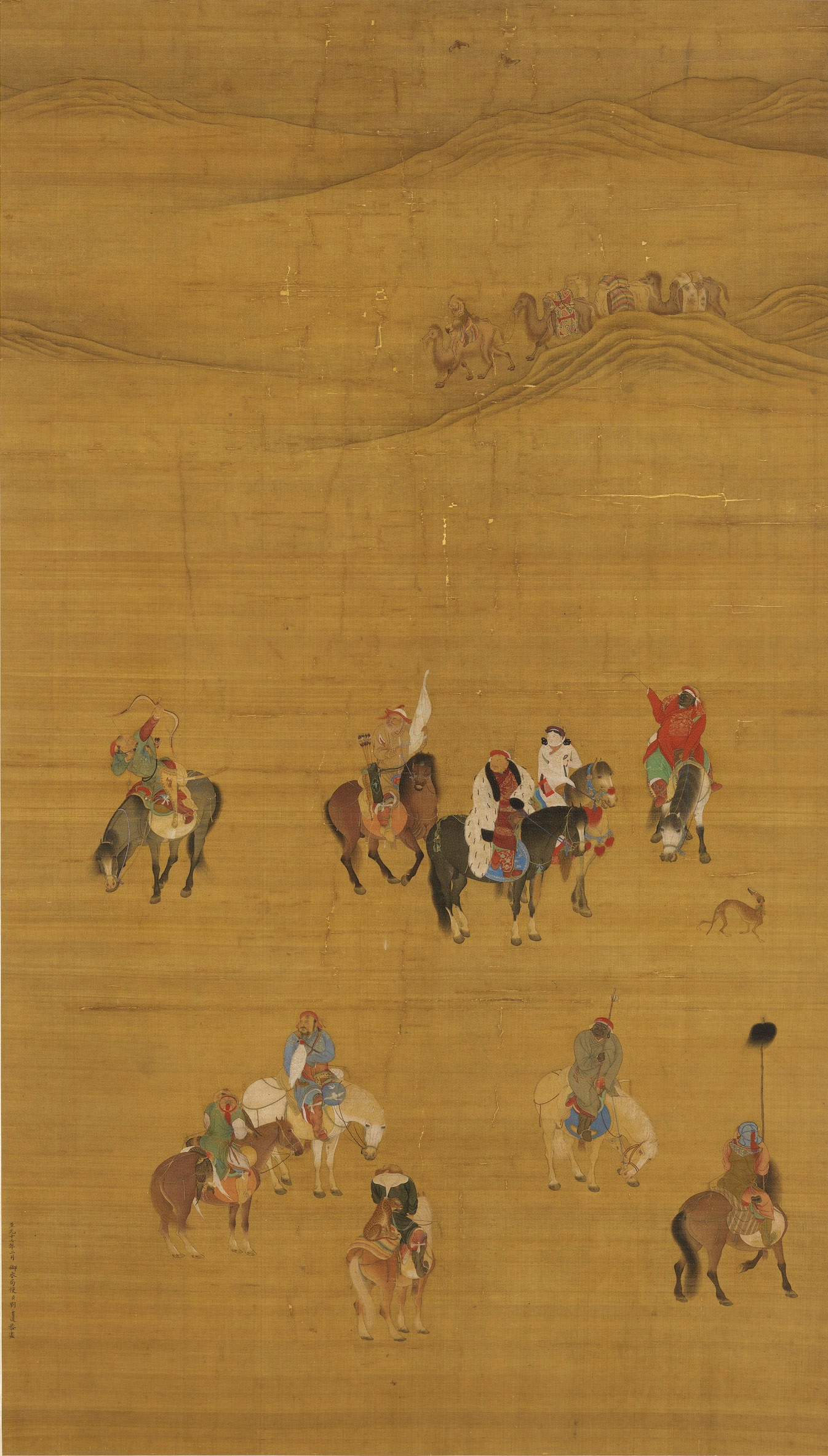
Here is a Chinese scroll painting from 1280 by Liu Kuan-tao showing a camel caravan carrying carpets in the background of a scene of the Mongol emperor Kublai Khan hunting. For a close up: click here

What were a camel’s advantages over wheeled vehicles?

For one, a camel can match horse or ox-drawn wagons for load and speed. A camel can carry 300 to 500 pounds on its back and, walking at speed of two and-a-half miles an hour, travel 20 miles a day.

But where wagons are expensive to build and operate, a camel is relatively cost-free.

Its saddle requires little wood, which is a valuable commodity in arid parts of the world.

And unlike horses and oxen, camels don’t need special fodder or much water. They can eat desert plants and – when unburdened – go as much as two weeks without a drink of water. And when they do drink, they fill up fast, at the rate of 28 gallons in 10 minutes.

Best of all, once a camel drinks water, he does not lose it again quickly – thanks to an amazing physiology. A camel’s feces are dry and its urine viscous. It sweats only after first tolerating a rise in its body temperature of a full 10 degrees Fahrenheit. And when it does start perspiring, it can survive a water loss of up to one-third of its body weight, then drink again and continue on its way.

All these factors made camel caravans incredibly cost-effective for overland travel.

Bulliet writes that the Romans, for example, estimated camel transport was about 20 percent cheaper than wagon transport, according to an edict on prices issued by Emperor Diocletian in the third century AD.

And it's interesting to note that once the cost-effective camel, supplemented by donkeys for lighter loads, displaced the wheel in the Middle East, the wheel did not return again until the age of the automobile.

A French traveler, Volney, observed in the 1780’s that “"It is remarkable that in all of Syria one does not see a single cart or wagon."

Bulliet says that the evidence of that total displacement of wagons can still be seen today in the patterns of the narrow streets in the historic old quarters of many towns:

“Although camels themselves were not too widely used within the walls of medieval towns, it was they who caused the tradition of wheeled transport to vanish; and it is the absence of carts and wagons that accounts in large part for the layout of medieval Middle Eastern cities,” he writes.


On the Silk Roads, two-humped camels were used from China through Central Asia and one-humped camels were used in the Middle East.

At either end, the physical challenges for the camel caravans that trekked across the vast distances involved were staggering.

Many historians like to describe the journey as equivalent to crossing an ocean – an ocean which stretched across almost the entire width of Eurasia.

There were caravansarais in accessible areas where the camels and merchants could rest, sometimes even at the end of each days’ journey. But there also were inaccessible areas that had to be crossed at risk of life and limb for days at a stretch.

Marco Polo, the Venetian traveler of the 13th century, provides vivid descriptions of some of the dangers in the account of his travels from Venice to the court of Kublai Khan in Khanbalik (modern Beijing):

* The Pamirs -- From here, one travels three days east, always climbing, until you reach gigantic mountains which are said to be the highest in the world.

* Taklamakan Desert – Those who venture here must take great care not to become separated from the others … because if they lose contact with their fellow travelers, they will only find their friends again with great difficulty, for all around them arise other voices which seem to call their names. From such hallucinations, many who cross (these singing sands) perish.

* Che-Si Corridor, near Kanju, China – Travelers do not dare to enter these mountains with any animals … because here a certain plant grows which is so poisonous that any animal who eats it is lost.

As Bulliet points out, a camel easily outperforms any other beast of burden in such in extreme places because, in fact, such places are its natural habitat.

For eons, the camel’s survival strategy has been to safeguard itself from predators by staying away from them. Over the course of its evolution, it deliberately abandoned the grasslands for the desert, where most predators cannot stand the extremes of heat and drought. And in this way, though it is totally defenseless and usually moves slowly, it has thrived.

Man originally domesticated the camel for milk and food. But those uses are negligible compared to the possibilities it offered as a pack-animal for long-distance travel and, ultimately, cross-continental caravans.

The caravans of the Silk Roads could involve hundreds of camels at once, with a combined carrying capacity equivalent to a sea-going ship of their time. They were highly organized and carried not just goods but paying passengers along regular and established routes.

A detailed idea of how they worked can be had from accounts as recent as the 1920’s, when camel caravans were still common in China’s eastern Xinjiang region – once a major crossroads of the Silk Roads.

This description comes from Owen Lattimore, who chronicled his travels with a caravan in his book 'Desert Road to Turkestan' (1929):

“A caravan could consist of 150 or so camels (8 or more files), with a camel-puller for each file. Besides the camel-pullers the caravan would also include a xiansheng (literally, "Sir" or "Mister," who was typically an older man with a long experience as a camel-puller, now playing the role of a general manager), one or two cooks, and the caravan master, whose authority over the caravan and its people was as absolute as that of a captain on a sea ship. If the owner of the caravan did not travel with the caravan himself, he would send along a supercargo - the person who will take care of the disposal of the freight upon arrival, but had no say during the travel. The caravan could carry a number of paying passengers as well, who would alternate between riding on top of a camel load and walking.”

The bonds that the camel handlers formed with their beasts can still be seen in traditions that remain strong in some places today.

One is the sport of camel fighting – a sport which, unlike many animal fights, was developed to entertain spectators while minimizing the danger for the camels, which were too valuable to put at risk.

The picture here of a camel fight is from 1585, painted by Abd as-Samad in Mughal India.

Camel fights still draw crowds of camel devotees in Turkey in the winter, which is the camel’s mating season and the time when males will try to knock each other down to win the females’ attention.

The battles are not unlike Sumo matches.

To start, specially bred camels weighing as much as a ton are led toward each other. Sometimes, one will run away just at the sight of the other. Usually, they crash into each other and then begin a shoulder-to-shoulder shoving match.

Injuries are rare because the camels, which usually hurt each other by biting, have their mouths tied shut. But the camels are full of tricks with their front legs and long necks, which they use to trip each other in skillful ways.

The fight ends when one camel flees, neighs out a call of surrender, or falls. The action, which can be hard to follow, is breathlessly called out play-by-play by a sports announcer.

Camel wrestling devotees in Turkey trace the sport back to the nomadic and caravan days of the region. The matches are spectacles that involve whole towns, with the camels paraded through the streets beforehand decked in mirrored blankets, bells, and colorful pompoms and accompanied by drummers and folk dancers.

Curiously, in a strange nod to the camel populations of both the Silk Roads’ eastern and western ends, the best fighting camels in Turkey are bred by mating a female camel with a single hump with a male camel with double humps.

What kind of prizes are at stake? From the sport’s earliest origins until today, that has never been in question. There is money to be made by betting, of course, but the symbol of victory that is awarded to the winner by the organizers is a carpet.

These days, the carpet is usually machine-made and of little value. But the practice recalls a time when, centuries ago on the Silk Roads, carpets were as much a form of currency as money.

(Illustrations from top to bottom: Tang dynasty terra-cotta camels, 618-907AD; Silk scroll painting of Kublai Khan Hunting by Liu Kuan-tao, 13th century; detail of camel carrying carpet from Liu Kuan-tao’s scroll; map of major Silk Road routes; NASA satellite image of Taklamakan desert; Bas relief, camel, Palazzo Mastelli, Venice; Mughal painting, 1585; Camel match, Selcuk, Turkey, 2000.)

Related Links:

Richard W. Bulliet: Why They Lost the Wheel, Saudi Aramco World, 1972


Stephen Kinzer, New York Times: On a Winter's Weekend in Turkey, The Camel Fight Is the Place to Be

#

RETURN TO HOME

#

Thursday, 6 August 2009

Istanbul: When The Grand Bazaar Was The Center Of The Ottoman World

ISTANBUL, August 15, 2009 – For centuries, the world greatest emporium for buying carpets was Istanbul, the capital of the Ottoman Empire.

And, specifically, the address was the Grand Bazaar, the richest and most popular shopping palace in the city.

The Grand Bazaar was the biggest terminus of the Silk Roads that moved west across Eurasia and it was to here that carpets and luxury goods of every kind flowed.

The Ottoman Empire itself, one of the world’s largest empires from its founding in the 14th century to its decline beginning in the 18th, was the biggest customer. But merchants from all over Europe also came to buy the goods wholesale and take them home for resale.

What could you find in the Grand Bazaar? What couldn’t you find in the Grand Bazaar!

There were rugs from Central Asia, from the Caucasus, from Anatolia. There were rugs smuggled by the tons across the border from Persia, the Ottoman Empire’s great eastern rival. The border was often officially closed but the carpet trade was so lucrative that both sides turned to a third party – their Armenian populations – to act as the go-between for the business and let them freely cross the frontier.

The carpets were sold in the Grand Bazaar along with rich silk and brocaded fabrics, precious stones, gold, silver, pearls, shoes, books, and jewel-encrusted weapons. The value of the goods was reflected in the rent merchants paid to occupy a space in the bazaar: many times more than for anywhere else in the city. And the bazaar extended through miles and miles of covered, labyrinthine lanes.

The story of the Grand Bazaar is told in a book of the same name written by the late Celik Gulersoy in 1980.

Gulersoy, a leading historical preservationist, conjures up the atmosphere of the bazaar in the Ottoman era through the impressions of Turkish and European writers of the time.

One vivid account comes from a French traveler in 1877, during the last years that the Grand Bazaar could still be seen in its original form. The writer, M. de Gasparin, is an incurable romantic. But there is clearly enough color in the bazaar to spark any imagination:

“An Arab, with his spear in hand, sitting surrounded by the Persian shawls which he brought by his caravans, used to walk after a long row of camels in the desert. Another merchant is from the depths of Central Asia. Another one, with a thin face and pale complexion, has passed the sand and the seaside beaches of Syria on horseback and brought golden colored silk from Lebanon and soft clothes and pleasant scarves from Tyre and Sidon ... Egypt has sent that nearly black-skinned merchant who has brought the heavy cloth of that country, a mixture of silk and wool. This thin-faced bronze, tanned man comes from Morocco, leaning against milk-white threads and lapis blue dresses. Wherever these men may have been, whatever adventures they may have lived and whichever foreign country has injected the traces of other skies into their faces, their brows have lost nothing of their majestic nobility and their meaningful eyes have lost nothing of the depth that comes from authority, self-respect, and self-assurance. These merchants do not call the passers-by to their shops. They do not even have an inviting attitude; one could sense no greed in them, nor any worry in their posture … If a buyer came, ‘Masallah,’ if no one entered their shops, ‘So what?’”

That is a very different image than the bazaar of today, where hustling a customer is the rule. But the Ottoman bazaar was a very different place before Turkey modernized at the turn-of-the-last century.

The traditional arrangement was for the traders to line both sides of the bazaar’s covered streets. Not standing in the doorway of walk-in shops like today, but sitting on divans with nothing behind them but a large cabinet or a set of shelves. The cabinets, fixed to the walls, showcased some of their wares and hid the rest.

“The space occupied by any one of these tradesmen was generally small, about six to eight feet in length,” Gulersoy says. “In the bazaar jargon, these were known as ‘dolap’(stalls) and they had a depth of about three to four feet. Sometimes they were separated by thin curtains or wooden latticework partitions. It was possible for the customer to sit on the divan next to the tradesman and examine his choice while conversing in an easy, comfortable manner and drinking coffee or smoking a ‘long pipe.’”

At night, the cabinets were closed up.

Why did the merchants favor this open-street arrangement for the bazaar?

One reason, says Gulersoy, was “the old traditional practice of women covering their faces in the presence of men. There was a need to prevent women from having to enter closed places where there were men. There was a tendency to resolve all social matters out in the open.” He adds that “the custom was that all the shopkeepers, Muslim and non-Muslim, sit on their benches quietly and only answer when the customer directs as question at them.”

The Ottoman Grand Bazaar was not just the richest shopping center in Istanbul, it was in many ways its economic heart.

Its core, two separate covered markets called the Inner and Outer Bedestan, was built by Mehmet soon after he conquered Constantinople in 1453. Over the following years, the streets between the two covered bazaars were covered over, too, along with the surrounding streets, creating a covered city.

This covered city was not just a marketplace but a bank, too. The Inner Bedestan, built with walls 1.5 meters thick that stand to this day, was Istanbul’s 'coffre fort' where the richest citizens could keep their valuables in security. The Inner Bedestan also had the city’s wealthiest merchants, who lent money at interest for business ventures and themselves might own trading ships or major shares in camel caravans.

When sultans wanted to impress the citizenry with the Ottoman Empire’s wealth, or celebrate special occasions, they would sometimes call out the Grand Bazaar's merchants to parade in public. One Turkish observer of such a parade, Evilya Celebi, wrote this account in the early 1600s:

“Sultan Murad IV, before the Baghdad campaign in the year of the Hagira 1048, summoned the authorities to his audience chamber and said, ‘If I conquer the city of Baghdad in this expedition, I want all the soldiers and shop owners of Istanbul, according to the old regulations, with their guild wardens, sages, sheiks, stewards, Aghas, guild caretakers, and guards, to parade in front of Alay Kosku (a pavilion not far from the Grand Bazaar formerly used by the sultans to watch parades) both on foot and horseback, in groups, with eight military bands playing. Take down all these instructions correctly. Those who supply false information, I will cut in four.”

Celibi then describes the merchants as they march with their wares. Some of them ride on carriages decked out like parade floats:

Carpet dealers – 40 shops and 111 men. They parade with their 'mounted shops' adorned with Thessaloniki, Ushak, Kula, Egyptian, and Isfahan rugs.

Silken Robes of Honor dealers – 5 shops and 105 people. This guild joins the parade weaving the seven types of the Royal Robes of Honor and adorning the robes.

Not just the merchants and craftsmen parade, so do the hundreds of officials and employees of the bazaar:

The Trade Watchmen of the Inner Bedestan – 70 persons. The head of these is the second officer of the Sultan’s black eunuchs. These are all guaranteed people, devout Muslims who light the oil lamps in the Market Hall … when their post is vacated … the vacancy is filled by one of the Bedestan porters who is worthy of the post.

The Porters of the Inner Bedestan – 300 persons. Each night they carry the tradesmen’s chests and merchandise to the outer cellars of the Bedestan, stacking them there as a safeguard against fire. These porters parade with their load supports on their backs, rope in hand, and sword in belt.

The Market Hall Criers – These men have warrants and trade charters and are magnificent and trustworthy men who serve in the Inner Bedestan. All of them join the parade with jewelry on their clothes, wearing swords, double-edged scimitars, fur, and other valuable clothes.

And on, and on.

As the parade suggests, the Grand Bazaar was a highly organized institution, as much or more than an urban shopping mall today. Its administration was overseen by the royal court and its commerce was carefully regulated by a guild system.

The guilds insisted that all the merchants of a single trade be located in a single street or area of adjoining streets in the bazaar. The close seating arrangement was a form of price control because it prevented individual merchants from underselling their fellow guildsmen or overcharging and driving away customers.

Today, the Ottoman market has long since become a free market. The guild system, abolished in 1913, has given way to shop owners of all kinds mixed together and competing for the highest prices.

It is ironic for visitors to realize that today's hustling chaos is a world removed from the calm, rich, self-satisfied air of the Grand Bazaar’s heyday.

Just how different was it?

Gulersoy tries to answer the question this way:

“While gold poured down on the Throne City, the Covered Bazaar was also filled with gold, silver, silver thread, silk, jewelry, and crystal. But when the empire fell, the pale and dead colors of the sunset reflected on these walls.”

He adds: “the mood of Istanbul in each period is shown in the Grand Bazaar … certain other ages came, and copper took the place of gold and bead that of pearl.”

Today, the Grand Bazaar is only one of many places in Istanbul to buy carpets and there are many opinions about which is the best.

But the Bazaar does offer one thing that no other venue can provide. That is, 1,500 years of history and the sense that, like the starting price of a carpet, there is more to the story than meets the eye.

#

RETURN TO HOME PAGE

#

Thursday, 14 August 2008

Every Era Sees Oriental Rugs It's Own Way

PRAGUE, August 15, 2008 -- Oriental carpets have caught the eye of Western writers ever since they began trickling into Europe in the 13th century or earlier.

But how Western writers look at these exotic creations has changed dramatically over the years.

In the early days, carpets were symbols of impossible luxury and power. They helped seal alliances between the Ottoman court and European kings, and ambassadors carefully recorded their acceptance and delivery.

Just what potent symbols these objects of art could be is apparent in this brief description of the victorious Sultan Suleyman II summoning the Hungarian king John to him immediately after the battle of Mohacs in 1526:

“Along the short mile the King traversed to go to the Emperor, Turkish and various fine carpets were laid on the earth as far as the tent of the Emperor.”

The words belong to the Hungarian royal chaplain George Szerémy, who was there. The picture of Sultan Suleyman II above is from an Ottoman court miniature.

Over time, carpets as trappings of royal command found their way (in reduced versions) into more and more Western households. First nobility, then merchants and then, with the industrial age, the ever more comfortable middle class bought eastern rugs. So many, in fact, that by the mid-1800s, the way carpets were displayed in Western homes could be an issue of public debate.

Edgar Allen Poe is best remembered today as an American pioneer of the Romanticist Horror genre. But he was also a well-known literary and, sometimes, social critic who contributed an essay entitled 'The Philosophy of Furniture' to Burton's Gentleman's Magazine in 1840:

“Carpets are better understood of late than of ancient days, but we still very frequently err in their patterns and colours. A carpet is the soul of the apartment. From it are deduced not only the hues but the forms of all objects incumbent. A judge at common law may be an ordinary man; a good judge of a carpet must be a genius. Yet I have heard fellows discourse of carpets with the visage of a sheep in reverie — "d'un mouton qui rêve" — who should not and who could not be entrusted with the management of their own moustachios."

Poe goes on to accuse the main commercial carpet centers of his day of violating all public standards of good taste. "Brussels is the preterpluperfect tense of fashion" in Western rugs, he claims, and "Turkey is taste in its dying agonies" for Eastern ones.

What does Poe like? Well, colors that are not too lively. "A carpet should not be bedizzened out like a Riccaree Indian — all red chalk, yellow ochre, and cock's feathers," he says, apparently having seen something like that on someone's floor. As for patterns, only non-figurative and preferably Arabesque. "Distinct grounds and vivid circular figures, of no meaning," are his maxim.

If Poe seems surprisingly argumentative about carpets, he is only a little ahead of his time. By the end of the 1800s, passions rose still higher.

Britain's The Burlington Magazine for Connoisseurs offers this view of carpet collecting in a 1903 commentary:

“There are, I must suppose, but few hobbies that claim so absorbing a devotion as does the pursuit of the oriental carpet. Every hobby, no doubt demands a good deal from its victims, but the exactions of most of them are tempered with mercy: thus the collector of old furniture does not necessarily cut himself adrift from pictures, nor does the lover of old arms from bric-a-brac; but the oriental carpet is inexorable and remorseless, and the true carpet lover gives himself to carpets and to carpets only. They are his pictures, his furniture, his bric-a-brac, his all. True, the field of the oriental carpet seeker is an immensely wide one. His horizon extends from Morocco to China, and the period during which the objects of his affections have existed, and existed as they do today, dates back to the days of the Pharaohs; in the palaces of ancient Egypt they were employed as decorations and the priests at Heliopolis used them at religious ceremonies.”

Whether these notes about the ancient Egyptians are well-researched, we can't say. But just a few years later, the same magazine makes it clear that a real connoisseur should and can get to a museum or bookstore to learn more about rugs:

"Not very long ago oriental carpets were bought only as house decorations. It is not much more than a decade since our museums accorded them notice on their own account. Today, however, we have turned over a new leaf. Bode, who may in one word be called the magnet of modern art dealing, has devoted intense labour to carpets and filled with them two rooms in the Kaiser-Friedrich Museum at Berlin. Since the transition of our interest in this species of art from art-craft to the actual art museums, the carpet has become a distinguished gentleman in the salons of science. I know of at least half a dozen books already written or in the press which will go into the new problem. The first of these works – a standard work in compass and contents – lies before me: F.R. Martin’s 'History of Oriental Carpets before 1800.'

The article, which appeared in 1908 translated from German, is signed Professor Josef Strzygowski. Pictured here is the Central Asian collection of the Russian pavillion at the 1900 Paris Exhibition, an event that greatly increased Western interest in the rugs of Turkestan.

Today, good taste, a collector's passion, and scholarly interest are all part of our outlook on oriental carpets. And there is still a sense of medieval awe that overwhelms anyone standing before a masterwork of the Mamluke, Ottoman, Safavid, or Mughal courts.

But contemporary writers also express something new, and that is anxiety - with a capital "A" - about something no previous generation had to think about. The anxiety is that today the chance of finding any new, as yet undiscovered, weaving cultures is nil and that, meanwhile, all the known weaving cultures are rapidly modernizing.

This gives rise to worries that come in both mild and potent varieties. The mild version is that carpet collecting has now reached a dead end and the thrill of new discoveries must give way to recycling what we have. The potent version is fear that the growing globalization of the carpet market will eventually drive many weaving cultures to extinction.

Here is the abstract of a scholarly paper presented in 1999 by anthropologist Tom O'Neill of Canada's University of Western Ontario. It describes how classical Tibetan weaving (below left) has turned into modern Tibetan-refugee weaving (below right) in Nepal:

"The popularity of the Tibeto-Nepalese carpet in the European hand-knotted carpet market created a modern industry in peri-urban Kathmandu, Nepal, that established the Tibetan refugee population there as well as a new class of Nepalese entrepreneur. This paper employs Igor Kopytoff's (1986) perspective on the social life of things and Keith Hart's (1982) definition of commoditization to argue that the short career of the Tibeto-Nepalese carpet as an export commodity has been one of increasing homogenization that has transformed the materials, weaving techniques, and meanings of the carpet.Easy access to the lucrative 'middle' markets of Europe has meant that Tibeto-Nepalese carpets are now standardized to compete with other categories of floor coverings, and that the unique hand-knotted quality desired by connoisseurs and collectors is slowly being eliminated."

The article is entitled 'The Lives of the Tibeto-Nepalese Carpet' and appears in the Journal of Material Culture, 1999.

How will writers of future eras view the art of oriental carpets? As the 21st century only just begins, it is far too early to guess. But if the past is any guide, the subject will remain as full of surprises tomorrow as it is today, or was yesterday.

#

RETURN TO HOME PAGE

#

Related Links:

Edgar Allen Poe: The Philosophy of Furniture


The Burlington Magazine: On Carpets

The Burlington Magazine: Oriental Carpets


Tom O’Neill: The Lives of the Tibeto-Nepalese Carpet

Friday, 11 April 2008

A Carpet Of Stone Honors Hamburg As Heart Of Europe's Oriental Rug Trade

HAMBURG, April 11, 2008 -- When people think of oriental carpets, they usually don’t think of Germany’s biggest port.

But Hamburg is the major entry point for handwoven carpets into Europe and for trans-shipments to America. One third of the world’s carpets move through here each year, along with many more goods from the East ranging from tea to coffee to computers.

For decades, this was best known only to cognoscenti of the carpet trade. But in recent years, enthusiasts have tried to put Hamburg more openly on the rug map. They have succeeded so well that today anyone visiting Hamburg’s port area can learn a lot about the global carpet business, too.

The place to begin is the port’s storehouse area, a sprawling complex of warehouses built along a maze of canals at the turn of the last century. Called the Speicherstadt (Storehouse City), the district is popular with tour boats which carry visitors up the canals to admire the red-brick architecture of the buildings. But the warehouses themselves, despite their yesteryear gables and turrets, are very much a still-functioning depot area.

In the heart of the warehouse complex is a bridge covered with an oriental carpet. There is a sign at each end that warns any ladies who happen to be walking by in high heels to be careful. The reason is not that they might damage the surface of the carpet, but so that they don’t trip on it.


The carpet is made of stone and is the brainchild of German artist Frank Raendchen. He mobilized scores of sculptors, illustrators, students and photographers in 2004 to join him in sticking 1.5 tons of colored stone to the bridge with synthetic resin to reproduce the design of a Persian carpet.

What are the stone carpet’s dimensions? Length: 37.5 meters. Width: 2.45 meters. “Pile” height: 1 centimeter. It is modeled on a real carpet that Raendchen rented for the project for 70 euros from a dealer.

Raendchen says his goal was to turn the warehouse area “inside-out” to show visitors the exotic things stored inside. He says he focused on carpets because “the oriental rug, besides its economic importance and its decorative value, still possesses some of the magical allure of the great wide world.”

The oriental carpet made of stone is not the only way to appreciate the some 3.6 million square meters worth of handwoven rugs that flood in and out of Speicherstadt each year. There are also several museums that tell the story of the port and its exotic trade.

Among these are the Speicherstadtmuseum, with its hands-on exhibits of bales of rubber and coffee sacks, and the Spice Museum, where visitors can see and smell some 50 spices. Both of them are located in original warehouses.

And there is also one very unexpected museum, squeezed between the Spice Museum and a carpet warehouse. It is the Afghan Museum, with displays of rugs and other artifacts. An Afghan carpet salesman founded it in 1998 to remind himself and other Afghans living in Germany of their homeland. Today, it helps to make ends meet by doubling as a venue for catered parties.

But perhaps the most fascinating thing a carpet lover can see in this sprawling warehouse town is history repeating itself – over and over again.

Despite all the modernization, the warehouse crews still use pulleys to haul pallets of carpets off barges and up to the warehouse windows many stories above the waterline. There the carpets will stay until they are sold to retailers around the Western world, and more rugs arrive to take their place.

#

RETURN TO HOME PAGE

#

Related Links:

Frank Raendchen's Stone Carpet

Speicherstadtmuseum

Spice Museum, Hamburg

Afghan Museum, Hamburg