Showing posts with label oriental carpet design and production. sultanabad. Show all posts

Sunday, 12 June 2011

The Antique Carpet Trade: "It's More About What People Feel Than What They Need."

NEW YORK, June 15, 2011 -- If there is a pinnacle to the rug business, it is the antique carpet trade.

It is not only where people are willing to spend the most on a carpet they admire but also where dealers take the greatest risks.

Why risks?

Because to be successful, a dealer not only has to invest huge amounts of money in inventory. He or she also has to hope the global economy stays strong enough to create enough buyers to keep turning the inventory over and make the business prosper.

That's why Tea & Carpets welcomed the opportunity recently to interview one of the most successful people in the antique carpet trade, Jason Nazmiyal.

His New-York based company Nazmiyal Collection has been a leading name in the antique carpet world for decades. If anyone can describe the ins-and-outs of the business he can.

We started with this question: How much has the economic downturn affected the antique carpet market?

The answer is: a lot. Since 2001, he says, the antique market has been under heavy pressure. That's because the purchase of antiques is related to the performance of the stock market. When people's investments do well, they spend their extra earnings on luxury items, when not, not.
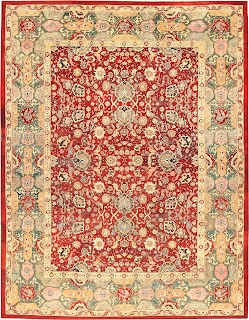
The goods Nazmiyal specializes in – room-sized decorative antique rugs – are luxury items running from $ 20,000 to $ 200,000. So, he has felt the pressure firsthand.

Shown here is an antique Agra currently available from the Nazmiyal Collection.

Buying antique rugs, Nazmiyal explains "is more about what people feel than what they need." And over the past years, when even CEOs have worried about losing their jobs, what many people have felt is the urge to be cautious.

But how that caution gets expressed in the rug market can be surprising.

What many interior decorators advised their clients to do during the worst of the downturn was to buy new rugs instead of antique ones, because they are less expensive.

And, as that caused antique rug inventories to pile up, many antique rug dealers followed suite. Rather than invest their capital in more inventory, they invested in producing new rugs themselves, instead.

Nazmiyal did not follow that strategy, but he says for many dealers it made economic sense.

Here's why: To sell a $ 25,000 antique rug, you have to have half a dozen similarly expensive pieces for the client to choose from. But to sell a room-sized new carpet you need only show a $ 200 weaving sample.

If the sample satisfies the client, weaving can go ahead with just a fifty percent deposit, with the rest to be paid when the rug is delivered.
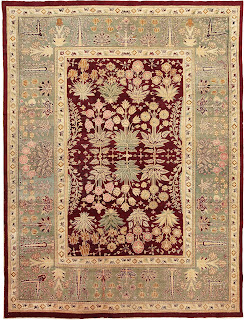
Here is another antique Agra carpet, with a flower design, available from Nazmiyal Collection.

The Nazmiyal Collection weathered the storm without switching to new rugs because its inventory is large and it has an extensive website with global clients. But, perhaps most valuably, the company's long-standing reputation for quality assures designers and others seek it out.

Today, with the economy showing signs of recovery, the antique carpet market is slowly stabilizing again.

Over the past six months, Nazmiyal says, the drift to new rugs has reversed and buyers are returning to vintage pieces.

The reasons they are returning are all the classic ones for which people value antiques. Compared to new rugs, antique rugs have greater interest of history and provenance, they have a patina that will take new carpets decades to acquire, and you don't have to wait six months for them to be woven.

There is another question that always fascinates people about the antique carpet business and that is the way it is influenced by changes of taste and style.

So, we asked how much tastes in antique rugs have changed over recent years and what is in demand now.

The answer, again, was surprising. Over the last 10 years in the United States , Nazmiyal says, decorators grew tired of busy Persian designs. They moved to East Turkestan rugs, for example, instead. Such rugs offered simpler designs and more monochromatic, muted colors.
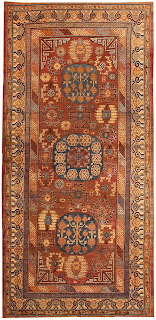
Here is an antique Khotan available from Nazmiyal Collection.

But over the past six months, things have shifted once again. Now high-end decorators are looking for traditional designs and bolder colors.

What drives the taste changes is a mystery. But the way it works is through the power of a handful of famous tastemakers.

Nazmiyal estimates that in New York City, there are about five "phenomenal designers" who are the trendsetters of our time and whom all the other designers watch. When their taste in fabrics, wallpapers, and other furnishings changes, so do the kinds of carpets the decorating world wants.

Interestingly, the designers themselves may or may not know much about the history of oriental carpets. "Some of the New York designers are so well trained to see beautiful things," he says, "that they don't need to know rug history and styles. They can just be confident of their own taste."

Does this mean that everywhere fashions change as if on cue? Not at all. There is still plenty of room for regional differences and there are variations in what kinds of antique rugs people want even from city to city.

Nazmiyal says that in Atlanta, for example, there is equal demand for beautiful carpets with medallion or all-over designs. But in New York, decorators only want all-over designs because they feel medallion designs fit less flexibly with current styles.

Similarly, there are trans-Atlantic differences.

In Europe, where houses and apartments tend to be smaller than in the United States, a 9 x 12 foot carpet is about the maximum any room can absorb. That makes a big rug, like a Sultanabad or Hajji Jalili, less desirable. And it gives people reasons to prefer smaller yet still highly visible rugs, like Caucasians, instead.
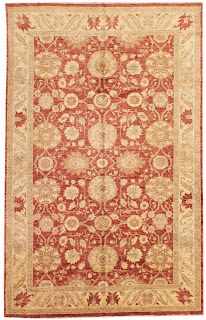
Here is an antique Sultanabad available from Nazmiyal Collection.

One could pose questions about the antique rug trade all day and still never finish. So, we ask a final question about something most people only dream of. That is: what rug do you select for your own house when you have virtually every possibility available in your inventory?

Nazmiyal says he has a mix. He keeps a silk and wool Tehrani woven in 1920-21 with blues and whites in his library. And an early Agra in his living room.

Then he has to laugh. Like many carpet enthusiasts, he has a small obstacle to bringing home ever more antique pieces, as much as he might want to.

"My wife likes new things, not old ones," he says. "So when I bring an antique rug home, it has to be clean and with a full pile and look like a new rug."

How familiar does that sound? Sometimes the husband is the collector, sometimes the wife, and always compromises have to be found.

"But over time," he adds, "she's come to like antique rugs much more. It only took 15 years."

May all families enjoy such peace. And thanks again to Jason Nazmiyal for sharing his experiences with us.

#

RETURN TO HOME


#

Friday, 2 April 2010

American Sarouks And Zieglers: The First Western-Designed Persian Carpets

ARAK, Iran; April 3, 2010 -- If you could travel back in time to an American home at the turn-of-the-last-century, it is very possible that the rug on the floor would be an American Sarouk.

The "Sarouk" in the carpet's name refers to the village of Sarouk, in northwestern Iran, where it was made.

But the "American" refers to how much it was modified to suit American tastes, and how hugely popular it became in America as a result.

The double-barreled name makes the American Sarouk one of the most striking examples of the way much of the Persian carpet industry changed between 1800 and 1900. It was a time when the Persian Empire changed greatly too, as it had to adapt to a new world order dominated by industrial powers.

The carpet is believed to have been designed by a dealer in New York, S. Tyriakian, who did what would have been unthinkable in earlier times.

He knew that for many Americans, Persian carpets were too "oriental." The floral patterns seemed too elaborate and overcrowded, while the colors called too much attention to the floor at the expense of the other furnishings.

So, he played with the design and colors to create rugs that owed as much, or more, to European artistic traditions than to Persian ones.

Here is a another Sarouk. This carpet is available to collectors from the Nazmiyal Collection in New York.

Often the background color was chosen to go well with dark-wood Western furniture, something totally foreign to Persian homes.

But the way the colors were obtained was itself still more unorthodox.

To soften the "garish" colors of imported carpets, dealers in New York, London and other European centers had developed "chemical washes." But not all dyes could stand up to them.

In the case of the American sarouks, the original bright pink of the field tended to disappear almost entirely in the bath. So, to restore the color, dealers hired touch-up artists to hand paint the field in the shades they wanted.

Such labor-intensive alterations were possible in the labor market of New York at the time, and as a result the American Sarouks are also commonly known as Painted Sarouks today.

The American Sarouk, which enjoyed a peak popularity in the 20s and 30s, is one of the best-known Westernized designs that came out of northwestern Persia.

But it was neither the only nor the first.

Decades earlier, western capital and finally even Western carpet manufacturers began moving into the Persian carpet industry much as they also were doing in the Ottoman Empire.

As they did, they not only helped to create the boom in 19th century interest in oriental rugs. Ironically, they also helped satisfy it with rugs that often were far more at home in Western houses than they ever would be in Eastern ones.

One of the reasons creating Western-designed rugs was possible in Persia is that, as the 19th century opened, the Persian carpet industry itself was in a state of disarray.

After producing stunning carpets during the long and stable Safavid era that started in 1501, Persia plunged into a prolonged period of power struggles and strife beginning with a Pashtun invasion from Afghanistan in 1722.

The court patronage system, which had stimulated the art of carpet making, ceased and the great urban workshops that supplied the aristocracy of Persia and Europe closed down.

It was not until the establishment of the Qajar dynasty in 1794 that things stabilized again. But by then, the world had changed.

The new challenge for the Persian Empire was to compete with expanding military and commercial strength of Europe which was based upon the industrial revolution.

One reaction was to adapt. The first signs of that can be seen in this royal portrait of the second Qajar shah, Fath Ali.

Such realistic portraiture was a huge departure from traditional Persian court painting based on the miniaturist style. According to Julian Raby, a Lecturer in Islamic Art and Archaeology at the University of Oxford, the look is directly borrowed from contemporaneous portraits of Napoleon, which were widely admired for their projection of power. The trees and sky in the background are equally European.

Fath Ali sought diplomatic contacts with the West. And he had an urgent reason to do so.

During his reign, Persia lost two wars in the Caucasus with the Russian Empire.

In 1813 it had to accept Russian annexation of Georgia and most of the north Caucasus region.

In 1828, it had to accept Russian sovereignty over the entire south Caucasus north of the Aras river (also known as the Araxes river and today's border between Iran and Azerbaijan).

This painting by Russian artist Franz Roubaud illustrates a scene from the Russo-Persian war of 1804 to 1813, when outnumbered Tsarist forces made a "living bridge" to transport their cannon to safety.

It was advances in artillery, many developed during the Napoleonic wars, that gave the Russian army a decisive advantage.

As part of their effort to secure the north of the Persian Empire against Russian expansion, the Qajars moved capital to Tehran.

And it is in the oldest historical building in this city – the Golestan Palace – that the empire's struggle to adapt to the West becomes still clearer.

By the time Nasr ud-Din, the best known shah of the Qajar dynasty, took the throne in 1848, Persian royal culture had adopted many of the trappings of European imperial style.

He alternated between wearing Western and Persian clothes, but preferred Western for official photos. As he posed, his empire was being flooded with cheap textiles from Russia and Britain, progressively putting traditional textile producers out of business.

Nasr ud-Dinh made several trips to Europe -- the first shah to do so – and encouraged the introduction of Western science, technology, and educational methods.

He also dramatically changed the Tehran skyline by building a new wing of the Golestan Palace with two European-model towers. Completed in 1867, and blending Eastern and Western designs, the towers were the first of their kind in the capital.

At the same time, Nasr ud-Dinh furnished some of his palace rooms in Western style and created museum rooms to display gifts received from European monarchs, especially chinaware.

Similarly dramatic changes happened in the world of traditional Persian carpets.

With Europe as the world's richest consumer market, Persian producers came under enormous pressure to adapt to that market's tastes.

That taste was no longer for court carpets – the shared culture of Renaissance days – but for carpets that fit middle class European homes with no equivalent in Persia at all.

Arto Keshishian, a London rug dealer, describes what happened next in his fascinating article 'Ziegler and Their Carpets,' published in Antiques and Fine Arts Magazine.

He notes that the traditional decorating scheme for the 'reception' room of a Persian home was one central rug surrounded by runners on all four sides.

But when these rugs were imported as individual pieces to the West they were considered “generally either too long or too narrow” for Western homes.

So, carpet designers – especially in Tabriz – began expanding production specifically to supply the Western market.

Focusing on the region around Sultanabad (now Arak), they encouraged weavers to weave larger carpets that could accent or fill large rooms. They also began modifying designs with Western styles in mind.

But that was hardly the only change.

By the 1880s, several Western companies moved into northwest Persia themselves, commissioning rugs to still more closely fit the home market. The most prominent was the Ph. Ziegler & Company, which would operate in Iran for 50 years and export tens of thousands of rugs to London and New York.

At the turn-of-the-last-century, Ziegler had about 2,500 looms in more than one hundred villages around Sultanabad.

The rugs traveled west on the same caravans that took Shi’ite pilgrims to the shrine city of Karbala in Iraq. At Baghdad, they were transferred to small steamers going downriver to Basra and then onto ships for London. (Patrice Fontaine’s ‘The Carpet Weaving Industry in the Arak Region,’ Oriental Carpet and Textile Studies III, Part I, 1987.)

Keshishian says the Ziegler carpets “were made to achieve a balance and symmetry in keeping with the scale of a room and its furnishings.”

Whether they were designed with a medallion or all-over floral pattern, they were “never overcrowded” so that they would “give a sense of open space and elegance.”

He writes: "The airy visual effect of Ziegler carpets resulted from the design as well as from a weave that was much coarser than that of traditional carpets."

As for color, “fewer color combinations were used, resulting in a simpler balance and harmony; the color green was liberally incorporated, perhaps to echo the English fondness for the countryside.”

The foreign companies' success had a direct impact on the other producers around Sultanabad.

Patrice Fontaine’s writes in her ‘The Carpet Weaving Industry in the Arak Region’ that to compete, Iranian merchants tried to lower production costs. They supplied weavers with lower-quality wool colored with new Western chemical dyes. And they commissioned designers to simplify rug patterns to speed up weaving and reduce the chance of mistakes.

It is possible today to view this Western tailoring of Persian rugs as an early example of globalization – of the same process of simplifying rug designs to match mass market tastes that characterizes much of the global carpet industry today.

And, indeed, there are some carpet experts who reject calling ‘American Sarouks,’ for example, oriental rugs at all.

As Murray L Eiland Jr. and Murray Eiland III, note in their book Oriental Carpets (2005):

“One might go as far as to say that there was nothing Persian about these rugs except the technique of pile knotting, and the same judgment could be made about thousands of Turkish rugs of the early 20th Century.”

But perhaps the first Western-designed Persian carpets tell a larger story than that.

They are equally a fascinating record of a time when the East’s whole relationship with the West was radically changing and ancient empires were desperately trying to adapt in order to survive.

The Persian Empire, like the Ottoman Empire, did not succeed. Here is a map showing its progressive loss of territory in the 19th and into the early 20th centuries.

With its territorial losses went ties to some of the most famous cities associated with the Persian Empire's traditional artistic culture, including Bukhara and Samarkand.

Meanwhile efforts to regain another key city, Herat, from Afghanistan failed definitively in 1857 with the Anglo-Persian war. Thereafter Russia and Britain directly vied for influence over the region, ending with the Anglo-Russian agreement of 1907 dividing nominally independent Qajar Iran into British and Russian spheres of influence.

By the start of the 20th century, the Persian dynasties were so weak that every shah thereafter would die in exile. The country has had to re-invent itself in a process that continues today.

#

RETURN TO HOME PAGE

#