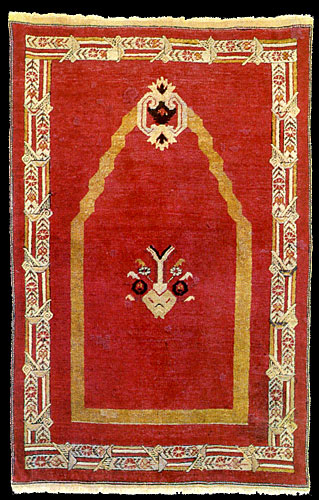
Showing posts with label Ottoman carpets. Show all posts

Saturday, 9 July 2011

Rugs And The Art Of Looking Beyond What You Can See

PRAGUE, July 15, 2011 -- Can viewing a rug be a metaphysical experience?

It can be if you see rugs as many are meant to be seen.

That is, as a patch of infinity.

The idea might not make much sense until you consider how many rugs have field patterns which do not seem to stop at the rug's border.

Instead, they have an endlessly repeating pattern which appears to spill under and past the rug's own borders.

And because the pattern seems to extend ever outward, it is easy to imagine the rug itself is just a small sample of an infinitely larger universe, like a patch of stars in the sky.

Just how this works can be seen in rugs from almost any era and from across the rug-producing East.

Here is an Ottoman court Usak Medallion carpet from around the 16th century.

The focal point of the rug is the central medallion but other, partial, medallions float above and below it, giving the impression that the patterns go on forever.

But if Ottoman court weavers seemed to enjoy creating such illusions of infinity, they were far from the only ones.

So did court weavers in Mamluk Egypt, Safavid Persia and Mughal India.

And so did -- and continue to do – many city and tribal weavers.

Below is a 19th century Turkmen tribal carpet – a Yomud – from Central Asia.

It, too, has a field made up of ever repeating elements that have no beginning and no end.

At the top of the carpet, the final row of field motifs is only half complete, as if they literally have been interrupted by the border only to continue again on the other side.

This Yomud rug is available to collectors from the Nazmiyal Collection in New York.

Interestingly, the appearance of the borders themselves often only helps heighten the sense of infinity.

Particularly on village rugs, weavers are likely to simply stop working on a rug when it reaches the desired length. The result is "unreconciled borders," where the repeat of the border motifs stops but does not clearly end, much like the field design itself.

The readiness of a weaver to stop "just-like-that" as she weaves suggests an artistic tradition very different from that of the West, where symmetry and a sense of completion are usually the rule in art.

So perhaps it is no surprise that some scholars have tried to explain where the tradition comes from and what it means.

Schuyler V.R. Cammann, a professor of East Asian studies who has written about rugs, puts it this way:

“We are accustomed to seeing patterns that fit neatly within trim borders or assigned frames, completely compact entities. To comprehend these infinite patterns, expressing a very different way of thinking, we must put asides our customary points of view and take a new look at some of the rugs we have come to take for granted.”

His remarks appear in the Textile Museum Journal, December 1972, in an article entitled "Symbolic Meanings in Oriental Rugs."

Cammann believes the answer lies in the way weavers in Muslim lands view the world and are inspired by the spiritual ideas and beliefs of their common faith.

As he notes, "we meet the concept of endlessness very frequently in Islamic thought. God – under the name of Allah – is described as having limitless transcendence, boundless power, infinite mercy and compassion."

But if the concept of infinity is central to Islam, he believes that Eastern artists' comfort with depicting the world in infinite terms can be traced to long before Islam itself.

Cammann notes that in the Louvre Museum there is a 7th century BC Assyrian carved stone slab which represents a carpet set before the throne in the king's court at Ninevah. Its central field, enclosed by a continuous floral border, also has a repeating pattern.

"These continuous patterns – so characteristic of Middle Eastern design and by no means confined to rugs – did not originate in the Islamic tradition, he concludes. "Muslim weavers took over this already ancient device to express some of their most fundamental beliefs."

If the artists who weave oriental carpets were content to express infinity in their work and stop there, it would already by interesting enough.

But some rug designs appear to go yet a step further and that is to try to suggest the "indefinability" of the world around us, as well.

That concept may seem more familiar when we realize that it already is a large part of what makes Islamic architecture so distinctive and instantly recognizable, such as this dome interior of the Sheikh Lotfollah in Isfahan.

On mosques, the walls and domes are often covered with arabesques and tile which break up the surface into myriad smaller patterns which make the solid structure of the building itself appear to be what it is not: airy and weightless.

In effect, matter is "dissolved," and that contradiction between appearance and reality powerfully evokes the indefinability of the divine, of the spiritual, and ultimately, of all creation.

Often the breaking up of a surface into smaller elements is done using a pattern which itself seems to endlessly repeat beyond the confines of the surface itself, further reinforcing the idea of the infinite, indefinable nature of the universe.

And it is this combination of techniques that can be seen at work in many of carpets which most famously have captured the imagination of Western rug collectors and painters.

Here is a photo of a Lotto carpet woven in a court workshop of the Ottoman Empire.

The Lotto design so captivated European Renaissance painters that it is the most frequently depicted classical Anatolian carpet of all, appearing this way or with variations in some 500 paintings.

But Lotto carpets are just one example. Cammann says the same principles can be seen in the earliest known rugs from Seljuk period and in the Mamluk carpets of pre-Ottoman Egypt.

And, again, they seem to be at work in many village and tribal rugs throughout history.

According to Cammann, the repeated stars and octagons and extra fillers in other shapes that break up the background of Caucasian rugs are not so much the result of a horror vacui, or fear of empty space, as many Westerners imagine, but an example of the dissolution of matter.

Here is a Shirvan carpet from the Caucasus, showing the use of such filler. It is available from Nazmiyal Collection in New York.

Many Central Asian rugs, including Yomud and Tekke, also combine the principles of infinity and dissolution of matter in their patterns.

It would be fascinating to know more about how and when weavers across the Muslim world began to introduce such intriguing ambiguity into their works.

But finding out is complicated by the fact that Muslim historians never paid much attention to chronicling changes in the arts.

The reasons for the absence of art history, interestingly, are much the same as those which made the artists allude to the indefinability of divine creation rather than depict subjects realistically.

If something is indefinable, it is not man's work to define it. The historians passed on to more worldly concerns, like politics, and left the artists' secrets to the artists themselves.

#

RETURN TO HOME

#

Friday, 29 January 2010

Mejid Rugs And The End Of The Ottoman Era

ISTANBUL, January 29, 2010 -- Can a single carpet style symbolize the sudden decline of a country’s carpet making tradition?

Many European carpet collectors once regarded this carpet – a so-called Mejid rug – just that way.

The rug is typical of a whole class of small-size, town-woven carpets that appeared in the mid-1800’s. It was a time when the Ottoman Empire was moving rapidly toward its final eclipse in 1923.

The rugs are striking for several reasons. One is their distinctly non-Anatolian look. The other is that, even though they were clearly influenced by the West’s own artistic values, Europeans at the time found them distasteful and fled from them.

How did these rugs come about and why were they popular in Turkey at the time?

The place to begin the story of the rugs is with their namesake, Sultan Abdul-Mejid.

He reigned from 1839 to 1861, during a time of massive threats to the empire’s traditional way of life. His efforts to fend off those threats by Westernizing many Ottoman institutions reached to every level of society, including the Arts. But the results were often mixed.

Abdul-Mejid came to the throne just as one of the empire’s prize possessions, Egypt, had permanently broken away. That followed the earlier loss of Greece and dramatically underlined the need to modernize both the army and to build loyalty among the empire's far-flung, multi-national subjects.

Abdul-Mejid, like his father Mahmud II before him, looked to France and the ideals of the French Revolution for inspiration.

At the time, monarchies everywhere were awed by the way ordinary Frenchmen had enlisted en-masse in the Revolution’s armies to defend the values of Liberty, Equality and Fraternity, and how Napoleon had later harnessed that power to all but conquer Europe. Many kings realized that their future depended upon at least partially making their societies more equitable.

Abdul-Mejid sought to transform Ottoman life by introducing the first of what would be many attempts at “Tanzimat,” or “Reordering” over the next decades.

The reforms attempted to stem the tide of nationalist movements within the Ottoman Empire by enhancing the civil liberties of non-Turks and non-Muslims and granting them equality throughout the Empire.

They also established a new system of state schools to produce a new generation of government officials more open to European technologies and administrative practices.

But the reforms were not only changes in substance but of style. Abdul-Mejid built Dolmabahce Palace in the French baroque manner, decorated it the same way, and moved there from Topkapi Palace. He also dressed in the European fashion and government functionaries began to do the same.

Over time, the new European dress-code would fully replace the complicated Ottoman hierarchy of different clothing styles and even shoe colors which had distinguished officials by rank and office. It consisted of a monotonous, long-tailed frock coat that was called the “stambouline” in the West and, more facetiously, the “bonjour tuxedo” in Turkey. Like new uniforms for the army, the coat was intended to change the mindset of those who wore it.

The message was not lost upon Turkish artists, including weavers, who closely watched court styles.

Entrepreneurs responded with new European-flavored designs of their own. One answer was the “Mejid” carpet, which gained wide domestic popularity.

The “Mejids” clearly reflect the Francophile taste of the sultan, though it is not known whether the sultan liked them himself. They were woven in bright pastel shades and decorated with sparse, natural-looking flowers or even rococo swirls. It was a huge departure from Turkey’s own design tradition of non-naturalistic ornamentation and richly concentrated colors.

Here is a carpet woven in Ghiordes at the time. The carpet is available to collectors from the Nazmiyal Collection in New York.

How much any empire can stave off collapse by adopting new models at times of crisis is debatable. Abdul-Mejid’s efforts ran into huge obstacles, not the least of which were the Western European powers themselves.

They loaned him massive amounts of money to buy weapons to confront the expanding Russian empire, but attached fatal conditions to the loans.

The conditions were demands for trade concessions to open the empire’s raw materials -- wool, cotton, silk and coal -- to European businesses and its markets to European products, including textiles. The results of this, too, were soon visible in the carpet industry and its commercial hub, the Istanbul bazaar.

Until 1830, the Ottoman Empire was still largely a self-contained and self-sufficient space. But with the opening to the West, its manufacturers suddenly came into direct competition with the industrial revolution. European textiles flooded the market and domestic producers found it impossible to compete.

Worse still for the domestic producers, the introduction of European fashions in the court harem caused a wave of emulation among Otttoman women. Dresses were made of European rather than local fabrics and the market for fine Ottoman silks collapsed.

Celik Gulersoy in his 1980 book ‘Story of the Grand Bazaar’ sums up the process this way:

“When ten thousand hand looms disappeared, villages could no longer be closed production units and the villagers turned into laborers and imported European goods rapidly took the place of domestic textiles in the Empire’s markets.”

The new shopping focus was the Bonmarches, the borrowed-from-French generic name for the shops erected in European style on the main avenue of Istanbul's chic Beyoglu district.

In 1881, a visiting English writer, Lady Brassey, described in her book ‘Sunshine and Storm in the East’ how rich Turkish ladies with their servants visiting the Grand Bazaar were surrounded by the treasures of the East but demanded the merchants show them Western goods instead, though these were mostly second quality. She regarded it as very strange.

By the turn-of-the-last century, the Grand Bazaar itself lost its most distinctive feature: the merchants sitting passively on wooden divans with their cupboards full of goods behind them. That, too, gave way to the new European style.

The arches lining the walls of the old Bazaar were connected to form shop facades and the merchants took to standing in their doorways.

In many cases, the merchants had no better choice because their new premises were no bigger than telephone booths. To complete the image of shops on a European street, they added signs and advertising above their doors.

During these decades, the Ottoman carpet production industry changed equally dramatically. Western capital entered the business and the Western market became the driving force of almost all the large-scale carpet manufactories.

Miroslav Jungr observes in his 2005 book ‘Oriental Carpets:’

“The European powers brought every aspect of mass production to bear on the weaving process, including using synthetic dyes and demolishing traditional design schemes. Floral patterns, beloved by foreign customers, became standard even though – with a few exceptions such as medallion ushaks – they had never been part of the Turkish tradition.”

Curiously, the Mejids, the Turkish weavers’ own early experiment with incorporating European styles, were completely overlooked in Europe. Jungr notes their stylized flowers and mostly shiny colors did not correspond to the cosmopolitan taste of the time. But in Turkey they remained popular even after the death of Sultan Abdul-Mejid himself in 1861.

Only today, as their story is becoming better known, are the Mejids beginning to win respect from collectors. And that is partly because of the bittersweet story they tell of the end of one era and the start of another.

#

RETURN TO HOME

#

Friday, 1 January 2010

The Origins Of Classical Geometric Carpet Motifs: Girih, Rumi, And Kufesque

ISTANBUL, January 1, 2010 - The geometric patterns of the Anatolian carpets that so fascinated European painters have diverse origins.

Some of them come from nomadic weaving traditions, such as the Memling gul. It is easy to weave and, unlike more sophisticated designs, has a flat, two dimensional appearance. It can be found in nomadic traditions ranging from Central Asia to the Transcaucasus to Iran and Anatolia.

But other motifs, especially those which appear to be three-dimensional (such as the medallion above), are so complicated they likely were borrowed from other fields of art.

The search for their origins takes one into the sophisticated world of Islamic decorative art and specifically, into the drafting rooms of court and commercial artists who created the complex designs and patterns that can be seen in the tile work of mosques and other buildings or in book illustrations.

One of the art forms such designers took to particular heights was ‘strapwork,’ the use of interlacing lines to give patterns an illusion of depth. The example at the top of this page is from a rug depicted in an Italian fresco from the early 1500s.

The motif -- an strapwork octagonal medallion -- is typical of both "Large Pattern Holbein" and "Small Pattern Holbein” carpets. The octagonal medallions are outlined by interlacing lines which make them stand out from the background field.

Shown here is a much rarer and more elaborate version of a strapwork medallion on a Large Pattern Holbein. It is depicted in the painting 'Virgin and Child with the Family of Burgomaster Meyer," by Hans Holbein the Younger in 1528.

Strapwork, also known as “girih” (the Persian word for knot), is a common design trick in both European and Islamic artwork. But eastern artists, who were particularly interested in geometric shapes, took it to levels of enormous complexity.

Just how complex it could be is only hinted at in carpets. But it is worth taking a moment to consider just for its own interest.

Here is an example of girih used to decorate the exterior of the restored Khanqah (lodging complex) of Nadir Divan Beg, dating to the early 17th century, in Bukhara, Uzbekistan.

The secret to understanding girih, which was meant to both delight and confound the eye, is understanding how the artisans created their designs.

They assembled them from jig-saw puzzle-like pieces, which could be combined with one another to generate an almost infinite variety of different patterns.

Here are five “ghiri tiles” representing different categories of puzzle pieces. They consist of a decagon, a pentagon, a hexagon, a bow tie, and a rhombus and all the sides of each are are of the same length, so any can fit together with the others.

The shapes of the girih tiles are not visible in the final design. What one sees are the patterns formed by the line decoration on the tiles.

How to create girih designs was a whole field of study that was codified in manuscripts of the time.

One such manuscript is the ‘Topkapi Scroll,’ a 15th century collection of architectural drawings created by master builders in the late medieval period in Iran.

The scroll, preserved in the Topkapi Palace complex in Istanbul, contains 114 individual geometric drawings detailing the theory and instructions for laying intricate patterns on walls and vaulted ceilings.

Both this picture and the one above are from ‘Medieval Islamic Architecture, Quasicrystals, and Penrose and Girih Tiles: Questions from the Classroom,’ by Raymond Tennant.

With time, every art form begins to experiment with stylizations, some of which try to turn the art form inside out.

In girih, this took the form of sometimes drawing designs by representing only the interstices where certain lines met. The lines themselves were dropped from view.

An example in carpets is this para-mamluke rug. It is not Anatolian but Syrian in origin.

With large-scale tile work on buildings, the effects of showing only certain interstices could be still more dramatic. The results resembles stars in the night sky, but arranged in subtle patterns that the brain perceives almost subconsciously.

There is no room here to discuss a kind of girih that never appears in carpets and is the most complex of all.

That is designs made up of shapes which, when put together, create a pattern that does not repeat itself, no matter where one looks. Moreover, the shapes cannot be re-arranged in any way that makes the pattern repeat.

One example is on the Darb-i-Imam Shrine (1453) in Isfahan.

The existence of shapes which can do this has only recently been identified by modern mathematicians, who still have difficulty modeling the phenomenon.

The fact that such shapes were being applied in art more than 500 years ago – with or without full understanding of the geometric laws involved – is a humbling reminder of the achievement of the ‘golden age’ of science in the Islamic world, which itself built upon the science of the classical world.

Still another, much easier to understand, motif which appears on Renaissance era Anatolian carpets and is borrowed from decorative tile designs is a motif composed of ‘split leaves.’

The split leaves are known as ‘rumi’ in Ottoman Turkey and “Islimi’ in Persia and can be seen in Small Pattern Holbein rugs (left).

The split leaves are arranged to form a quatrefoil that is the secondary motif in the rug pattern. The quatrefoils alternate with the primary motif, which is the octagonal girih medallion.

What did the split-leaf motif, appears as very angular in these carpets, look like in its original version on tile work?

Here is a sample (right). It is a quatrefoil of four rumi forms embracing a lotus flower and is very curving and lifelike in design. The motif was made angular for carpets to conform with the ‘geometric’ style popular for carpets at the time.

The rumi design, like girih, was subject to much experimentation. One result was what may have been the most popular of all the Anatolian export carpets to Renaissance Europe, the so-called Lotto design.

The Lotto (below), which at first glance looks like an abstraction of the Small Pattern Holbein, has both its motif elements derived from the rumi form.

Most frequently it appears in Renaissance paintings as a yellow geometric rumi lattice on a red ground. In fact, it is the most frequently depicted classical Anatolian carpet of all, appearing this way or with variations in some 500 paintings.

This picture of also shows yet another carpet pattern – this time to form the border – derived from still another field of decorative art: calligraphy.

In the ‘kufesque’ border, the calligraphy, which is highly ornate and curvilinear in its original medium of book illustration, is made geometric by the weavers.

The Anatolian geometric carpets were characteristic of carpet tastes across the Islamic world until styles began shifting toward curvilinear and floral patterns in the late 1400s.

Walter B. Denny, writes in “Anatolian Carpets’ (2002) that “it appears that before the phenomenon known as the ‘carpet revolution’ began to dominate carpet production in the last part of the 15th century, the carpet traditions of all these weaving centers may have shared elements of a common design vocabulary of geometric girih motifs, rumi design, and kufesque borders.”

It is interesting to think that while Renaissance Europeans did not import much Eastern art other than carpets, the rugs did offer them a considerable sample of what was going on in the other Islamic arts of the time.

Today, oriental carpets remain the only form of Eastern art that is widespread in Western homes. Often unbeknown to us, it is still a window onto the much larger, and ever changing, world of Eastern design.

#

RETURN TO HOME

#

Related Links:

‘Medieval Islamic Architecture, Quasicrystals, and Penrose and Girih Tiles: Questions from the Classroom,’ Raymond Tennant.

‘The Tiles of Infinity,’ Sebastian R. Prange, Saudi Aramco World magazine, Septmber/October 2009.

Wednesday, 16 December 2009

Topkapi Palace And The Art Of The Ottoman Court

ISTANBUL, December 17, 2009 -- Ottoman court carpets are intimately connected with a very special artistic culture, that of the Ottoman court itself.

The court both inspired and was the main consumer of the carpets, tiles, illustrated books and other art objects by countless artisans attached to court workshops inside and outside of Istanbul.

The imperial artisans, collectively called the Ehl-i Hiref or Community of the Talented, produced much of the finest work in the Ottoman Empire and their designs were copied or adapted by commercial artists even down to the village level.

But what why did the Ottoman rulers attach such great importance to developing and maintaining an artistic style that would clearly distinguish the court from the rest of the world outside?

The immediate answer might be that all courts in all lands tend to do the same. Just one other example is Versailles, designed as a pinnacle of Baroque style to underline the power of Louis XIV.

But the Ottoman court, with its seat in Topkapi palace, was very different from Versailles. Whereas Versailles was designed as a public stage, Topkapi was designed as a private one, and its culture was far more self-defined and self-contained.

There was a logic behind that choice.

The story is neatly told in the book ‘The Ottomans’ by Andrew Wheatcroft (1993). As he points out, the Ottoman court projected power through an image of inaccessibility, exclusivity, and mystery designed to create a sense of public awe. And everything about Topkapi palace and its court culture was intended to heighten that effect.

The first great Ottoman sultan, Mehmet II, began building the palace almost immediately after he conquered Constantinople in 1453.

A contemporary, the Greek historian Critoboulos of Imbros, wrote at the time:

“He gave orders for the erection of a palace on the point of old Byzantium which stretches out into the sea – a palace that should outshine all and be more marvelous than the preceding palaces in looks, size, cost and gracefulness.”

The site was the ancient Greek acropolis of Byzantium, the highest ground in the city. And originally, the grounds were far vaster than they are today, extending all the way down the shoreline below.

But if the acropolis had been an open area, Mehmet’s Yeni Sarai (New Palace) was deliberately isolated and separated from the city. Its buildings were hidden behind a massive wall some 35 feet tall. And it was organized in three areas, of ever diminishing accessibility to the public, guarded by three successive entry gates.

The first great courtyard, behind the Imperial Gate was the largest, with an area of 500,000 square feet. It included the workplaces of some 600 craftsmen: goldsmiths, weavers, amber-workers, armor-makers, potters, upholsterers, and many others. There were also stables and the barracks of guards and gatekeepers.

Anybody could enter from the street but once inside had to move and speak quietly.

Europeans found the hushed atmosphere eerie and regularly remarked upon it. Artist Nicolas de Nicolay wrote in 1551 that “notwithstanding the number of people coming together from all parts is very great, yet such silence is kept, that yee could scarcely say that the standers-by did either spit or cough.”

The second courtyard, behind the Gate of Saluation, marked the real boundary between outer and inner worlds. The gate had two sets of doors strong enough to resist a siege and guests passed through it only by invitation or for ceremonial occasions of state.

Once inside, the atmosphere was of a park, with lawns and fountains under cypress trees and gazelles wandering freely. The gardens were dotted with pavilions, or kiosks, which gave the impression of tents erected in an open space. It was an echo – conscious or not – of nomadic life and love of nature in the middle of a thriving but shut out metropolis.

At times, sultans also held outdoor audiences in the park, like the one shown here.

In the park was also the meeting place of the Sultan’s councilors – a kiosk known as the Hall of the Divan. The Hall’s floor was gilded and covered with a carpet of gold and there was a dias with the sultan’s throne. But the sultans themselves often preferred to appear to be absent, listening when they wanted from behind a grilled window.

The window, and the uncertainty of whether the sultan heard what was being said, gave the sultan such a degree of control that many sultans rarely attended the meetings of the divan at all.

The innermost world lay behind a third and final gate: the Gate of Felicity. Here was the sultan’s inner realm with those who lived closest to him, including the harem, with his wives and concubines and their children, and his retainers.

This retreat, known as The Abode of Bliss, was in fact a miniature city where more than 3,000 people spent their entire adult lives.

They spent their lives in splendid, luxurious isolation. But the isolation was not intended to cut them off from the world so much as to produce people who totally identified with the court and would be loyal to it throughout their lives.

These people were the royal pages, for whom court life was a school and who later would be sent out to govern the vast reaches of the empire.

In the early days of the empire, the sultan chose the boys who would become pages from outside the Turkic population, with its strong clan system. That was yet another way of creating an isolated group loyal only to the throne.

Gia Maria Angiolello, a young Venetian who served as a translator in the palace from 1473 to 1481, describes the Sultan’s pages this way:

“Sons of Christians, in part taken in expeditions with foreign countries and in part drawn from his own subjects … after they have been in his service a certain time, when in the opinion of the lord he can trust them, he sends them out of the palace with salaries which are increased as he thinks fitting.”

The “sons” initially were part of the tribute which the Ottomans exacted from conquered peoples, particularly in the Balkans and Caucasus, to create the Janissaries, the Sultan’s most rewarded and loyal troops.

Shown here is an Ottoman miniature of Janissaries battling the Knights of St. John in the siege of Rhodes, 1522.

The Janissaries, too, were an isolated group outside the clan system and the boys who would fill their ranks spent their childhoods on special farms in Anatolia where they became Muslims, gained strength, and learned to fight.

Both the pages, who were raised in the palace, and the Janissaries were the “kul,” or slaves of the sultan.

It was a privileged position, so much so that even after the tribute system was abandoned, the status of kul and the opportunities it offered passed from father to son. And over time many free-born Muslims also bribed or negotiated their way into the Sultan’s household to gain the same status

As Angiolello remarked in his early observations about pages, “there are few that do not accomplish their duties, because they are rewarded for the smallest service to their lord, and also because they are punished for the smallest fault.”

Wheatcroft notes that after the pages finished their training, they were given wives from among the harem women who were also slaves of the Sultan. This became a further bond to the court, because both “shared the common experience of palace life and even the unique dialect spoken in the Abode of Bliss.”

When the couple was dispatched to the provinces, it modeled its own household on the Ottoman court and spread that court culture farther.

Here is a painting of an Ottoman house in Cairo, before the influence of Western styles, by Frank Dillon (1823-1909).

Did the system work well? Yes, and for centuries.

As Wheatcroft puts it, “When the Conqueror built the Abode of Bliss on Seraglio Point, he created more than a building. The palace was the apex of Ottoman society: all power flowed from it, carried forth by the sultan’s servants sent to govern in his name.”

In this system, the arts were not only decorative but also helped create a frame of reference agreed upon by the court’s members. The shared style, like everything else, reinforced loyalty to the group and distinguished them from those outside the walls.

All the procedures within the palace were codified in kanunname, or law codes that even specified the dress for every rank of the ruling class.

Pictured here is the Sultan leaving Topkapi Palace for Friday prayers in one of the capital's mosques circa 1810 by an unknown artist. The once-a-week outing was the only time the Sultan appeared in public.

The advisers to the Sultan, the viziers, wore green. Chamberlains wore scarlet. Religious dignitaries wore purple and mullahs light blue. The master of horse dressed head-to-foot in dark green.

Court officers wore light red shoes. Those who worked in the Grand Vizier’s office, located just outside the palace walls, wore yellow shoes. And among non-Muslims, Greeks wore black shoes, Armenians violet, and Jews blue slippers.

Topkapı Palace gradually lost its importance at the end of the 17th century, as the Sultans preferred to spend more time in their new palaces along the Bosporus.

In 1856, Sultan Abdül Mecid I decided to move the court to the newly built Dolmabahçe Palace (shown here), the first European-style palace in the city.

By then, the Ottoman Empire was changing rapidly and its court life was becoming more European as well.

But how that happened is another story.

#

RETURN TO HOME

#

Saturday, 14 November 2009

Romania: Transylvanian Carpets and Gothic Churches

BRASOV, Romania; Nov. 17, 2009 -- One of the greatest collections of Ottoman-era rugs in the western world is kept in what might seem one of the unlikeliest places.

That is Transylvania, the region of Romania best known since 1897 as the remote home of Bram Stoker’s Count Dracula.

The rugs have been there for centuries, hanging from the walls and behind the side pews of a handful of German-built Gothic churches that dot the mountainous countryside.

How they got there, and remain on display today as a national treasure, is one of the great stories of rug collecting.

But first, it’s helpful to give a few details about the number and range of the rugs in Transylvania to suggest just how extraordinary this story is.

There are almost 400 rugs in the region’s churches and museums and they include many of the rugs that once most fascinated Renaissance Europe’s painters, such as Holbeins, Lottos, and white background Chintamani and Bird carpets.

There are also rugs with Ottoman-era designs that are virtually unknown outside of the samples preserved in Transylvania.

These rugs – ranging from single and double niche formats, column formats, to various prayer rugs -- are today simply called “Transylvanians” for lack of any better way to classify them.

Here is 17th century carpet from Transylvania. The carpet is available to collectors from the Nazmiyal Collection in New York.

So, how did so many carpets, all woven between the mid-15th to mid-18th century, get here? And why were they given such importance in the churches that they were so carefully preserved?

The answer takes the form of a series of actors taking their place on a stage in a remote corner of Europe where one would hardly expect them to meet.

The first are German-speaking colonists who came into Transylvania at the invitation of the region’s Hungarian rulers. The immigration was intended to revive the area’s economy and bolster its defenses, particularly after the Mongol invasions of the 13th century.

The Germans, known locally as Saxons, built towns for themselves whose central feature was a church surrounded by massive walls that could double as a citadel.

The area they inhabited came to be called the Siebenbürgen or “Seven Citadels” after these distinctive redoubts.

Pictured here is the citadel in the town of Cincsor.

All of this might never have connected to rugs except for another development some 300 years later -- the Protestant Reformation.

Most of the Transylvanian Saxons gave up Catholicism to embrace the new creed of Martin Luther and, as they did, they threw out the traditional, baroque Catholic furnishings of their churches.

That left the churches open to new decorating ideas. And the ideas arrived with the next actors taking their place on the stage at about the same moment, the Ottomans.

Just how suddenly the Ottomans arrived in Europe after conquering Constantinople in 1453 is worth taking a moment to mention.

At the time, no army in the world made greater use of artillery and musket firepower than the Ottomans. So their opponents, who in Eastern Europe relied mostly upon the massed charge of heavily armored knights, were routed in terrible massacres.

The Hungarian nobility, which still ruled Transylvania, was eliminated at the Battle of Mohacs in 1526, along with Hungarian King Louis II.

Immediately after the battle, the victorious Sultan Suleyman (right) summoned the hastily crowned new Hungarian King John to his camp for a lesson in wealth and power. The Hungarian royal chaplain, George Szerémy, described the scene:

“Along the short mile the King traversed to go to the Emperor, Turkish and various fine carpets were laid on the earth as far as the Emperor's tent.”

The Ottomans occupied Budapest but did not bother to take over Transylvania. They let Transylvania pay tribute instead as a self-ruling vassal state on the periphery of their Empire.

The fact that the Ottomans never occupied Transylvania defied the odds at the time.

Every year throughout the 16th to 18th centuries, the Ottoman Empire launched a military expedition to expand its holdings.

Sometimes the army, which assembled in Istanbul, marched toward Europe, sometimes toward Persia, North Africa, or Arabia. Eventually, they went in every direction.

Pictured here is an Ottoman miniature of the Siege of Vienna in 1529.

Andrew Wheatcroft explains the Ottoman’s expansionism in his book ‘The Ottomans’ (1993). He notes that war was essential to the economy because it brought in revenue and tributes that funded the state. But it also gave the state, army and people a sense of higher purpose:

“A common faith provided the cement that held the Ottoman host together. It was the duty of every Muslim to extend the ‘Domain of Peace’ – the dar ul Islam, the lands where Islam reigned supreme – into the ‘Domain of War’ – dar ul harb – where Allah was not honored,” he says.

“Since the wars were driven by the demands of an advancing faith, the enemy was also clear, and unvarying. In the west, and at sea, it was Christendom; to the east, it was the heretic Shiah empire of Iran.”

Given all this, one might have expected the Transylvanian Saxons to have lived in such dread of the Ottoman Empire that they would have tried to remain as isolated from it as possible.

But, in fact, trade flourished between Europe and the Ottomans. The same kinds of rugs that had lined the road to Suleyman’s camp became highly desired imports and wealthy Saxons, like Europeans elsewhere, sought them for their homes.

Just where the Saxons’ got their unique idea of festooning the walls of their Gothic churches with Ottoman rugs is unknown.

But the tradition seems to have begun with rich parishioners bequeathing their valuable rugs to the churches when they died.

Here is the interior of the Black Church, in Brasov.

Romanian carpet expert Stefano Ionescu notes that some rugs had the function of identifying the pews of individual families, like place markings. Describing the rugs in his article ‘Transylvanian Tale’ in Hali Magazine (Issue 137), he says:

“In the austere and aniconic spirit of the early Reformation, they were considered decent, and indeed suitable, decoration for recently denuded (former Catholic) churches. And when used by parishioners to mark out their personal space in the church, they also subtly hinted at the wealth and prestige of their owners.”

Interestingly, the Saxons’ custom bore a curious resemblance to the Turkish custom of bequeathing carpets to mosques. Such gifts have made layers upon layers of rugs build up on mosque floors in Anatolia over the centuries. In Transylvania, too, the endowments resulted in huge collections of carpets, far more than could be displayed.

Today, the Black Church in Brasov, and the Brukenthal Musuem in Sibiu hold the most important collections in the region. The History Musuem of Transylvnia in Cluj-Napoca also has a less well-known collection.

Rug collectors often debate whether the most unique among rugs in these collections – the so-called “Transylvanians” – could have been woven in Transylvania or elsewhere in Eastern Europe, rather than in Anatolia.

Rug historian Charles Grant Ellis has proposed that some of the rugs might have been produced in the Balkans under Ottoman provincial rule.

But Ionescu argues that “ever since the rugs in the Black Church were first catalogued … in 1898, they have been considered of Anatolian origin and that is still the opinion of most experts.”

He adds that “attention is rarely drawn to the fact that rugs of this type, in all its familiar variants (single and double-niche, prayer and column rugs) are also to be found in museums in Turkey, as well as in Beirut and Cairo.”

This carpet is a single-niche Transylvanian from the mid 17th century.

Many experts thing that the “Transylvanian type” will ultimately be traced to an as yet unidentified region in western Analtolia, not far from Izmir, Usak, Kula, Ghiordes and Milas.

But that is a task for future rug scholars to pursue.

(Photo at the top of this article is of downtown Brasov around the Black Church.)

#

Related Links

Antique Ottoman Rugs in Transylvania, edited by Stefano Ionescu

Ottoman Miniatures, Bilkent University

#

RETURN TO HOME

#

Friday, 16 October 2009

The Floral Medallion Revolution and Ottoman Court Carpets

ISTANBUL, October 17, 2009 – Do carpet designs change with the fortunes of war?

It may not seem likely, but many historians have long attributed the changes that occurred in the design of Ottoman carpets in the 16th century to the battle of Chaldiran.

That battle was fought on a hot August day in 1514 and is famous for several reasons.

It marked the Ottoman halt of the vigorously expanding Safavid Empire under that empire’s founder, Ismail.

And it marked the first time that a Muslim army massively deployed artillery and musketry in the field. The Ottoman’s use of large-scale firepower devastated Ismail’s troops, who still relied upon the time-honored force of archers on horseback.

Before the battle, the two emperors, both of whom were Turkic speaking, exchanged belligerent letters daring each other to fight. In one, the previously undefeated Shah Ismail, who had already expanded from his base in Tabriz to conquer Persia, wrote:

Mən pirimi hak bilirəm,
Yoluna qurban oluram,
Dün dogdum bugün ölürəm,
Ölən gəlsin istə meydan.

I know the Truth as my supreme guide,
I would sacrifice myself in his way,
I was born yesterday, I will die today,
Come, whoever would die, here is the arena.

But how badly Ismail was defeated can be judged from the fact that he himself was wounded and almost seized and his harem with two of his wives was captured in the mayhem. After the defeat, which established the boundary between Turkey and Iran as it remains today, Shah Ismail never personally led his army into battle again.

Here is a photo of the memorial marking the battle-site near the Turkish border in northwestern Iran.

The victorious Ottoman sultan, Selim I, later made this comment about the confrontation: “A carpet is large enough to accommodate two sufis, but the world is not large enough for two Kings.”

Perhaps more directly related to rugs, the battle also led to the Ottoman’s brief occupation of Tabriz, the then-capital of the Safavids.

The city was a major weaving center for the new Safavid style of floral medallion carpets and, when the Ottomans withdrew several weeks later, they allegedly took top artisans from the city back to Istanbul with them.

This has long been seen by rug historians as one convincing way to explain why, around this time, carpets woven for the Ottoman court suddenly moved from being geometric (see: Renaissance European Painters’ Passion For Turkish Geometric Rugs) to a new floral medallion style of their own.

Here is a picture of one of the new Ottoman court medallion rugs, from around the 16th century.

Rug experts Murray L. Eiland and Murray Eiland III describe the new Ottomon court rugs this way in their book ‘Oriental Carpets’ (2005):

“Unlike other Turkish rugs these are extremely finely woven with a design vocabulary – the so called “saz” style that includes curvilinear medallions, palmettes, scrolling vines, and elaborate lancet-shaped leaves.”

The authors add, “The sudden appearance of such lushly naturalistic vegetation within a tradition that had previously produced coarser rugs in geometric designs has raised many questions, particularly since these (new) rugs are woven with the asymmetrical knot.”

The Eilands suggest the temporary Ottoman capture of Tabriz could be one explanation. They also suggest that the Ottoman’s capture of Cairo three years later, this time by using massive firepower against the Mamlukes, could equally be a factor.

Both Safavid and Cairene rugs were asymmetrically knotted – a knotting system which allows weaving of greater detail than does the traditional Turkish symmetric knot.

Still, if the Ottoman court carpets moved to a floral medallion style, they did not duplicate Safavid designs. They are very much their own variation on the theme.

Safavid carpets had a single large medallion that appeared to be floating like a picture in a frame created by four quarter-sized corner medallions.

But the Ottoman court carpets often had not one medallion but several columns of medallions.

The central medallion is still the focus, but identical, partial medallions float above and below it. Other, non-identical partial medallions, float beside it. The result is the impression that the medallions go on forever, in an endlessly repeating pattern extending beyond the rug.

This sense of an endlessly repeating pattern was heightened by the fact that these rugs were huge compared to other Ottoman rugs, often reaching a length of five to seven meters. They were palace carpets, conceived by professional artists and woven on huge looms by master craftsmen in court workshops in Istanbul or in the commercial center of Usak (Ushak, Oushak) in western Anatolia.

The differences between Ottoman and Safavid floral medallion rugs make some researchers wonder whether the Ottoman design revolution can really be explained merely as the result of the fortunes of war.

Another possibility now gaining ground is that the Ottoman and Safavid floral medallion carpet styles originated quite independently and more or less simultaneously as the result of trends in the shared artistic culture of the region.

Here is an Ottoman miniature painting from 1570, showing a medallion rug. It is from the illustrated book, the Sehname-i Selim Han, that celebrates the achievements of Sultan Selim, the victor at Chaldiran.

The argument for a shared regional culture, rather than Anatolia’s borrowing of the floral rug style from Safavid Persia, is based on some interesting bits of recent research.

For many years researchers assumed that the earliest surviving medallion carpets from the Safavid Empire pre-dated the medallion carpets of the Ottomans.

But art expert Julian Raby argues that the ovid Ottoman carpet medallions closely resemble the medallions tooled in leather on the covers of Ottoman manuscripts that date from the 1460s. That’s earlier than the Safavid rugs.

Here is an Ottoman bookbinding from the early 1500s for comparison. The resemblance to the Ottoman court carpet is especially close in the drawing of the medallions’ scrolling and interlocking floral forms.

Raby puts his argument this way: "The Ottoman carpet revolution was comparable to the change being wrought at the same period by Timurid designers. However ... the Timurids resorted to a different compositional formula in freeing their carpet designs from the geometric traditions. Their is therefore no need to argue a direct Timurid influence on Medallion Usaks. There development should be seen not in the context of a specific carpet influence but of a general change in Ottoman decorative arts." ("Court and Export: The Usak Carpets" by Julian Raby, Oriental Carpet and Textile Studies II, 1986)

If the Ottoman medallion carpets have their origins in the overall development of Turkish art in the late 15th century, that would make for an interesting parallel with the way Safavid carpets are closely related to the overall development of Timurid art of the late 15th century.

But if the floral revolutions on both sides of the Ottoman-Persian border were indeed two manifestations of a single “international style,” what would that say about the way art evolves? The message in this case, happily, would be that art is the world of shared ideas and inspirations, not of kings and wars.

The Ottoman court carpets came in two main variants: those with ovid medallions and those with star-shaped medallions. It is not known which style predates the other. Here is a Star Usak from the 16th century.

Ottoman court carpets continued to be woven for many centuries and their complexity was such that one might expect, incorrectly, that they would have a minimal impact on Turkish popular weaving. After all, their giant formats were much too big to fit ordinary looms and Turkish popular weaving, in any case, has always preferred geometric designs.

But, in fact, the court carpets had a massive influence. As textile expert Walter B. Denny notes in his book ‘The Classical Tradition in Anatolian Carpets’ (2002), “the new designs diffused into the lexicon of the town and village industries and adaptations of the court medallion rugs from Usak and elsewhere soon appeared.”

Town and village weavers adopted the floral designs by making them more geometric and that created a whole vocabulary of new designs that still influence Turkish weaving today.

Here is just one example: a three medallion carpet from Usak in the 16th century.

This process of highly complex, curvilinear court designs being re-interpreted into geometric patterns by town and village weavers was not limited to medallion rugs.

A still greater influence was exerted by Ottoman court prayer rugs upon popular prayer rug designs.

The “geometrization” of highly curvilinear court prayer rugs by village and town weavers would create some of Turkey’s most successful commercial carpet designs and set off a European passion for Turkish prayer rugs in the 19th century.

But how that happened is the subject of another story.

#

RETURN TO HOME

#

Thursday, 7 May 2009

Were Animal Design Carpets Renaissance Europe’s First Favorite Oriental Rugs?

VENICE, May 8, 2009 – It is impossible to visit Venice and not wonder what the first carpets that came to Europe through this great trading port looked like.

After all, Venice is home to Marco Polo, who very early on registered his appreciation of oriental rugs when he visited Konya in the Seljuk-controlled Sultanate of Rum in Anatolia.

The quintessential Venetian traveler of the 13th century mentioned the fineness of the carpets he saw and it is clear they were part of an already thriving commercial industry.

Another famous traveler of the time, Ibn Battuta, noted that Konya carpets were being exported to Egypt, Syria, Iraq, Persia, India, and China.

Here is a Seljuk rug of that era which was discovered in 1905 buried under the layers of prayer carpets that accumulated over the centuries like geological strata on the floor of the great mosque of Alaeddin in Konya.

But one cannot be sure of what kinds of carpets reached Europe until much later, the early Renaissance period of the 1400s. That is when Europeans fell so in love with rugs that they began to regularly include glimpses of them in paintings.

The paintings are not of rugs per se. The rugs only appear as trappings, sometimes with just a corner or edge showing, like stage props. And the only reason to include them in the pictures seems to have been to enhance the beauty of religious scenes or prove the wealth of the nobles and merchants sitting for their portraits.

But because the paintings can be dated, the paintings offer both a wide sample of rugs on the European market and even give some idea of the market trends over time.

Are there some surprises?

One is that the first carpets to show up in the paintings are not the kinds of sumptuous and complicated court workshop carpets one generally associates with days gone by.

Instead, almost all the carpets to appear in pictures before 1450 are of rather simple pieces with highly exotic animal motifs. They are rugs that – astonishingly – can remind a modern viewer of our own enthusiasm for ethno and tribal works today.

One of the animal carpet designs is shown in this detail from a fresco painted in 1440. The fresco is one of three large mural paintings by Domenico di Bartolo to decorate the wall of a hospital (the Spedale di Santa Maria della Scala) in Siena and celebrate the main activities of the facility. Those activities were to care for the sick, distribute alms to the poor, and to raise and marry off orphan girls.

Under the feet of the girl in the fresco (‘The Rearing and Marriage of Female Foundlings’) is a carpet with a curiously Far Eastern looking dragon-and-phoenix motif.

There are no known surviving rugs of this type, so scholars have had to look for something resembling it from the same period. The closest parallel seems to be this carpet from Anatolia, woven in the early to mid 1400s.

It is unclear when the dragon-and-phoenix motif carpets first came to Europe. But the motif itself appears to have a history that much pre-dates the carpets themselves.

Rosamond Mack, in an article entitled ‘Oriental carpets in Italian Renaissance paintings: art objects and status symbols’ (Magazine Antiques, Dec. 2004), says confrontations between fantastic animals such as a dragon and phoenix were common in the textiles and other arts of Mongol-ruled Asia in the 1200s and 1300s.

During that time – the Pax Mongolica – art motifs were easily shared across Eurasia as trade along the Silk Roads flourished. The Silk Roads ran from China across Central Asia to the Eastern Mediterranean.

Many scholars believe that, along the way, motifs like Chinese animal patterns were stylized and simplified into more geometric forms as they were adopted by Islamic weavers. Mack observes that Turkoman tribesmen migrating from Central Asia, in turn, may have brought the stylized motifs to Anatolia.

Rug scholar Nalan Turkmen dates the motifs’ appearance in Anatolia to the early 14th century, after the fall of the Seljuks. He writes that the carpets “represent a new stage in Turkish carpet weaving which coves two hundred years from the early 14th century to the late 15th centuries” (‘Tracing Central Asian Turkmen Carpet Designs Through Parallels With Anatolian Carpets,’ Oriental Carpet and Textile Studies, Volume V Part 1, 1999).

The vast majority of the carpets in early Renaissance Europe are believed to have come from Anatolia and phoenix-and-dragon motifs are just one of a variety of different compartmentalized animal designs that appear in the paintings of that time. Mack notes “the majority (of the animal design carpets) show pairs of birds flanking a tree, and the rest have various animals alone or in pairs.”

These animal carpets are from the 1400s during the Ottoman period.

As to why the designs were popular with Europeans of the early Renaissance, one can only guess. But European art of the just-ended Medieval period made wide use of fantastic creatures, including unicorns, so the stylized animal design carpets would have seemed exotic, but not strange, to European eyes.

Animal carpets were far from the only carpets reaching Europe at the time. There were also Anatolian carpets with geometric designs, as well as carpets woven in Cairo and Damascus. But the animal carpets stand out for their popularity and, also, for one more great surprise. And that is the fact that, after 1450, they completely disappear from the European market.

The trend is recorded in the paintings. Suddenly, almost all the carpets pictured are geometric designs and only the faintest echoes of the once so dominant animal carpets remain.

The faint echoes take the form shown in this detail from a painting by Carlo Crivelli in 1486. The animals are reduced to a mere cameo appearance within the compartments of the rug’s complicated 16-point star pattern.

A surviving example of the same kind of carpet is shown below. The carpet is believed to have come from Anatolia, but there is no known record of where the style was woven. The best rug scholars have been able to do is name the style after the Renaissance painter who depicts it: Crivelli himself.

If animal carpets suddenly vanished from the European market after 1450, what could be the reason?

There are two possible explanations.

One possibility is on the producers’ side. Some rug experts believe that by this time the Ottoman authorities who ruled Anatolia were becoming stricter about depicting life forms in works of art. That is in line with Muslim prohibitions against making something to look like God’s creation, because it includes an implicit claim of an ability similar to that of God.

Nalan Turkmen observes that “when animal figures disappeared from Turkish carpets in the 16th century their place was taken by geometric motifs such as octagons or diamonds set in the compartments of a squared ground.” He adds that animal figures do not reappear again in Turkish carpets until the late 16th century and then only as a filler, not as a main motif.

The other possibility to explain the disappearance of animal motifs carpets in Europe is on the consumers’ side. By the mid-1450s the Renaissance had come to fully dominate Europe’s cultural life. And with its emphasis on humanism, logic, and science, it may have left no room in the market for artwork that appealed to a Medieval fascination with mysticism and symbols.

Whatever the reason, it seems things in the early carpet market never stayed the same for long -- just as in the carpet market today.

Here is the kind of geometric carpet that took the place of the animal carpets in Renaissance paintings after 1450. It is a Memling pattern, named after the artist Hans Memling, who depicted it often in the late 1400s.

It is interesting to note that Renaissance collectors – or at least the people who valued carpets enough to make them available to artists to copy – were not collecting either antiques or even the most extraordinary carpets of their time.

Throughout the 200 years or so of the Renaissance, the most complex Mamluk and Ottoman court carpets almost never appear in paintings and no-one knows whether this is because they were rare or because they were simply extremely difficult to paint. Persian carpets do not appear until end of the 16th century. Then, too, the finely-knotted silk carpets woven at Kashan and Isfahan are rarely represented.

Instead it seems the Europe’s carpet owners, especially as carpets became commonplace in the homes of the well-to-do by the mid 1600s, mostly bought and valued carpets that reflected the commercial trends of their day – again, much the way most people do now.

The fact that these carpets are extraordinarily beautiful is perhaps the biggest surprise for a modern viewer of all. It seems to be due as much to the high-level of the carpet industry at the time as to the discerning eye of the early collectors. And that is a situation contemporary carpet lovers can only envy.

(The picture at the top of this article is Marco Polo’s family home in Venice.)

#

RETURN TO HOME

#

Related Links

Oriental Carpets in Italian Renaissance Paintings: art objects and status symbols, by Rosamond Mack, Magazine Antiques

Wikipedia: On Oriental Carpets in Renaissance Painting


The Carpet Index: The Oriental Carpet in Early Renaissance Paintings

Medieval and Renaissance Material Culture: a gallery of Renaissance paintings

Seljuk Textiles and Carpets

Seljuk Rugs

Old Turkish Carpets

Grove Encyclopedia of Decorative Arts: Ottoman Court Carpets


Ottoman Carpets

Ottoman Dynasty Carpets and Rugs